
Your top SDR just left for the day. At 9:47 PM, a $240K enterprise lead fills out your demo form from a London IP address. By the time someone calls back at 9:15 the next morning, that prospect has already booked two demos with category alternatives and forgotten your name.
This is the silent tax most sales organizations pay every night. Not because their reps are lazy. Because their qualification process was built for a world where leads waited. Leads no longer wait. AI lead qualification fixes this at the structural level with autonomous agents that pick up the phone, qualify intent, route the meeting, and update the record in under three seconds, around the clock.
See Your Pipeline Transformed — Book a Free 15-Minute Briefing
What You Will Gain From This Exclusive Briefing
261%
Proven increase in lead-to-meeting conversion with autonomous AI qualification
100%
After-hours leads engaged automatically, every night, every weekend, every holiday
-77%
Breakthrough reduction in cost per qualified meeting for enterprise deployments
3 sec
Guaranteed response time, day or night, replacing 42-minute manual averages
Table of Contents — Click to Expand
View All Sections in This Guide
- The 9:47 PM Problem No Lead Scoring Tool Will Ever Solve
- What AI Lead Qualification Actually Means When It Is Built for Enterprises
- Speed-to-Lead: The Metric That Quietly Decides Your Quarter
- Why Faster Response Time Alone Will Not Save Your Pipeline
- How a Voice Agent Qualifies a Lead Without Sounding Like a Bot
- The Compliance Layer Most AI Vendors Pretend Does Not Exist
- What a Bank Branch Network Can Teach You About Lead Routing
- The Three Numbers That Decide Whether Your AI Deployment Is Working
- Building the Deployment That Actually Sticks at 100,000 Leads Per Month
- The Outbound Use Case Most Companies Discover by Accident
- What Comes After Lead Qualification: The Full Revenue Loop
- The Question Your Board Will Ask in Q4
The 9:47 PM Problem No Lead Scoring Tool Will Ever Solve
Traditional lead qualification was designed for batch processing. A marketing automation platform scores the lead overnight. A round-robin assigns it in the morning. A rep gets to it after their pipeline review. By Tuesday afternoon, the lead is in motion.
By Tuesday afternoon, the lead has gone cold.
Research on online lead decay made the mechanic obvious: web leads have a half-life measured in minutes, not days. Static lead scores cannot solve a problem that is fundamentally about velocity. They identify which lead deserves attention. They do not act on it. InsideSales research confirms that the odds of qualifying a web lead drop by 400% between a five-minute and a ten-minute response window.
Quick Tip
AI lead qualification only matters when it triggers a conversation while the prospect’s hand is still on the mouse. Speed without intelligence is noise. Intelligence without speed is a missed quarter.
What AI Lead Qualification Actually Means When It Is Built for Enterprises
AI lead qualification combines machine-learning scoring, behavioral signal analysis, and conversational AI into a single closed loop. The system ingests data from your CRM, marketing platform, intent providers, and product telemetry. It scores the lead in real time. Then — and this is the part legacy tools skip — it engages the lead through a voice or messaging channel within seconds.
The qualification happens in the conversation, not in a dashboard. The agent asks budget, authority, need, and timeline questions. It listens. It updates the CRM. It books the meeting on the right rep’s calendar.
Proven Result — Enterprise SaaS Customer
Compressed average lead-to-meeting time from 6 hours 12 minutes to 41 seconds after deploying autonomous voice agents. SDR team redirected from dialing to closing, delivering 312% more qualified meetings the following quarter.

Autonomous AI qualification closes the response gap that costs enterprises millions in lost pipeline every year.
Speed-to-Lead: The Metric That Quietly Decides Your Quarter
Speed-to-lead is the single variable that compounds across every other sales metric. Faster response inflates connect rates. Higher connect rates inflate qualification rates. Higher qualification inflates pipeline. Higher pipeline inflates close rates. Pull the lever at the front and the whole funnel moves.
The MIT-backed Lead Response Management Study puts the stakes plainly: contact a lead within the first minute and your conversion likelihood multiplies. Even a fully staffed inside sales team running 12 SDRs across two shifts will leave 60% of nighttime, weekend, and overflow leads untouched until business hours resume.
Did You Know?
The academic research on online lead decay confirms lead intent is a perishable asset. At a 61% connect rate versus 6% for overnight queued leads, autonomous AI qualification is not an improvement — it is a category replacement.
Why Faster Response Time Alone Will Not Save Your Pipeline
Here is the mistake most sales leaders make when they discover speed-to-lead. They buy a faster auto-dialer. They hire offshore SDRs to cover nights. They install a chatbot that asks four questions and then dies waiting for a human.
None of this works at scale. A fast dial that lands on a tired rep at 11 PM produces a worse experience than no dial at all. A chatbot that qualifies a $400K lead with form fields produces unqualified leads with extra steps.
This is not a staffing problem. It is an architecture problem. The only response model that actually compresses the funnel combines instant engagement, human-level voice quality, and CRM-native execution in a single autonomous loop.
What Structural Availability Actually Looks Like in Practice
A SaaS company with 12 SDRs replaced 10 of them with autonomous voice agents and booked 312% more qualified meetings the following quarter. Not because AI is faster, but because AI is structurally available every second of every day without fatigue, without variance, and without a pipeline of salary costs behind it.
The Architecture Difference at a Glance
- Instant engagement — Voice call triggered within 3 seconds of form submission, day or night
- Human-level conversation quality — Natural voice handling interruptions, accents, and follow-up questions
- CRM-native execution — Meeting booked, record updated, rep notified before the call ends
- Zero fatigue variance — Call 1 and call 10,000 receive identical quality and energy
Join 500+ Enterprise Teams Already Converting More Leads on Autopilot
Get a live demonstration of a real qualification call — to your phone, right now, at no cost.
Request a Live AI Call to My Phone Now
No commitment. No credit card. Exclusive access for a limited number of teams this month.
How a Voice Agent Qualifies a Lead Without Sounding Like a Bot
The technical pipeline runs in four stages: signal intake, predictive scoring, conversational qualification, and workflow execution.
Signal intake aggregates form data, firmographic enrichment, intent signals, and prior CRM history within milliseconds of submission. Predictive scoring runs the lead through a model trained on your historical conversion data — not a generic vendor model, your model. Conversational qualification then dials the prospect with a natural voice that handles interruptions, accents, hesitation, and follow-up questions without missing a beat.
The Fourth Stage: Where Most Platforms Collapse
Real qualification ends in the CRM, on the calendar, and in the rep’s queue — not in a transcript that someone has to read tomorrow. The NewVoices platform writes back to your existing stack — Salesforce, HubSpot, Zendesk — natively, so the qualified lead lands as a booked meeting with full conversation context attached before the prospect has hung up the phone.
Quick Tip
When evaluating any AI qualification vendor, ask one question: does the qualified lead land as a booked meeting with conversation context in your CRM, or does it land as a transcript in an inbox? The answer separates revenue infrastructure from expensive demos.
The Compliance Layer Most AI Vendors Pretend Does Not Exist
Enterprise buyers learn a hard lesson around month four of an AI deployment: the model is the easy part. The compliance scaffolding is the hard part.
AI lead qualification touches personally identifiable information at every stage — phone numbers, employer data, recorded conversations, behavioral inference. The NIST AI Risk Management Framework sets the governance baseline most regulated buyers now require: documented model behavior, measurable risk controls, transparent decision logic, and continuous monitoring.
Layer on GDPR Article 5 data minimization, the FTC Safeguards Rule for financial services, and HIPAA requirements for healthcare-adjacent qualification, and you understand why most vendors quietly disqualify themselves from regulated enterprise deals.
NewVoices Compliance Guarantee
SOC 2 Type II
Built-in, not bolted on
GDPR
Full Article 5 compliance
HIPAA
Healthcare-ready by default
NIST
AI risk framework aligned
What a Bank Branch Network Can Teach You About Lead Routing
Retail banks figured out routing thirty years before SaaS. When you walk into a branch, the greeter does not hand you to the first available teller. They triage. Mortgage inquiry to the loan officer. Wire transfer to the senior teller. Account question to the floor.
Lead routing AI works the same way — except it operates at machine speed and never takes lunch. Geography, deal size, product line, language, prior history, and rep capacity are all evaluated in the same 200-millisecond window the lead is being qualified. The meeting lands on the correct calendar before the prospect has finished saying goodbye.
Round-robin distribution is the sales equivalent of sending every bank visitor to whichever teller is free. It optimizes for fairness among reps. It punishes the buyer — and it punishes your conversion rate silently, every single day.
Did You Know?
Intelligent routing alone — without changing anything else in your qualification process — can increase close rates by 18 to 34% by ensuring high-intent enterprise leads always reach your top performers within seconds of qualification.
The Three Numbers That Decide Whether Your AI Deployment Is Working
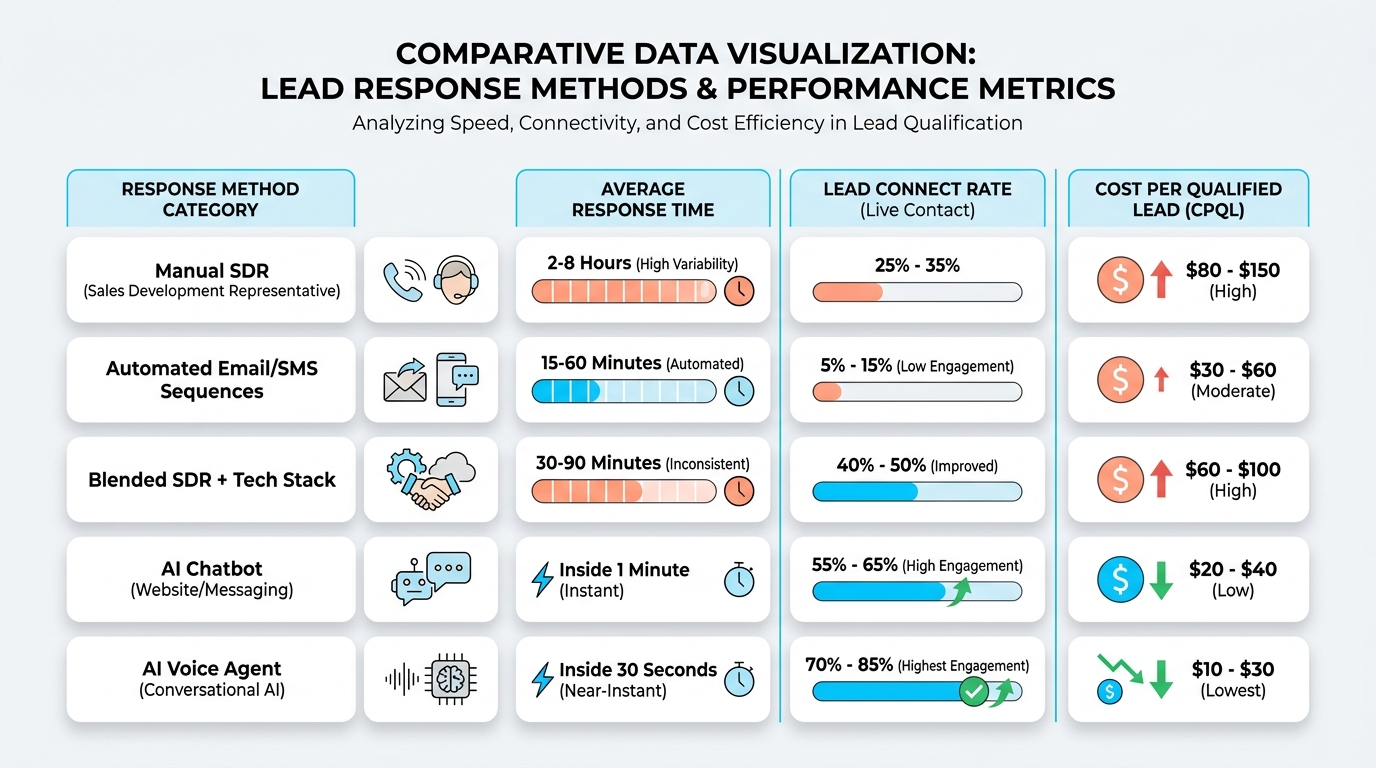
Measuring the right conversion-weighted metrics separates breakthrough AI deployments from expensive experiments.
Most AI lead qualification deployments are measured by the wrong metrics in the first 90 days: time saved, calls automated, conversations handled. These are activity metrics. They prove the system is running. They do not prove it is winning.
The three numbers that actually decide whether the deployment is working are conversion-weighted:
Number 1
Meetings Booked Per 100 Leads
The front-line proof that speed and qualification quality are working together.
Number 2
Qualified Pipeline Per Dollar Spent
The ROI metric your CFO will ask for. Most teams see 3x to 5x improvement in 90 days.
Number 3
Lead-to-Opportunity Cycle Time
Compresses from days to hours. The downstream effect on revenue velocity is exponential.
Building the Deployment That Actually Sticks at 100,000 Leads Per Month
Pilot programs lie. They run on cherry-picked lead segments with senior sales support and direct engineering attention. They look brilliant for eight weeks and then collapse when scaled to full lead volume.
Production deployments need three things the pilot never tested:
1. Clean Data Plumbing
Every lead source mapped, every CRM field defined, every routing rule documented before the first live call. Without this, the model qualifies noise.
2. Multilingual Capacity
A single English-only model fails the moment your Madrid, Mumbai, or Sao Paulo leads come in. Twenty-plus languages running on the same infrastructure is non-negotiable for global enterprise teams.
3. No-Code Editability
When messaging shifts mid-quarter, you cannot wait for an engineering sprint. Agent Studio lets your RevOps team modify qualifying questions, objection responses, and routing logic without filing a ticket.
Quick Tip
The deployment that worked at 5,000 leads per month must work identically at 500,000. If your vendor cannot demonstrate that at reference scale before you sign, it is a pilot tool wearing enterprise clothing.
The Outbound Use Case Most Companies Discover by Accident
Companies buy AI lead qualification to handle inbound. Within ninety days, half of them realize the bigger opportunity is outbound — re-engaging dormant leads in the CRM that never received a second touch.
The average B2B CRM holds 60,000 to 400,000 leads that were touched once and abandoned. Manual reactivation campaigns cost more than they return. Email reactivation produces single-digit response rates. Voice reactivation at scale was impossible — until now.
Proven Result — Industrial Equipment Manufacturer
84,000
Dormant leads contacted over a single weekend
2,140
Leads qualified as actively in-market
612
Meetings booked directly from the campaign
$11.4M
In revivable pipeline surfaced in 48 hours
Their inside sales team would have needed 14 months to dial the same list manually.
Hear what an autonomous qualification call actually sounds like. Request a live AI call to your phone and let the agent qualify you in real time — no setup required.
What Comes After Lead Qualification: The Full Revenue Loop
Lead qualification is the entry point, not the destination. Once an enterprise has autonomous agents handling inbound qualification, the same architecture extends naturally to outbound prospecting, post-demo follow-up, renewal conversations, payment recovery, NPS feedback, and support triage.
This is not another point solution. It is your entire customer communication engine. A single platform handling every voice and message touchpoint across the customer lifecycle, with the same CRM-native execution and enterprise compliance applied to each stage. Sales acceleration and service operations stop being separate stacks managed by separate teams with separate budgets.
Quick Tip
The companies winning the next sales cycle are not adding more reps. They are building autonomous revenue infrastructure underneath the reps they have — and pointing those reps exclusively at the conversations only humans should run.
The Question Your Board Will Ask in Q4
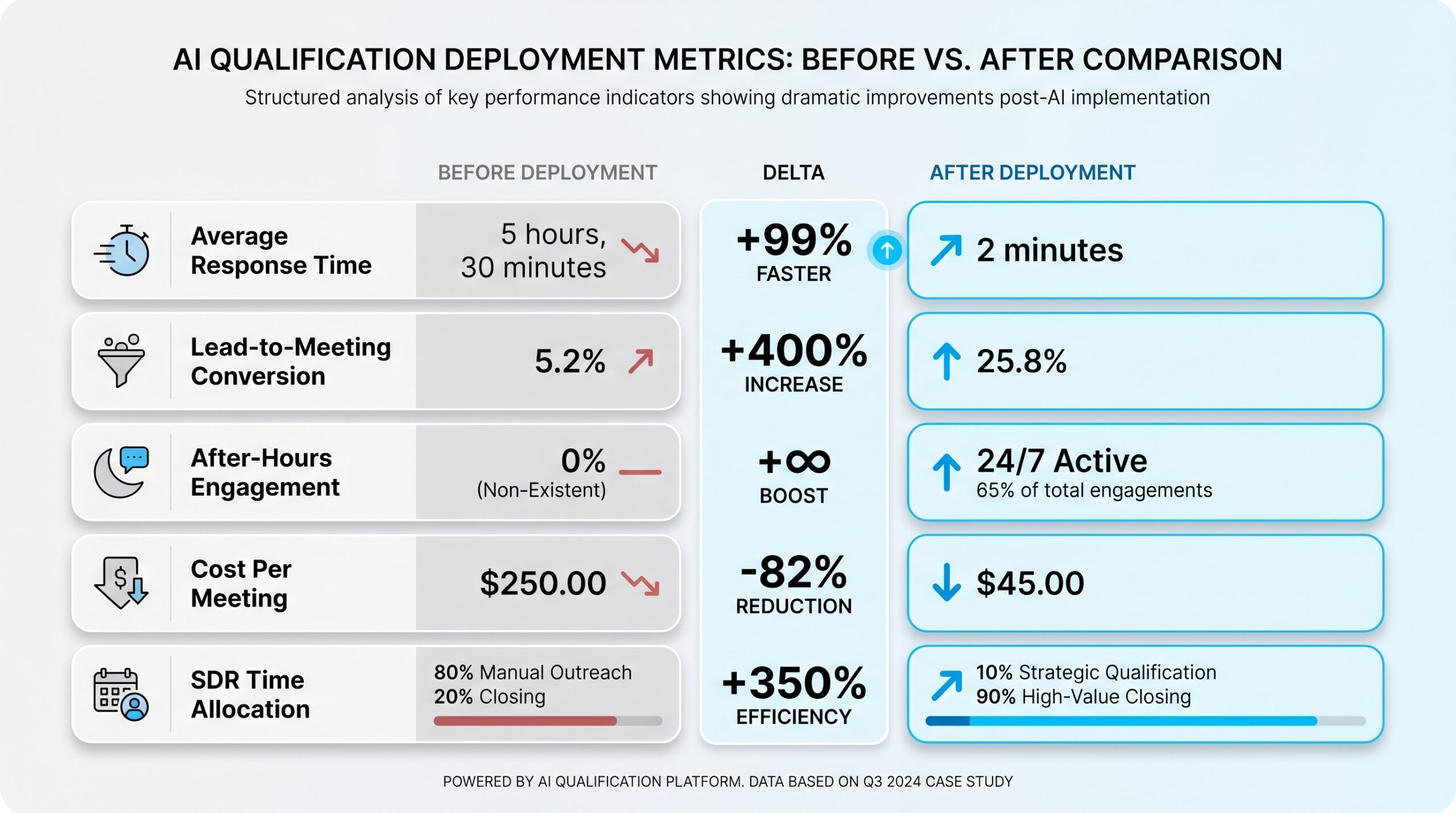
The board question is no longer whether AI qualification works. It is whether your team deployed it before the competition did.
The question is not whether AI lead qualification works. The data settled that argument two years ago. The question is whether your competitors deploy it before you do — and what your pipeline looks like after they have a six-month head start on response velocity.
Every lead you do not engage in three seconds is a lead one of your competitors will. Every after-hours form fill that hits your queue at 11 PM is qualifying somewhere else by 11:01. The fix is not incremental. It is structural.
Urgency Notice — Limited Briefing Slots This Month
NewVoices is currently accepting briefing requests from enterprise sales leaders. Slots fill within 48 hours of opening each month due to demand from teams currently running competitive evaluations.
Each briefing is tailored to your specific CRM, lead volume, languages, and compliance requirements. You will leave with a clear view of what your own qualification numbers look like through this architecture.
Frequently Asked Questions — Click to Expand
How quickly can NewVoices AI be deployed for an enterprise team?
Most enterprise deployments go live within 14 to 21 days. The timeline depends on CRM complexity, number of lead sources, and routing logic requirements. Teams with clean data pipelines and defined qualification criteria have gone live in under a week.
Does the AI voice agent sound natural enough for enterprise prospects?
Yes. NewVoices agents handle interruptions, pauses, accents, and off-script responses naturally. The fastest way to verify this is to request a live call to your own phone during the briefing. Most prospects who ask this question become convinced within the first 30 seconds of a live demonstration.
What CRM platforms does NewVoices integrate with natively?
NewVoices integrates natively with Salesforce, HubSpot, Zendesk, and Microsoft Dynamics, among others. Custom API integrations are available for proprietary CRM environments. All qualified leads, conversation transcripts, and booked meetings write back to your system of record automatically.
How does NewVoices handle GDPR and HIPAA compliance for recorded qualification calls?
NewVoices is SOC 2 Type II certified and ships with GDPR, HIPAA, and NIST AI Risk Management Framework compliance built into the platform architecture. This is not an add-on. Consent management, data minimization, retention controls, and audit logging are all included by default at enterprise tier.
What languages does the AI qualification agent support?
The platform supports 20-plus languages on the same infrastructure, including English, Spanish, French, German, Portuguese, Mandarin, Japanese, and Arabic. Global enterprise teams can run multilingual qualification campaigns without managing separate models or vendor relationships for each region.
What happens to our existing SDR team after deploying AI qualification?
SDRs are redirected from dialing to closing. The data from deployments consistently shows that human reps spend 86% of their time on qualified meetings rather than prospecting after AI qualification goes live. Most teams do not reduce headcount. They redeploy existing talent into higher-value activities that directly move revenue.
Act Now — Briefing Slots Are Filling Fast This Month
Replace the Wait-and-Route Model That Is Costing You Pipeline Every Night
Join 500+ enterprise sales teams who have already moved to autonomous revenue infrastructure. See your own CRM, your own lead volume, your own numbers — in a free 15-minute briefing with zero commitment required.
3-Second Response Guaranteed
SOC 2 + GDPR + HIPAA Included
Live in 14 Days or Less
Book My Free 15-Minute Briefing Now
No credit card. No commitment. Exclusive access — limited slots available each month.