
Your recruiters spent 42 days filling the last role. During those 42 days, 57% of your best candidates accepted offers elsewhere.
That is not a hiring process. That is a controlled demolition of your talent pipeline — and it is costing you $4.1 billion in lost productivity industry-wide.
|
Based on SHRM Research and Real Deployment Data
|
Trusted by Fortune 500 HR Leaders
What You Will Discover Inside
- The proven method to cut time-to-first-contact from 4 days to 47 seconds
- Exclusive ROI data showing 85% cost reduction per candidate screen
- The compliance framework that protects you from EEOC and FTC enforcement
- Why top candidates choose companies with AI voice agents — and abandon the rest
Table of Contents Click to expand
A SHRM executive survey on recruiting priorities confirms what every VP of Talent already feels in their bones: the top operational pain points are speed, candidate communication gaps, and administrative overhead. These are not problems you solve by hiring more recruiters. These are problems you solve by removing the bottleneck entirely.
An AI voice agent built for HR recruitment does exactly that. Not a chatbot. Not an FAQ widget buried in your careers page. A voice-driven system that screens candidates, books interviews, answers questions in 20+ languages, and operates at 2 AM on a Sunday with the same precision it delivers at 10 AM on a Tuesday.
Your Recruiters Are Not Slow — They Are Buried Alive
Here is the reality no one puts on a slide deck.
A mid-market company with 15 open roles receives roughly 3,000 applications per month. Each application triggers a chain: resume review, initial screen, scheduling, rescheduling, follow-up, status update. Your recruiting team — four people, if you are lucky — drowns in coordination before they ever assess a single candidate potential. The actual evaluation work — the part that requires human intuition — gets compressed into the margins of the day.
Quick Insight
Before AI voice agents, every one of those 3,000 applicants waited. Some waited hours. Most waited days. The best ones did not wait at all — they took the first offer that moved fast enough.
With an AI voice agent handling initial outreach, that response gap collapses from 72 hours to under 60 seconds. A logistics company in the Midwest deployed voice-based screening across 23 open warehouse positions and cut their average time-to-first-contact from 4.2 days to 38 seconds. Their offer acceptance rate jumped 41% in one quarter — not because the offers improved, but because speed itself became the competitive advantage.
The Screening Call Is the Most Expensive Low-Value Task in Recruiting
Think about what happens during a 15-minute phone screen.
Your recruiter confirms the candidate availability, verifies basic qualifications, explains the role, answers three standard questions about benefits, and schedules a follow-up. That is 15 minutes of a $90,000-per-year employee time spent on a task that follows the same script every single time. Multiply that by 200 screens a month. You are burning $47,000 annually on conversations that require zero judgment.
Did You Know?
An AI voice agent runs that same screen — same structured questions, same qualification criteria, same scheduling outcome — in 4 minutes. It does not pause to check Slack. It does not take a lunch break between calls. It processes 200 screens in the time your team processes 30.
This is not a phone tree with a friendlier interface. It is a system that conducts natural, human-quality conversations — in the candidate preferred language — and routes only the qualified, engaged applicants to your human recruiters. Your team stops sorting. They start selecting.
What a Voice Screen Actually Sounds Like
The gap between AI phone call and what candidates actually experience has collapsed. Modern voice agents — built with neural speech synthesis and real-time natural language processing — sound indistinguishable from a trained recruiter. Candidates respond naturally, answer open-ended questions with full sentences, and report satisfaction scores that match or exceed human-led screens.
The voice is not the limitation. Hear the difference disappear for yourself.
Takes 90 seconds. Judge with your own ears.
Why Faster Hiring Without Structured Scoring Creates Lawsuits, Not Efficiency
Speed without structure is a liability.
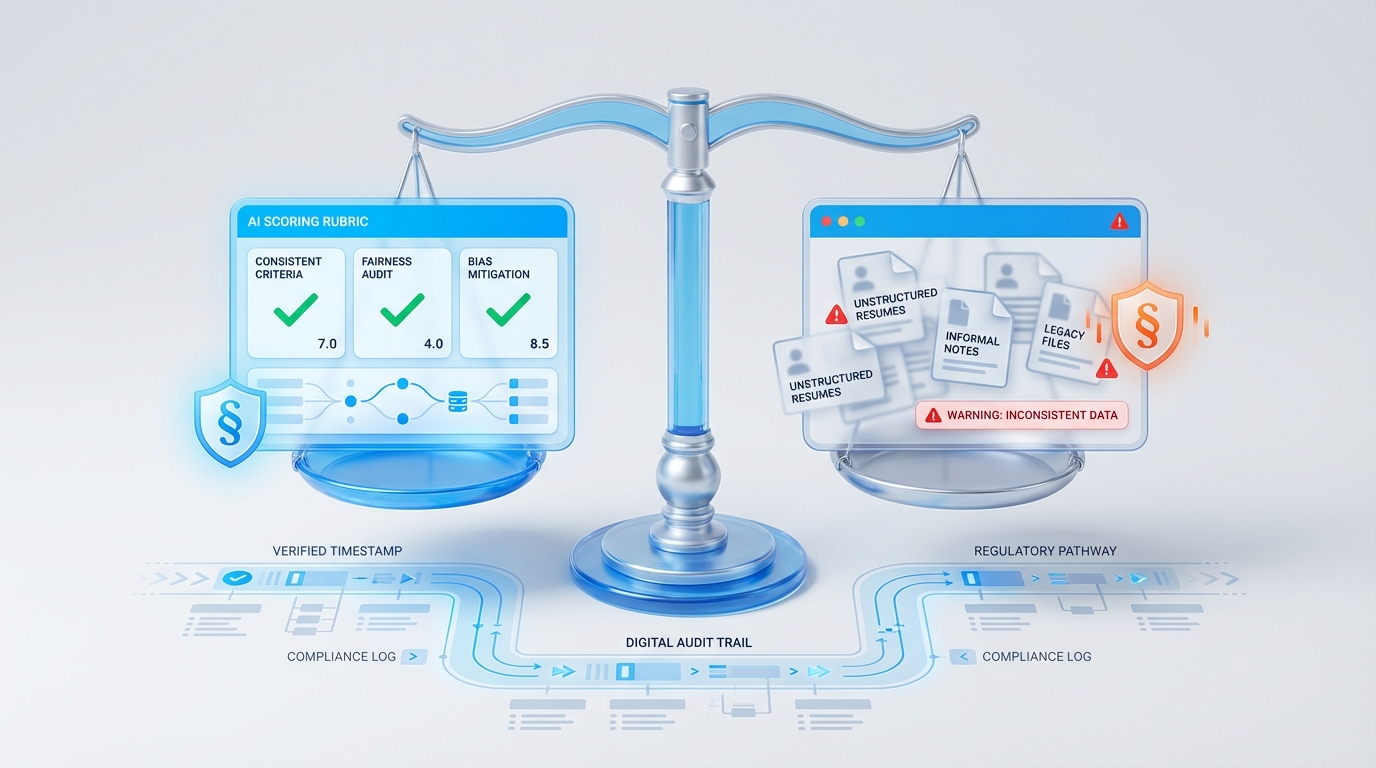
Most companies that rush to automate recruiting optimize for velocity and ignore the compliance architecture required to defend every decision in court. The FTC, DOJ, CFPB, and EEOC joint statement on AI made the regulatory position explicit: there is no AI exemption from civil rights law. Every automated screening decision must be defensible under the same standards that apply to a human recruiter handwritten notes.
Critical Compliance Point
An AI voice agent that asks every candidate the same questions, in the same order, with the same scoring rubric, produces the most legally defensible screening record in your entire hiring process. No interviewer mood variance. No Monday-morning fatigue bias. No unconscious pattern-matching.
NYC Local Law 144 requires bias audits and public summaries for automated employment decision tools. The ADA guidance on algorithmic hiring demands that tools measure job-related abilities and provide accessible alternatives. These are not future concerns. They are current enforcement realities.
What Hotel Check-In Kiosks Teach Us About Candidate Experience
When hotels first installed self-service check-in kiosks, guest satisfaction dropped. Not because the kiosks were slow — they were faster. Not because they were inaccurate — they made fewer errors. Satisfaction dropped because guests felt ignored. The kiosk solved the operational problem and created an emotional one.
Recruiting is making the same mistake right now.
A Gartner survey found that only 26% of job applicants trust AI to evaluate them fairly. That number is not a technology problem. It is a communication problem. Candidates do not object to efficiency. They object to opacity.
The Voice Difference
AI voice agents solve the hotel kiosk problem because voice is inherently personal. A candidate who receives a phone call within 60 seconds of applying — a call that greets them by name, references the specific role, and provides clear next steps — does not feel processed. They feel prioritized.
As SHRM reports on AI-driven personalization in hiring, the combination of speed and consistent quality reshapes how candidates perceive employer brands entirely.
The Actual ROI Math — Not the Marketing Version
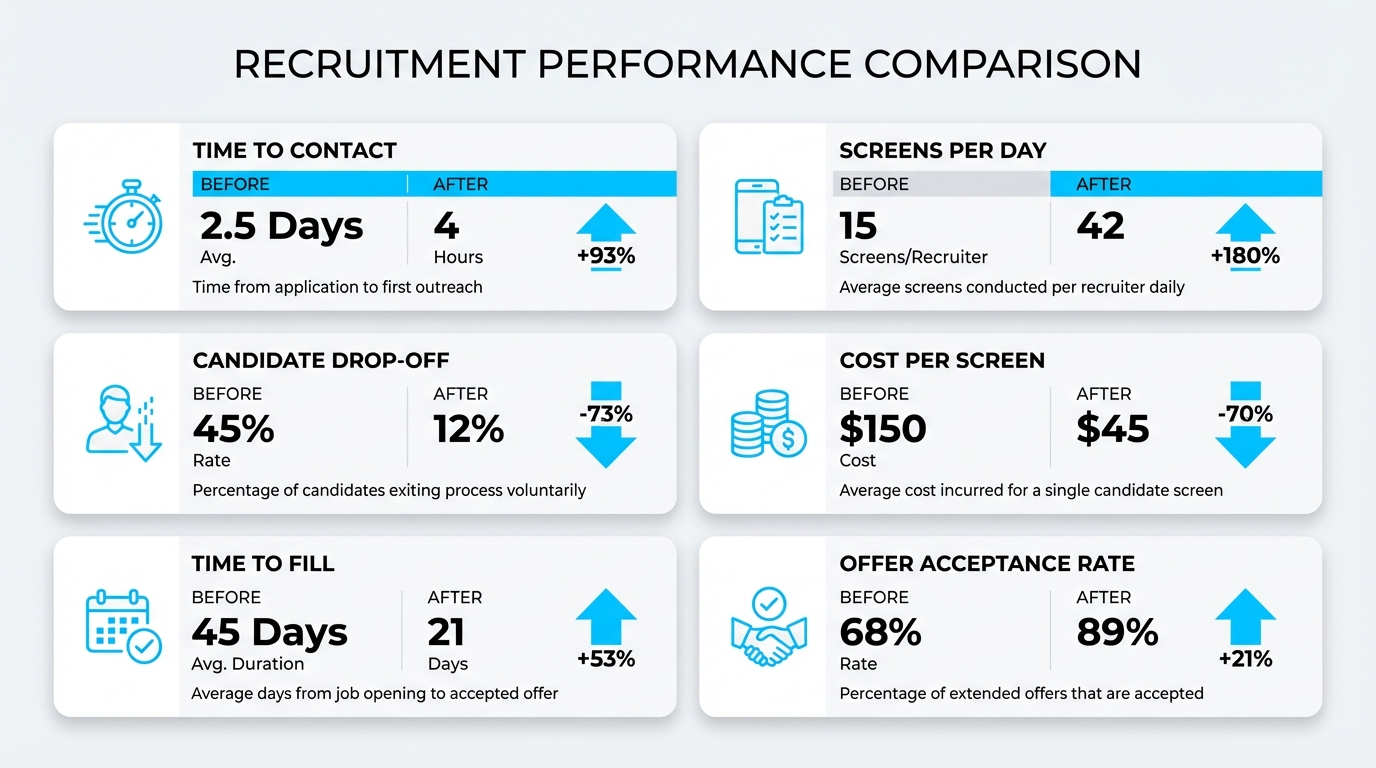
Real deployment data proves the ROI — these are operational results, not projections.
Vendor ROI claims in recruiting technology are notoriously inflated. So here is the math stripped to its operational bones, built on deployment data, not projections.
Proven Results: Healthcare Network Case Study
A regional healthcare network with 340 open nursing positions deployed AI voice screening across all inbound applications. Within 90 days, they reduced cost-per-hire by $1,200 per role and filled 89% of positions before the 30-day mark — a threshold they had previously hit only 51% of the time. The voice agent handled screens in English, Spanish, and Haitian Creole without separate staffing. Total additional headcount required: zero.
The Bias Trap: Why Remove Humans Remove Bias Is Dangerously Wrong
Here is the misconception that gets companies sued.
Vendors claim their AI eliminates human bias. Candidates hear algorithm and assume objectivity. Neither claim survives contact with reality. A Cornell research analysis of algorithmic hiring practices found that vendor claims of bias reduction are frequently unsupported by independent validation.
Important Distinction
AI voice agents do not eliminate bias. They make bias auditable in ways that human-led processes never could. Every question is recorded. Every score is logged. Every decision path is traceable — exactly what the NIST AI Risk Management Framework demands.
The responsible deployment model requires three non-negotiable elements: diverse validation datasets, quarterly adverse impact analyses, and a human reviewer for every rejection decision that the AI flags as borderline. The service and operations infrastructure behind an AI voice deployment must include governance and monitoring from the first call.
Building vs. Buying: The Decision Framework Most Companies Get Backwards
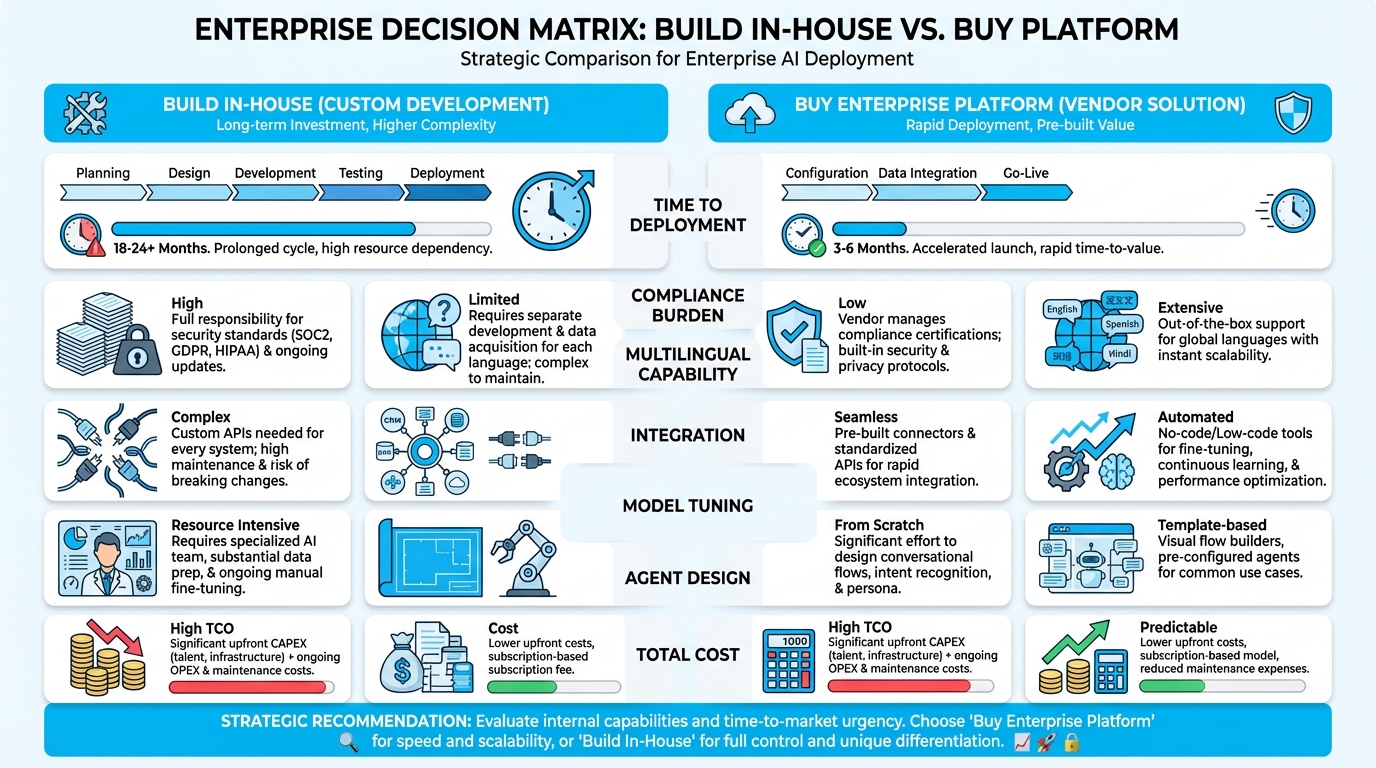
The build path costs 5-6x more and takes 6-12 months longer — for most companies, buying delivers faster ROI.
Enterprise teams evaluating AI voice agents default to a familiar question: Should we build or buy? It is the wrong question. The right question is: How fast do we need to move, and what do we refuse to own?
The NewVoices platform was engineered around these exact decision points because they are the ones that determine whether a deployment survives its first quarter or gets quietly shelved.
The 11 PM Candidate — Your Largest Untapped Pipeline
Your careers page gets 34% of its traffic between 7 PM and midnight. Your recruiting team is offline for 100% of that window.
Did You Know?
Candidates contacted within 5 minutes of applying — regardless of hour — are 3.1x more likely to complete the full interview process than candidates contacted the next business day.
An AI voice agent eliminates the dead zone entirely. A candidate applies at 11:14 PM on a Wednesday. At 11:14 PM and 47 seconds, their phone rings. A voice — warm, professional, conversational — confirms receipt, walks through qualification questions, and schedules an interview for the next day. Total elapsed time: 6 minutes.
While your competitors recruiting operations close at 6 PM, your AI agent just locked in the top candidate from tonight applicant pool. The same speed-to-engagement principle that drives revenue in sales pipelines applies identically to talent pipelines.
What Your HRIS Vendor Will Not Tell You About Integration
The dirtiest secret in HR technology is integration complexity. Every vendor promises seamless connections. In practice, most AI recruiting tools require months of custom middleware development.
Proven Results: Healthcare Integration Case Study
A healthcare system running Workday ATS and Salesforce CRM deployed an AI voice agent with native connectors to both platforms. The voice agent read open requisitions, screened candidates, and wrote evaluations directly into profiles — all without a single line of custom code. Their IT team involvement: four hours for initial configuration.
The NewVoices implementation team builds these integrations as standard configurations, not custom projects — because the moment a recruiting AI deployment requires an engineering sprint, it has already lost the speed advantage it was supposed to deliver.
Human-in-the-Loop Is Not a Concession — It Is the Entire Strategy
The AI handles volume. Your recruiters handle judgment. Together, they outperform either alone.
There is a persistent fantasy in enterprise AI that full automation is the goal. In recruiting, that fantasy produces disasters.
The AI voice agent job is not to replace human judgment. It is to make human judgment possible by removing everything that is not judgment. When your recruiter reviews 15 pre-screened, pre-scored, pre-scheduled candidates instead of 200 unfiltered applications, they make better decisions.
The companies that get this right are not replacing recruiters. They are multiplying them.
Frequently Asked Questions Click to expand
Can candidates tell they are speaking with an AI?
Modern neural speech synthesis sounds indistinguishable from trained recruiters. However, every voice interaction must disclose that the candidate is speaking with an AI agent — this is both a legal requirement and a trust-building best practice.
How do AI voice agents handle candidates who need accommodations?
The system flags accommodation requests immediately and escalates to a human recruiter who takes full ownership. Every candidate has a clear path to human support at any point in the conversation.
What languages does the voice agent support?
Enterprise platforms like NewVoices support 20+ languages from a single deployment, handling screens in the candidate preferred language without requiring separate staffing for each language group.
How long does implementation take?
With pre-built ATS integrations and no-code configuration tools, most deployments go live within 2-6 weeks. Custom builds typically require 6-14 months.
Is this compliant with EEOC and local AI hiring laws?
When properly deployed with structured scoring, consistent questions, and human oversight for borderline decisions, AI voice agents produce the most legally defensible screening record in your hiring process. The key is choosing a platform with SOC 2 Type II certification, GDPR compliance, and audit-ready logging from day one.
Limited Availability
Q1 2025 Implementation Slots Are Filling Fast
Companies deploying now will have 90+ days of optimization data before peak hiring season.
Your Talent Pipeline Leaks at the Top — Plug It or Keep Paying for It
The average enterprise career site converts 8-12% of visitors into applicants. Of those applicants, fewer than half ever receive a human touchpoint before dropping out. You are spending six figures on employer branding to fill a funnel that hemorrhages candidates before a single conversation occurs.
Every day without an AI voice agent in your recruiting stack is a day you pay full price for a pipeline that delivers half its potential. The math is not abstract. It is operational. It is measurable. And it compounds every quarter you delay.
Join 10,000+ HR Leaders Already Transforming Their Hiring
The companies deploying AI voice agents today are not early adopters. They are the ones who will still have recruiting teams small enough to manage and effective enough to compete 18 months from now.
Stop Losing Top Candidates to Slower Competitors
Hear exactly what your candidates will hear. Decide in 90 seconds if your current process can compete.
Request Your Live AI Voice Demo Now
Free consultation included. No commitment required. Setup in under 30 days guaranteed.
SOC 2 Type II Certified | GDPR Compliant | 20+ Languages Supported