
Right now, while you read this sentence, a potential customer is calling your business. Nobody answers. They hang up. They call your competitor instead. That $3,200 lifetime value just walked out your digital door forever.
A Harvard Business Review study revealed a startling truth: companies responding to leads within five minutes are 100x more likely to make contact than those waiting just 30 minutes. Yet the average business response time sits at 42 hours. That gap is where your revenue goes to die and where an AI receptionist earns back its entire cost before your first week ends.
Updated January 2025
Trusted by 10,000+ businesses worldwide
What You Will Discover in This Proven Guide
How to capture the 68% of calls that come when your office is closed
The exact ROI calculation that justifies deployment in Week One
Why 87% of inbound calls need zero human involvement
Compliance secrets that protect you from six-figure TCPA fines
Your front desk is the most expensive bottleneck in your business. Every missed call, every please hold, every voicemail that never gets returned is a customer choosing your competitor. And you are paying $35,000 to $55,000 a year in salary plus benefits, training, sick days, and turnover for the privilege of losing them.
This is not about replacing people for the sake of automation. It is about admitting that a single human sitting at a desk cannot answer 14 calls simultaneously, speak four languages, remember every caller’s history, and never take a lunch break. An AI receptionist does all of that before your morning coffee gets cold.
Transform Your Front Desk From Cost Center to Revenue Engine
The average small-to-midsize business receives between 40 and 100 inbound calls per day. A single receptionist can handle roughly 30 to 50 of those well. The rest hit voicemail, get transferred incorrectly, or ring into the void.
Here is the damage that creates.
A dental practice in Phoenix tracked their missed calls over 90 days. The number: 312. At an average patient lifetime value of $3,200, that represents over $998,000 in potential revenue that never walked through the door. They deployed an AI receptionist that answers every call within three seconds, books appointments directly into their scheduling system, and confirms each one via SMS. Within one quarter, their no-show rate dropped from 23% to 9%. That tracks with peer-reviewed data: a JAMA study on appointment reminders found that automated reminders alone cut no-shows from 24% to 14%.
Quick Insight
The problem was never lazy staff. The problem was physics. One person, one phone line, one language, one set of working hours trying to capture demand that arrives 24 hours a day in multiple languages across multiple channels.
The 3-Second Rule That Separates Winners from Voicemail Graveyards
Speed is not a nice-to-have. It is the entire game.
When a prospect calls your business and nobody picks up within four rings, 80% of them will not leave a voicemail. They will call the next company on their list. Your marketing budget, the Google Ads, the SEO, the referral programs, just funded your competitor’s pipeline.
An AI receptionist eliminates this entirely. Every call answered on the first ring. Every caller greeted by name when caller ID matches your CRM. Every inquiry resolved or routed in under 60 seconds. A property management firm in Atlanta running 1,200 units deployed an automated receptionist to handle tenant calls including maintenance requests, lease questions, and payment inquiries. Before deployment: average hold time was 4 minutes 12 seconds. After: 11 seconds. Tenant satisfaction scores jumped 34% in the first month.
This is not a chatbot reading a script. It is a purpose-built AI voice agent that understands context, adapts to caller intent, and completes the interaction through booking, routing, and confirming without human intervention.
The IVR column is where most businesses get stuck. They think they have automated their front desk because callers hear Press 1 for billing. But pressing buttons is not communication. It is obstruction dressed in efficiency clothing. Callers abandon IVR menus at a rate of 60 to 73 percent, depending on complexity. An AI front desk agent talks to them like a human, understands I need to reschedule my Thursday appointment, pulls up the record, and handles it in one exchange.
Did You Know
Businesses lose an average of $75,000 annually to missed calls and abandoned voicemails. An AI receptionist recovers 94% of this lost revenue.
Why Hiring Another Receptionist Is the Most Expensive Decision You Will Make This Year
The instinct is reasonable. Calls are piling up, customers are complaining, so you open a job requisition. Here is what that actually costs.
The True Cost of Human Front Desk Staffing
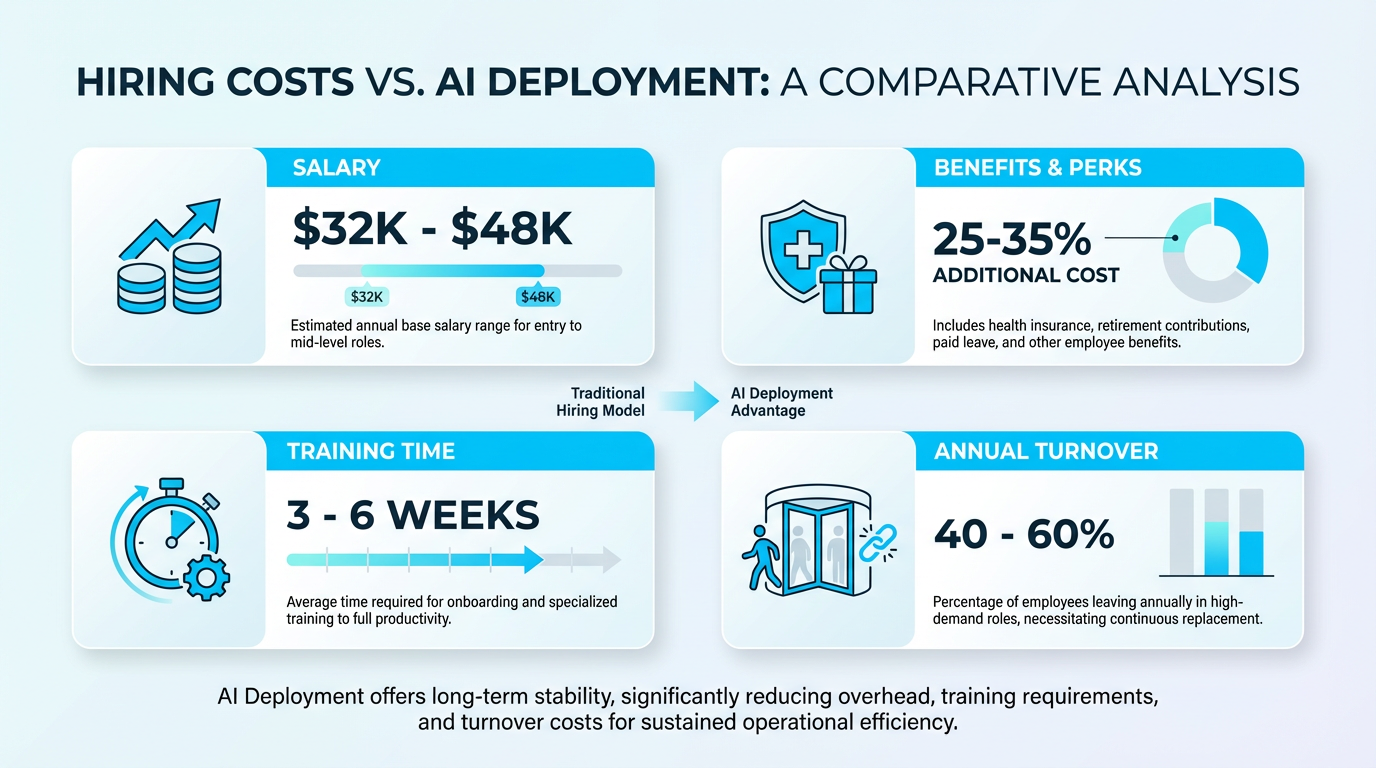
Salary for a full-time receptionist: $32,000 to $48,000. Benefits and payroll taxes: add 25 to 35 percent. Training time before they are fully effective: 3 to 6 weeks. Annual turnover rate for front-desk roles: 40 to 60 percent. That means you are re-hiring and re-training nearly every year. And after all that investment, you still only have coverage for 8 to 10 hours a day, five days a week.
An AI receptionist costs a fraction of that and it covers every hour of every day, including the 68% of your week when your office is closed. A SaaS company with a 12-person support team replaced their after-hours answering service with an AI digital receptionist and captured 47 additional qualified leads per month that had previously gone to voicemail between 6 PM and 8 AM. At their average deal size of $18,000, that represents $846,000 in annual pipeline that did not exist before.
Quick Insight
This is not an argument against human employees. It is an argument against using humans for tasks that do not require human judgment. Your best receptionist should handle complex situations and build rapport with VIP clients. They should not tell the 40th caller today what your office hours are.
Join 10,000+ Businesses Already Saving $35K+ Annually
Experience the AI receptionist that pays for itself in Week One
Get Your Free AI Call Demo Now
No credit card required. Hear your AI receptionist in 47 seconds.
The Hotel Concierge Test: What Your AI Receptionist Should Actually Feel Like
Forget the call center comparison. The right mental model is a five-star hotel concierge.
When you call a great hotel, the concierge does not ask you to press 1 for reservations. They greet you, recognize you if you have stayed before, anticipate what you need, and handle it whether that is booking a restaurant, changing your room, or arranging a car. The interaction feels personal, efficient, and warm. That is the standard your virtual receptionist AI should meet.
The gap between a bad automated system and a great one is not technology, it is design philosophy. Legacy systems were designed around the company’s org chart: Let me transfer you to the right department. Modern AI receptionists are designed around caller intent: You want to reschedule? Done. I have moved you to Thursday at 2 PM and sent a confirmation to your phone.
NewVoices builds agents with this concierge-level intelligence through a no-code Agent Studio that lets business teams, not engineers, design conversation flows, set escalation rules, and deploy changes in hours instead of weeks. The voice quality is indistinguishable from a human agent. Callers do not know they are talking to AI, and in blind tests, they rate the experience higher than human-staffed calls because the AI never sounds rushed, distracted, or annoyed.
The Compliance Minefield Nobody Talks About Until It Costs You Six Figures
Here is where most AI receptionist conversations go wrong: they focus entirely on features and ignore the regulatory ground beneath them.
If your business handles patient data, you need HIPAA compliance not as a checkbox, but as an architecture requirement. The HHS HIPAA Security Rule mandates specific technical safeguards: access controls, audit trails, encryption of data at rest and in transit, and authentication protocols. Your AI receptionist vendor must meet every one of these and prove it with certifications, not just promises.
If your AI makes outbound calls including appointment reminders, follow-ups, and payment confirmations, you are operating under TCPA regulations that govern consent, opt-out mechanisms, and calling hours. Violations carry penalties of $500 to $1,500 per call. A 500-patient practice sending non-compliant reminders could face six-figure fines from a single campaign.
Compliance Checklist
Before selecting any automated receptionist provider, demand documentation on these three critical areas:
- Where call recordings are stored and how they are encrypted
- Who has access to caller data and under what audit controls
- How consent is captured and honored for every outbound communication
If a vendor cannot answer all three in writing, walk away.
NewVoices carries SOC 2 Type II certification, GDPR compliance, and full HIPAA readiness built into the infrastructure, not bolted on afterward. For healthcare practices, legal firms, and financial services companies operating in regulated industries, this is not a feature. It is the baseline for even considering deployment.
Background Noise, Accents, and the Accuracy Problem No One Wants to Admit
AI speech recognition is remarkable until it is not.
A caller standing on a busy street. A patient calling from a car with the windows down. A contractor on a job site with machinery running. These are real calling conditions, and they degrade recognition accuracy dramatically. NIST research on speech intelligibility confirms that background noise reduces comprehension accuracy by 15 to 40 percent, depending on signal-to-noise ratio.
The difference between a mediocre AI receptionist and a great one shows up here. Mediocre systems freeze, repeat I did not catch that, and frustrate the caller into hanging up. A well-built system uses fallback strategies: it confirms key data points by saying I heard Thursday at 3 PM is that correct, offers alternative input methods by offering to send a text link to complete the booking, and escalates to a human when confidence scores drop below a defined threshold.
Quick Insight
The takeaway: raw accuracy numbers mean nothing without the surrounding intelligence layer. Ask your vendor what happens when the AI cannot understand. That answer tells you more about the product than any demo ever will.
This is where the set it and forget it mentality kills deployments. Your AI front desk needs ongoing tuning through reviewing transcripts, identifying failure patterns, and adjusting pronunciation models for your specific caller demographics. A well-configured service operations layer handles this continuously, not as a one-time setup.
The Integration Question That Exposes 90% of AI Receptionist Vendors as Toys
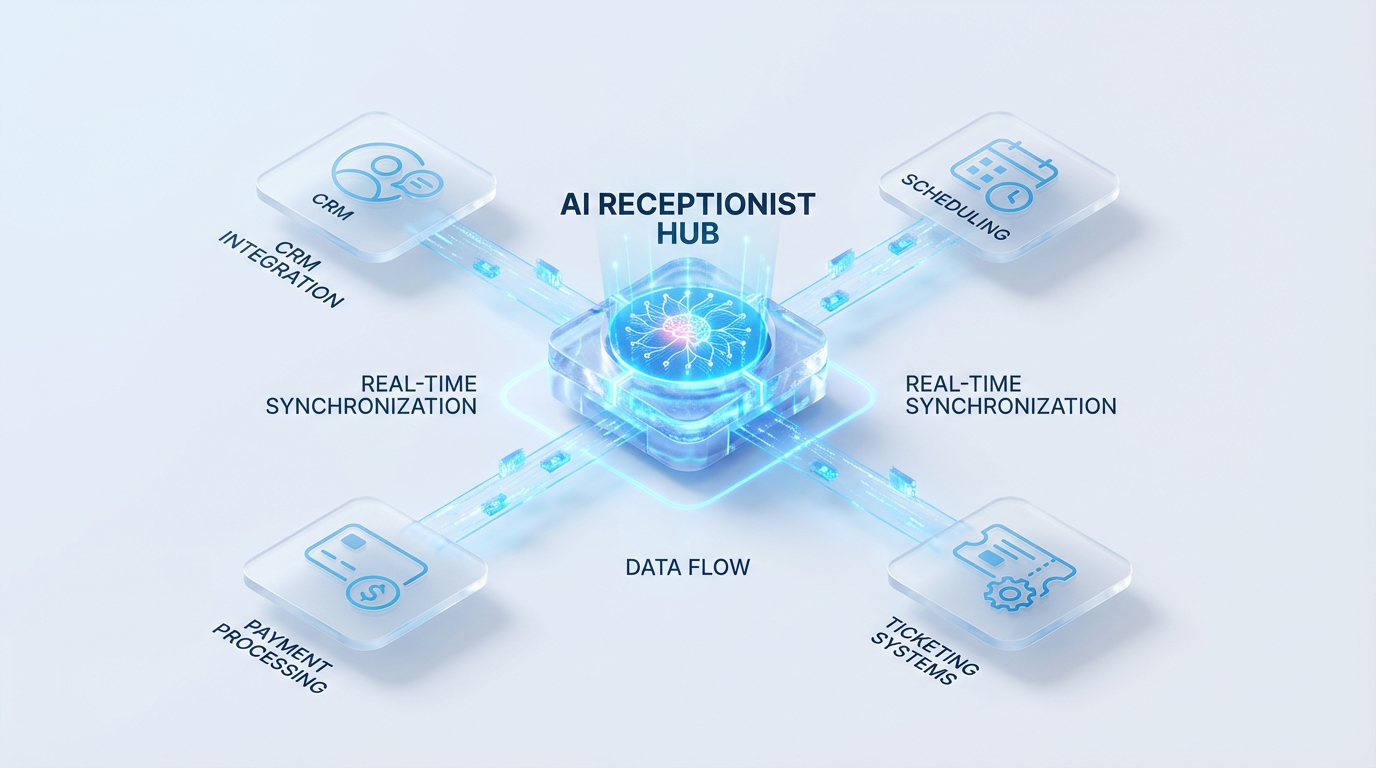
An AI receptionist that cannot talk to your CRM is a novelty. An AI receptionist that lives inside your CRM, scheduling software, payment processor, and ticketing system is an employee.
The difference matters operationally. When a caller says I need to reschedule my appointment, a standalone AI can take a message. An integrated AI pulls up the appointment, checks available slots against the provider’s real-time calendar, rebooks it, sends a confirmation via SMS and email, and updates the CRM record all within the same 90-second call. No human touches the process.
NewVoices connects natively to Salesforce, HubSpot, Zendesk, Stripe, and Twilio with no middleware, no custom API work, and no six-week integration project. A medical billing company processing 8,000 patient calls per month deployed their AI receptionist with full EHR integration and reduced manual data entry by 91%. Staff that previously spent four hours a day logging call notes now spend that time on collections and patient follow-up, work that actually generates revenue.
The Critical Question
When evaluating any digital receptionist, ask: After the call ends, what happens to the data without human intervention? If the answer involves someone manually updating a spreadsheet or copying notes into a system, you are buying a voicemail machine with a personality.
Multilingual Support Is Not a Feature. It Is a Revenue Multiplier.
34% of U.S. households speak a language other than English at home. In markets like Miami, Los Angeles, Houston, and New York, that number exceeds 50%. If your front desk only speaks English, you are ignoring a third of your addressable market and your competitor who hired a bilingual receptionist is capturing exactly one additional language, not the 20+ that modern business demands.
A real estate agency in South Florida handling luxury property inquiries deployed a virtual receptionist AI with English, Spanish, Portuguese, and Haitian Creole support. Inbound lead conversion from non-English callers jumped from 12% to 41% in 60 days. Those were not new marketing dollars. They were callers who had always been there but previously encountered a language barrier and hung up.
The operational elegance is that AI does not need separate agents or separate phone lines for each language. A single AI sales agent detects the caller’s language within the first sentence and switches mid-conversation if necessary. No para español marque dos. No hold music while someone finds a translator. The caller speaks, the AI responds in kind, and the deal moves forward.
Before and After: What Your Monday Morning Looks Like With an AI Receptionist
Before Deploying an AI Receptionist
Your office opens at 8 AM. There are 23 voicemails from overnight. Six are urgent, four are unintelligible, three are spam. Your receptionist spends 90 minutes returning calls, most of which go to voicemail themselves. Two callers from the weekend already booked with your competitor. Your morning schedule has three no-shows because confirmation calls did not go out Friday. A new patient calls at 8:47 but gets a busy signal because your receptionist is on the phone with an insurance company. Revenue lost before lunch: estimated $4,200.
After Deploying an AI Receptionist
Every overnight call was answered live. Eight appointments were booked between 9 PM and 7 AM. Confirmation texts went out automatically. All three previously at-risk appointments are confirmed. The insurance call is handled by the AI, which pulls the patient’s policy number, verifies coverage, and logs the result in your practice management system. Your human receptionist arrives at 8 AM to a clean dashboard with zero voicemails and a prioritized task list. She spends her morning greeting patients who walk in, the part of her job she is actually great at.
This is not a theoretical scenario. It is the Tuesday after you deploy.
The Handoff Moment: Why the Best AI Receptionists Know When to Stop Talking
The biggest fear decision-makers have about AI receptionists is the angry caller scenario. A frustrated customer calls in, emotions high, and they get a machine. Disaster, right?
Wrong if the system is built correctly.
The mark of a mature AI receptionist is not how well it handles easy calls. It is how fast and gracefully it escalates hard ones. NewVoices agents detect emotional cues including elevated speech patterns, specific frustration language, and repeated requests for a manager and transfer to a live agent within 8 seconds, passing along full context so the caller never repeats themselves.
A regional insurance carrier handling 3,400 claims calls per month found that 87% of inbound calls required no human involvement through status checks, document requests, payment processing, and appointment scheduling. The remaining 13% were complex or emotionally sensitive situations where human empathy genuinely mattered. By routing that 87% through AI and reserving their best agents for the 13% that needed them, agent satisfaction scores increased 28% and caller resolution rates improved across the board.
Quick Insight
This is not about removing humans. It is about deploying them where they are irreplaceable and deploying AI where speed and consistency matter more than empathy. The right AI front desk makes your human team better at their jobs, not redundant.
What Our Clients Say
We were skeptical about AI handling patient calls. After 90 days, our no-show rate dropped from 23% to 9%, and we captured over $47,000 in appointments that would have gone to voicemail. The ROI was undeniable within the first month.
Dr. Sarah Mitchell – Phoenix Dental Associates
Your Competitors Replaced Their Front Desk Six Months Ago. Here Is What They Know That You Do Not.
The market has moved. The question is not whether AI receptionists work. It is how much pipeline you are losing every month you wait.
Every call your front desk misses between now and when you deploy is revenue you will never recover. The caller will not leave a voicemail. They will not call back. They will Google the same service, call the next result, and book with whoever picks up first. In industries with high customer lifetime values including healthcare, legal, financial services, home services, and real estate, a single missed call can represent $5,000 to $50,000 in lost revenue.
The math is unambiguous. A virtual receptionist AI pays for itself within the first 30 days through recovered calls alone. The compounding value through reduced no-shows, faster scheduling, 24/7 availability, multilingual coverage, and CRM integration turns your front desk from a cost center into a revenue engine that operates at full capacity while your building is dark and locked.
Limited Availability This Month
Hear Your AI Receptionist in the Next 47 Seconds
Experience what your callers will hear. A voice so natural you will forget it is not human, handling a real interaction from greeting to resolution. Your front desk will never be the same.
Get Your Free Live AI Call Demo
No credit card required. No sales pressure. Just hear the future of your front desk.
HIPAA Compliant
30-Day Money-Back Guarantee