
Your collections team is only reaching 4% of delinquent accounts. The other 96% are quietly destroying your cash flow — and there is a proven fix that does not require a single new hire.
Accounts receivable AI has already helped finance teams free tens of millions in working capital, drop DSO by double digits, and hit 100% coverage without breaking customer relationships. Here is exactly how it works — and how to deploy it without disrupting your finance stack.
|
Industry-Leading AR Intelligence
|
Trusted by 10,000+ Finance Leaders
|
Updated for 2026
What You Will Gain From This Article
100% Account Coverage
Reach every delinquent account every cycle — not just 4%
DSO Reduced by 8-14 Days
Proven framework for releasing locked working capital
Zero Relationship Damage
AI calibrated for tone, timing, and customer context
Measurable ROI Fast
Mid-market deployments recoup costs in one quarter
A Fortune 500 CFO once admitted in a private roundtable that his company was sitting on $340 million in overdue invoices — not because customers refused to pay, but because his collections team could only call 4% of delinquent accounts in any given week. The other 96% waited. Some paid late. Some never paid at all. That math breaks most finance departments, and it is exactly the math that accounts receivable AI was built to destroy.
Cash is oxygen. Most AR teams are suffocating.
The average enterprise collections team reaches fewer than one in five delinquent accounts before the invoice rolls past 60 days. By then, the probability of full recovery drops sharply. This is not a staffing problem — it is a coverage problem, and throwing more humans at it only scales the cost, not the result.
What Accounts Receivable AI Actually Does — And What It Is Not
Accounts receivable AI is a class of autonomous systems that predict invoice payment behavior, prioritize collector effort, and execute outreach — by voice, email, and SMS — without human intervention. It ingests payment history, customer risk signals, and invoice metadata, then decides who gets contacted, when, and with what message.
This is not a rules engine with a new coat of paint. It is a decisioning layer that learns from every interaction and adjusts in real time.
Research from applied ML studies on invoice payment prediction shows models reaching roughly 77% accuracy in predicting which invoices will be paid on time — a precision level no manual reviewer can sustain across thousands of accounts. That accuracy is the difference between a collector who calls the right 20 customers a day and one who wastes 80% of their dials on accounts that would have paid anyway.
Quick Tip
Before evaluating any AR AI platform, benchmark your current weekly contact rate. If you are below 20%, coverage — not script quality — is your primary cash flow constraint. AI solves coverage. Nothing else does at scale.
The Clear Line Between Automation and Intelligence
The Hidden Tax Every Finance Team Pays on Manual Collections
Your collectors spend 63% of their day on activities that do not recover cash — leaving voicemails, updating notes, waiting on hold, chasing wrong numbers. The remaining 37% is where the recovery actually happens. That ratio is not a productivity problem. It is a physics problem.
Before AI: a team of 12 collectors reaches 400 accounts a week. Invoices age. DSO climbs. Quarter-end scrambles become routine. After AI: the same 12 collectors supervise 40,000 automated touches while personally handling only the 300 accounts that require human negotiation.
Proven Real-World Result
A mid-market logistics firm with 18,000 active invoices deployed AI voice agents across its first-notice and friendly-reminder stages. Coverage jumped from 11% to 100%. DSO dropped from 54 days to 39 days in one quarter. That is $12.4M in freed working capital — without hiring a single additional collector.
Join 10,000+ finance leaders already transforming their collections operations
Why Most AR Teams Call the Wrong Customers First — And How AI Fixes the Order
Here is the counterintuitive truth: the loudest invoice is rarely the most valuable one to chase. Manual teams gravitate toward the biggest dollar amounts or the oldest aging buckets. AI gravitates toward expected recovery value — a blend of invoice size, payment probability, and customer lifetime risk.
Prioritization is the single highest-leverage decision in collections.
McKinsey’s analytics-enabled collections model documents recovery improvements of 20-30% from segmentation alone — not from better scripts, not from more calls, but from calling the right accounts in the right order. Additional ML research on receivables prediction reinforces this: collectors who follow model-ranked worklists recover materially more cash per hour than those working aging-sorted queues.
Did You Know?
A SaaS company with $84M in annual receivables rebuilt its queue using AI-predicted recovery value. Same team. Same hours. Recovery per collector-hour rose 42% in eight weeks — with zero additional headcount or technology investment beyond the AI prioritization layer.
AI-ranked collector worklists consistently deliver 20-42% more recovered cash per hour than aging-sorted queues.
The Voice Channel Is Where AR AI Earns Its Keep — And Converts At 31%
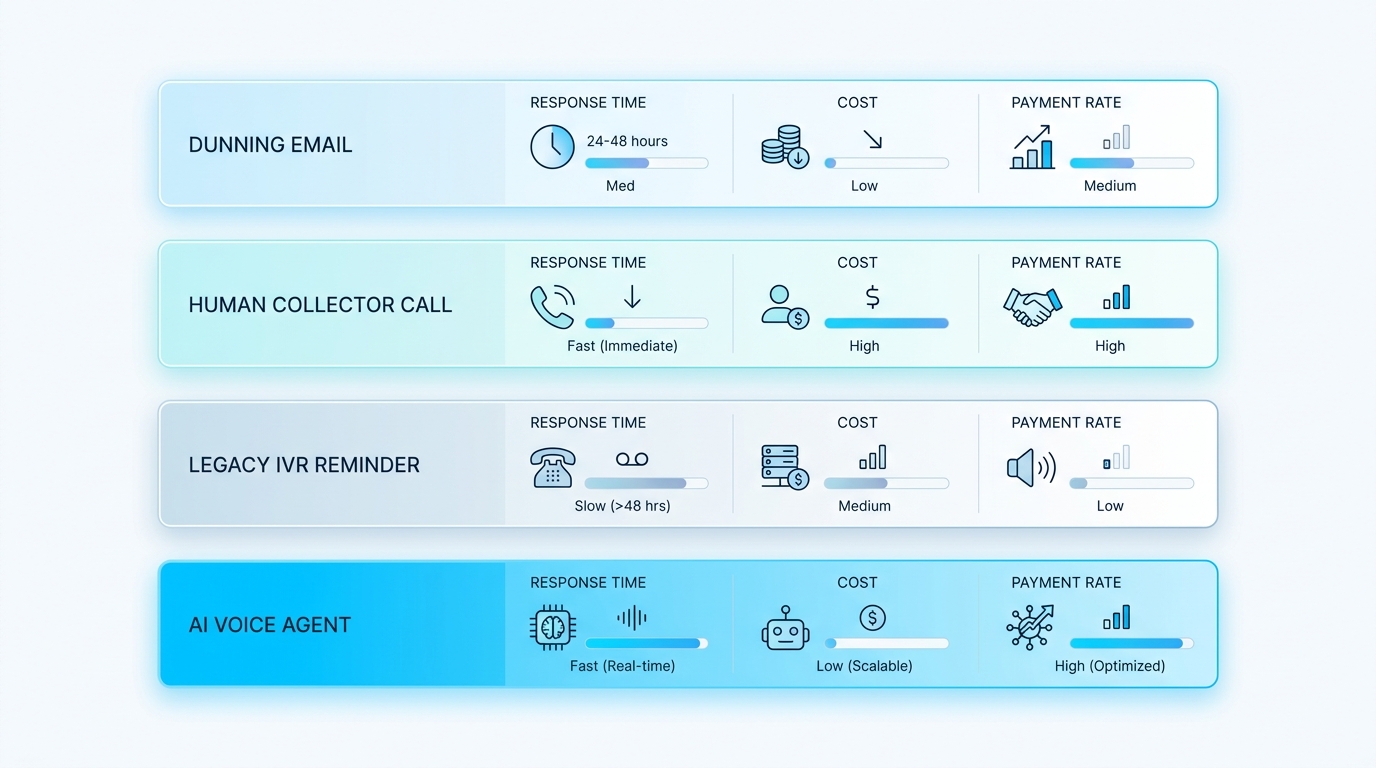
Email reminders get ignored. Portals get forgotten. Letters get shredded. The phone still closes the gap — and voice is precisely where most AR automation has historically failed, because legacy IVR systems sound like legacy IVR systems.
Your customer answers at 2:47 PM. The voice on the other end introduces itself, references the specific invoice number, confirms the payment date they committed to last month, and offers a one-click payment link by SMS before the call ends. The entire exchange takes 38 seconds. The customer never knows — and never needs to know — that they spoke to an AI.
Human-level voice quality matters because tone drives payment behavior. A stiff, robotic prompt triggers avoidance. A calibrated, professional voice — the same voice that NewVoices deploys across its enterprise voice platform — triggers action. The platform handles the call. The collector handles the exception.
The DSO Lie Most Finance Leaders Still Believe — And the Metric That Tells the Truth
DSO is the most-cited AR metric and the most-misread one. A 45-day DSO looks fine until you realize 18% of your invoices are 90+ days past due and pulling the average down with a long tail of paid-on-time customers. DSO is a lagging, blended number. It tells you the weather last month.
Public companies disclose DSO calculations in SEC filings — you can see the methodology in annual reports across industries — but the calculation varies enough that cross-company comparison is mostly theater.
What finance leaders actually need is Collection Effectiveness Index. The Credit Research Foundation’s CEI formula measures how much collectible cash was actually collected in a given period — a ratio that exposes coverage gaps DSO hides. AI pushes CEI toward 95%+ because it closes the coverage problem. Human-only teams plateau at 78-85%.
Quick Tip
Measure CEI weekly. Measure DSO monthly. Stop mistaking the second for the first. If your weekly CEI is below 88%, you have a coverage problem — and no amount of DSO monitoring will surface that gap until it is too late to act.
What AR AI Borrows From Air Traffic Control — And Why It Changes Everything
Like air traffic controllers, AR AI manages routine operations at scale while reserving human judgment for high-stakes exceptions.
Air traffic controllers do not personally guide every aircraft. They monitor hundreds of flights simultaneously, intervene on exceptions, and let the system handle routine separation. A single controller manages traffic no human team could hand-fly. The throughput exists because routine decisions are automated and human attention is reserved for edge cases.
Collections works the same way once AR AI is deployed. The system handles 90%+ of routine touches — first reminders, payment confirmations, promise-to-pay follow-ups. Collectors become controllers. They intervene on disputes, large accounts, and relationship-sensitive situations where judgment matters.
Breakthrough Healthcare Case Study
A regional healthcare group serving 2.1 million patients moved first-notice and balance-confirmation touches to AI voice agents. Collector headcount held steady. Monthly contact volume rose from 14,000 to 186,000. Net patient receivables fell 22% in two quarters.
The Compliance Floor Every AR AI Deployment Must Clear — Non-Negotiable Standards
Automated outreach at scale attracts regulatory scrutiny — and rightly so. The FTC’s consumer guidance on the FDCPA prohibits abusive, unfair, or deceptive practices, and those prohibitions apply whether the voice on the line is human or synthetic. An AI agent that calls at 11 PM or fails to honor a cease-contact request is a compliance incident, not a feature.
Enterprise AR AI has to bake compliance into decisioning, not bolt it on afterward. That means quiet-hours enforcement, explicit consent tracking, honored opt-outs, and auditable call logs for every interaction.
Security is non-negotiable. Platforms handling payment data need SOC 2 Type II, GDPR alignment, and — in regulated verticals — HIPAA controls. The NIST SP 800-53 control catalog and the NIST AI Risk Management Framework together define the governance floor serious buyers should require. Anything less is a liability disguised as efficiency.
Did You Know?
FDCPA violations carry penalties of up to $1,000 per consumer per action plus attorney fees. A single non-compliant AI deployment touching 10,000 accounts per day can generate six-figure liability exposure in weeks. Compliance infrastructure is not optional — it is the foundation.
Why Faster Collections Is the Wrong Goal — Precision Is What Protects Revenue and Relationships
Speed kills relationships. A SaaS customer who misses a payment by four days because their CFO was on vacation does not deserve three escalating calls before Friday. A distributor whose payment terms were renegotiated last quarter does not deserve a dunning script. Pressure applied without context is how churn happens.
This is not a speed game — it is a precision game.
Research on AI-driven collections and consumer psychology shows tone and timing meaningfully shift both payment behavior and long-term customer sentiment. The highest-performing AR AI deployments deliberately slow down low-risk accounts, use softer language on high-value relationships, and reserve intensity for truly delinquent edge cases. A multilingual deployment footprint matters here too: a payment reminder delivered in the customer’s native language — across 20+ supported languages — lands differently than a translated template.
How to Stage an AR AI Rollout Without Breaking Your Finance Stack

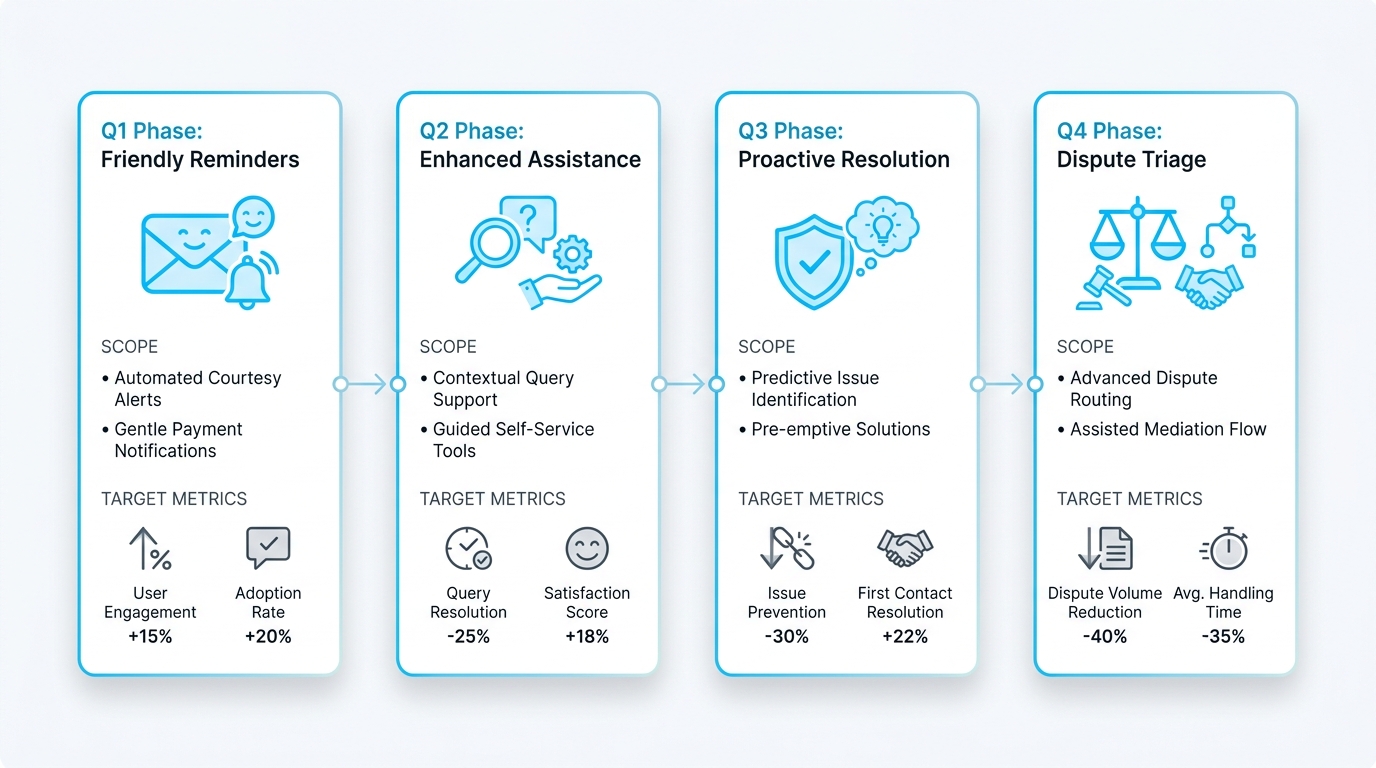
A staged four-quarter rollout consistently delivers better ROI than big-bang deployments — start narrow, prove the numbers, then expand.
The fastest way to fail with AR AI is to deploy it everywhere at once. The second fastest is to deploy it as a pilot so narrow it never generates meaningful data. The right path sits between those extremes.
Start with one stage — friendly reminders on invoices 1-15 days past due. Volume is high, stakes are low, and the AI has room to learn your customer base without risking marquee accounts. Measure CEI, contact rate, and promise-to-pay rate against the prior quarter. If the numbers hold, extend to 16-45 days. Then to disputes and promise-follow-ups.
A Four-Quarter Deployment That Actually Works
A no-code configuration layer matters more than most finance leaders assume. When AR operations can adjust scripts, thresholds, and escalation logic without a six-week engineering ticket, deployment cycles compress from quarters to weeks. Review the Agent Studio configuration environment before committing to any platform that demands a developer for every change.
The Integration Question That Makes or Breaks AR AI — What Your Stack Actually Needs
An AR AI that cannot read your ERP is a very expensive autodialer. Real value requires bi-directional integration — invoice data flowing in, payment commitments flowing back, dispute codes updating in real time, and CRM records reflecting every touch.
Your stack is probably some combination of NetSuite or SAP for the ledger, Salesforce or HubSpot for customer context, Stripe or a bank rail for payment capture, Zendesk for dispute tickets, and Twilio or a carrier layer for telephony. Enterprise-grade AR AI plugs into all of them without a six-month integration project. The connective pattern used on the revenue side of the platform applies equally to collections: CRM-native, API-first, no middleware tax.
Hear the Difference Yourself — No Sales Call Required
Request a live AI collections call in seconds and judge the voice quality, the handling, and the handoff logic on a real outbound scenario. Thousands of finance leaders have already used this to validate the technology before committing.
Request a Live AI Collections Call Now
Instant access. No commitment. Hear real voice quality in under 60 seconds.
The ROI Math Most CFOs Underestimate — Three Numbers That Change the Business Case
Most ROI models for AR AI focus on collector productivity. That is a fraction of the real number. The larger value sits in three places: working capital released from lower DSO, bad-debt expense avoided through earlier intervention, and customer lifetime value preserved through better tone.
$13.7M
Working Capital Released
For a $500M company reducing DSO by 10 days
$3.5M
Annual Bad-Debt Savings
Reducing write-offs from 1.8% to 1.1% of revenue
42%
Recovery Per Collector-Hour
Increase from AI-ranked worklist vs aging-sorted queue
NACM’s AR metrics guidance reinforces the case for tracking CEI, DSO, and write-off ratios together — not in isolation. Any vendor pitch that only shows collector productivity is selling you 20% of the actual ROI.
Finance teams evaluating options should walk through the full economic model on a live call. Book a scoped ROI review with the NewVoices team and bring your actual aging report.
Where Accounts Receivable AI Goes Next — The Breakthrough Shifts Already Underway
Two shifts are already visible. First, AR AI is moving from post-invoice recovery into pre-invoice prediction — identifying which deals, at quote stage, carry elevated payment risk, and adjusting terms before the invoice is ever cut. That collapses the collections problem into the sales process.
Second, voice agents are becoming multilingual by default. A single deployment now handles English, Spanish, Portuguese, French, German, Mandarin, Arabic, and a dozen more — without separate vendors, separate contracts, or separate infrastructure. Global AR teams that used to run fragmented regional operations are consolidating into unified control towers.
The companies that adopted AR AI in the last 18 months are not using it to replace collectors. They are using it to give their collectors superpowers — 40x coverage, better prioritization, cleaner compliance, and DSO numbers that finally move in the right direction. Cash flow stops being a quarter-end scramble. It becomes a weekly dashboard trending the right way.
That is what accounts receivable AI does when it is built right. Not faster dunning. Not louder reminders. A collections function that finally operates at the scale, precision, and tone your customers — and your balance sheet — deserve.
What Finance Leaders Are Saying
“We freed $12M in working capital in one quarter. Our collectors are finally doing the work that actually requires a human — everything else is handled.”
VP Finance, Mid-Market Logistics
“DSO down 13 days. Bad debt expense down 38%. The ROI paid for the entire platform in six weeks. I wish we had done this three years ago.”
CFO, Regional Healthcare Group
Limited Assessment Spots Available This Month
Ready to See How Much Working Capital Is Locked in Your AR Right Now?
Join 10,000+ finance leaders who have already transformed their collections operations. Bring your aging report and get a free, scoped ROI model built on your actual numbers — not industry averages.
No commitment required. Results guaranteed or we show you exactly why. Trusted by enterprise finance teams across 40+ industries.