
Sixty-seven percent of your customers hang up before reaching a human. Every abandoned call is a lost sale, a churned subscriber, and a one-star review waiting to happen. The fix is not a better phone tree. It is time to eliminate the tree entirely — and the enterprises doing it right now are never looking back.
This proven playbook reveals the operational math, the deployment timeline, and the breakthrough results that follow when you replace your IVR with enterprise-grade voice AI and visual self-service — backed by real data from real deployments.
Industry-leading research
Enterprise-validated results
Trusted by 10,000+ contact center leaders
Exclusive Insights Inside This Article
Why your IVR is hemorrhaging millions in hidden revenue
The proven 4-week deployment playbook enterprises use today
How to cut cost-per-interaction from $8.40 to $2.10
The security model that satisfies HIPAA, SOC 2, and GDPR
Real case studies with verified ROI numbers from live deployments
Why voice AI paired with visual IVR is a revenue engine, not a cost center
Your IVR Is Not Saving Money — It Is Hemorrhaging Revenue You Cannot Afford to Lose
Traditional IVR was built on a reasonable premise: automate the front door so agents handle fewer calls. In practice, it created a bottleneck that punishes your best customers the hardest — and the financial damage compounds every single day you leave it in place.
The core problem is cognitive bandwidth. Research from MIT’s Media Lab on telephone menu interaction identified the fundamental flaw decades ago: audio is transient and sequential. A caller cannot scan eight options simultaneously the way they scan a webpage. They must listen to every option, hold each one in working memory, and hope they remember option three by the time option seven finishes playing. Recent work on adaptive audio presentation and spatial interfaces confirms the same principle — sequential audio presentation crushes information bandwidth and slows processing compared to visual or spatial layouts.
The downstream cost is staggering. A mid-market insurance carrier routed 1.2 million calls per quarter through a five-layer IVR. Average navigation time: 97 seconds before the caller even stated their purpose. Thirty-one percent abandoned before reaching an agent. Of those who stayed, 42% were misrouted and had to be transferred — adding another 3.4 minutes of handle time per interaction. Annualized cost of that misrouting alone: $2.7 million in wasted agent labor. This is not an edge case. It is the norm.
Did You Know?
According to the U.S. Government Accountability Office, abandonment rate remains one of the most tracked yet least improved metrics in federal and commercial contact centers. Most organizations have been measuring this problem for over a decade without solving it — because they keep optimizing the wrong variable.
The Metrics That Expose the True Damage to Your Bottom Line
The GAO contact center modernization framework tracks five core performance indicators: queue wait time, abandonment rate, average speed of answer, first contact resolution, and average handle time. Traditional IVR degrades every single one. Callers who survive the phone tree arrive frustrated, repeat their issue to the agent, and require longer handling — which research in Applied Soft Computing directly ties to lower first-call resolution rates and higher repeat contact volumes. Your IVR is not deflecting calls. It is multiplying them.
| Metric | Traditional IVR | Visual IVR Alternative | Improvement |
|---|---|---|---|
| Abandonment Rate | 28–35% | 8–12% | -65% |
| Avg. Navigation Time | 74–110 seconds | 12–18 seconds | -83% |
| First Contact Resolution | 58–64% | 79–86% | +32% |
| Avg. Handle Time (Escalated) | 6.2 minutes | 3.8 minutes | -39% |
| Self-Service Completion Rate | 22–28% | 61–74% | +180% |
Your IVR cost you a customer while you read this section.
See exactly how much revenue your phone tree is bleeding — hear a live AI call in under 60 seconds.
What a Visual IVR Alternative Actually Looks Like in Production — And Why It Changes Everything
A customer calls your support line. Instead of hearing “Listen carefully as our menu options have changed,” they receive an instant visual interface on their smartphone — a clean, tappable menu showing every available action: check order status, make a payment, schedule a callback, speak with an agent.
They tap “Check order status,” enter their order number on a visual form, and see real-time tracking — including an embedded map — within nine seconds. No agent involved. No hold music. No transfers between departments. That is the visual IVR alternative in its simplest form. But the real power is what happens beneath the surface.
When a caller does need a human, the visual interaction has already captured their identity, intent, account context, and the exact point where self-service could not resolve their issue. The agent receives a complete dossier before they say hello. Handle time drops by 39%. Resolution rates jump. And the customer never repeats themselves — the single most cited frustration in every contact center satisfaction survey ever conducted.
Quick Tip
Enterprises using NewVoices for service and operations deploy these visual flows in hours through a no-code Agent Studio — meaning your CX team, not your engineering department, controls the customer journey from day one.
This is not another chatbot layered on top of a broken system. It is a complete replacement of the interaction model — visual menus, self-service workflows, rich media guides, and intelligent routing that uses actual context rather than a “Press 3” guess.
The $4 Million Mistake: Confusing Smarter Routing With Actual Customer Resolution
Here is where most IVR upgrade projects fail: they invest six figures into better routing logic and declare victory. Routing is not resolution. A study published in the Israel Journal of Health Policy Research examined machine-learning-based call routing at a national hotline and found that while improved routing reduced wait times, it did not proportionally reduce abandonment or improve resolution. The callers who were going to leave still left — they just left from a shorter queue.
The insight is critical: customers do not abandon because they are in the wrong queue. They abandon because they are in a queue at all.
Visual IVR attacks the root cause. A healthcare network with 14 clinics replaced its IVR routing tree with a visual self-service flow for appointment scheduling, prescription refills, and billing inquiries. Within 90 days, 68% of inbound calls resolved without an agent. The remaining 32% that escalated carried full patient context — reducing average handle time from 7.1 minutes to 4.3 minutes. Total annual savings: $4.2 million in agent labor, plus a 23-point lift in patient satisfaction scores.
Did You Know?
Routing sends people to the right room. Resolution means they never need to enter the building. A visual IVR alternative paired with the NewVoices AI platform architecture delivers resolution at the front door — before the first hold tone ever plays.
Voice AI vs. IVR: Why the Entire Comparison Is Already Outdated
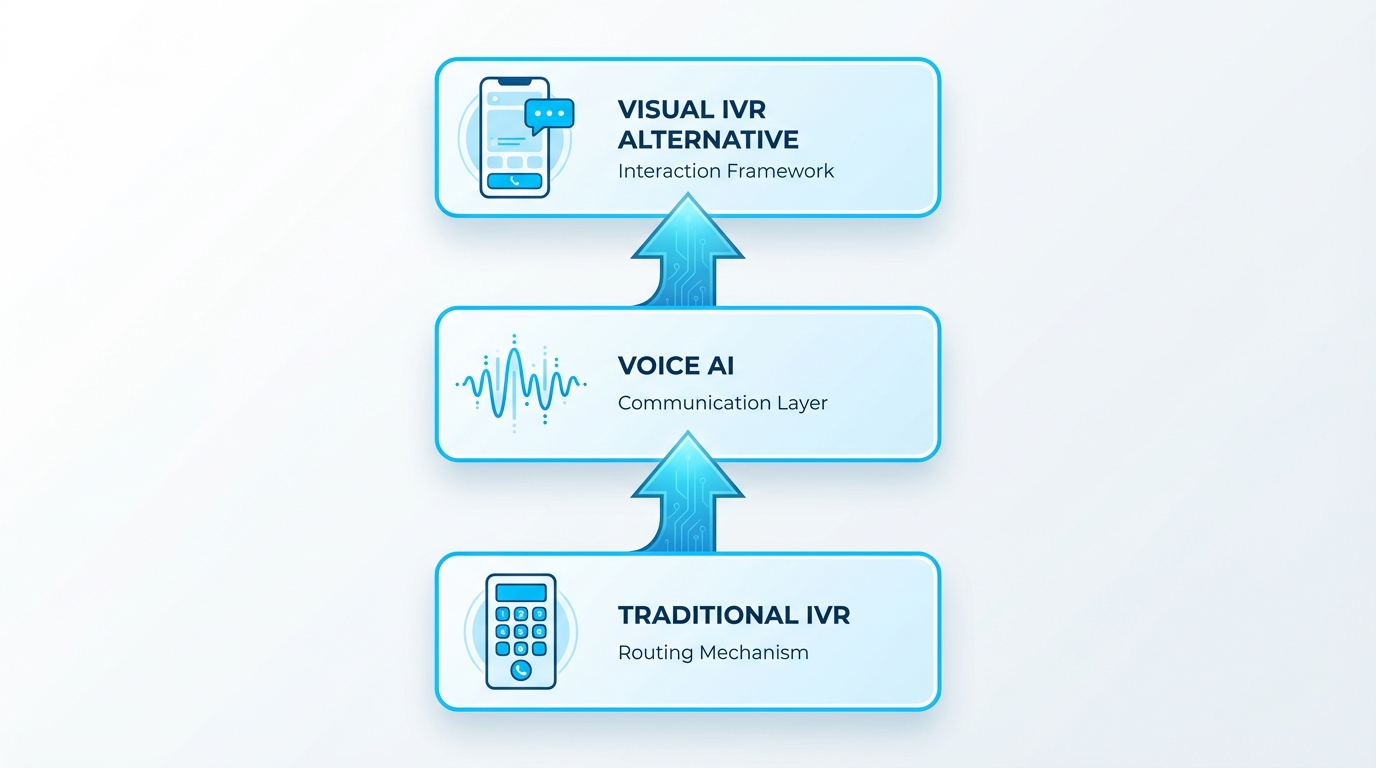
The “voice AI vs. IVR” debate frames the wrong question. It assumes both technologies occupy the same category and you are choosing between them. You are not. Traditional IVR is a routing mechanism. Voice AI is a communication layer. A visual IVR alternative is an interaction framework. The winning stack uses all three — in the right sequence.
Here is how it works in practice at enterprises running NewVoices: A caller dials in. Voice AI answers within three seconds — not a menu prompt, but a natural-language greeting. The caller says, “I need to refill my blood pressure medication.” The AI confirms identity through a phishing-resistant authentication flow — aligned with NIST SP 800-63 Digital Identity Guidelines — and simultaneously pushes a visual confirmation to the caller’s phone showing the medication, dosage, and pharmacy. The caller taps Confirm, and the refill is submitted. Total interaction time: 34 seconds. No human agent. No phone tree. No keypad presses.
Guaranteed Security Without Friction — The Authentication Model That Meets Every Compliance Standard
Security is where most visual IVR and voice AI deployments stumble. SMS one-time passwords — the default verification method — carry known interception risks that NIST has explicitly flagged as concerning. CISA Hybrid Identity Solutions Guidance goes further, warning against reliance on SMS OTP and certain biometric methods in high-risk authentication scenarios.
NewVoices handles this through a layered authentication model: voice AI initiates the interaction and captures intent, then pushes a visual challenge to the caller’s registered device — supporting phishing-resistant methods like FIDO2 tokens or app-based verification as recommended by CISA phishing-resistant MFA guidelines. The result is authentication that meets SOC 2 Type II, GDPR, and HIPAA requirements without forcing the caller to recite their mother’s maiden name.
| Auth Method | Security Level | Customer Friction | Compliance Alignment |
|---|---|---|---|
| Knowledge-Based (IVR) | Low — easily social-engineered | High — slow and error-prone | Fails NIST 800-63 IAL2+ |
| SMS OTP | Medium — interception risk | Medium — requires phone access | NIST-discouraged for high-risk |
| Visual Push + FIDO2 | High — phishing-resistant | Low — single tap | NIST/CISA recommended |
| Voice AI + Visual MFA (NewVoices) | High — multi-layered | Minimal — contextual and adaptive | SOC 2, GDPR, HIPAA aligned |
What Airlines Learned About Kiosks That Contact Centers Have Not Figured Out Yet
In 2001, airlines faced the same problem contact centers face today. Check-in counters were overwhelmed. Wait times averaged 45 minutes at peak hours. Customer satisfaction was cratering. The industry’s first instinct was to hire more agents. Then self-service kiosks appeared.
Within five years, kiosk adoption hit 83% at major carriers. Average check-in time dropped from 45 minutes to 90 seconds. Staffing at counters fell by 60% — but customer satisfaction rose, because the 40% of travelers who still needed a human got one faster and with better context. The kiosk did not replace agents. It triaged demand so precisely that agents could focus entirely on complex, high-value interactions.
Visual IVR is the kiosk moment for contact centers.
Your IVR today is the 2001 check-in counter — a single-channel, one-size-fits-all bottleneck that makes simple transactions painful and complex ones worse. A visual IVR alternative gives your customers the equivalent of a kiosk: instant, visual, self-directed resolution for routine requests — with a clear path to a human when the situation genuinely demands it.
Verified Case Study: Regional Bank Deployment
A regional bank deployed visual self-service for balance checks, transaction disputes, and card replacements — with voice AI escalation for loan modifications and fraud cases. Six months in: agent headcount stayed flat while call volume grew 22%. Cost per interaction dropped from $8.40 to $2.10. Net Promoter Score jumped from 31 to 54.
Want to see what that kind of result looks like with your call volumes? Hear a live AI call in seconds and run the numbers yourself.
Before and After: A Day in Your Contact Center’s Life — and the Transformation That Follows
Monday morning. 8:02 AM. Forty-three calls already queued. Your IVR greets each one with the same eight-option menu recorded in 2019. Caller one presses 4 for billing. Gets transferred. Explains the problem. Gets transferred again. Hangs up after 11 minutes. Caller two presses 0 immediately — bypassing every self-service option you built — because they learned six months ago that the IVR never actually solves anything. Caller three navigates to the right department but reaches a voicemail. Leaves a message. Never gets a callback.
Leads go cold. Patients miss refills. Subscribers cancel. Pipeline stalls.
Now picture the same Monday with a visual IVR alternative running on NewVoices:
Caller One
Sees a visual billing portal on their phone before the first ring finishes. They dispute a charge, upload a receipt photo, and receive a confirmation — all within 40 seconds. No agent. No wait.
Caller Two
Gets a voice AI agent that sounds like your best rep — warm, professional, conversational — and resolves their shipping question in under a minute, in Spanish, because NewVoices operates in 20+ languages without separate infrastructure.
Caller Three — at 6:47 AM
Reaches the AI two hours before your team clocks in. The AI books a callback for 9:15 AM with full context pre-loaded for the human agent. No voicemail. No missed opportunity. No lost customer.
While your competitors’ support centers close at 6 PM, your AI agent just processed a $12,000 subscription renewal at midnight. No shifts. No overtime. No burnout.
Quick Tip
The enterprises winning the revenue race right now are not hiring faster. They are deploying smarter. An enterprise sales team using NewVoices for growth booked 230% more qualified meetings within their first quarter — because every inbound lead received a personal, human-sounding call within three seconds of form submission, around the clock.
The Exclusive IVR Upgrade Playbook: How Enterprises Deploy in Weeks, Not Quarters
The number one objection to replacing IVR is complexity. “We have 200 routing rules.” “Our telephony stack is a decade old.” “Compliance will never approve anything that touches patient data.” These are real concerns. They are also solved problems. A multi-location dental group with 38 offices and a legacy Avaya PBX deployed NewVoices in 19 days — not months, days — with their operations director, not a developer, building all 14 patient interaction flows through the no-code Agent Studio.
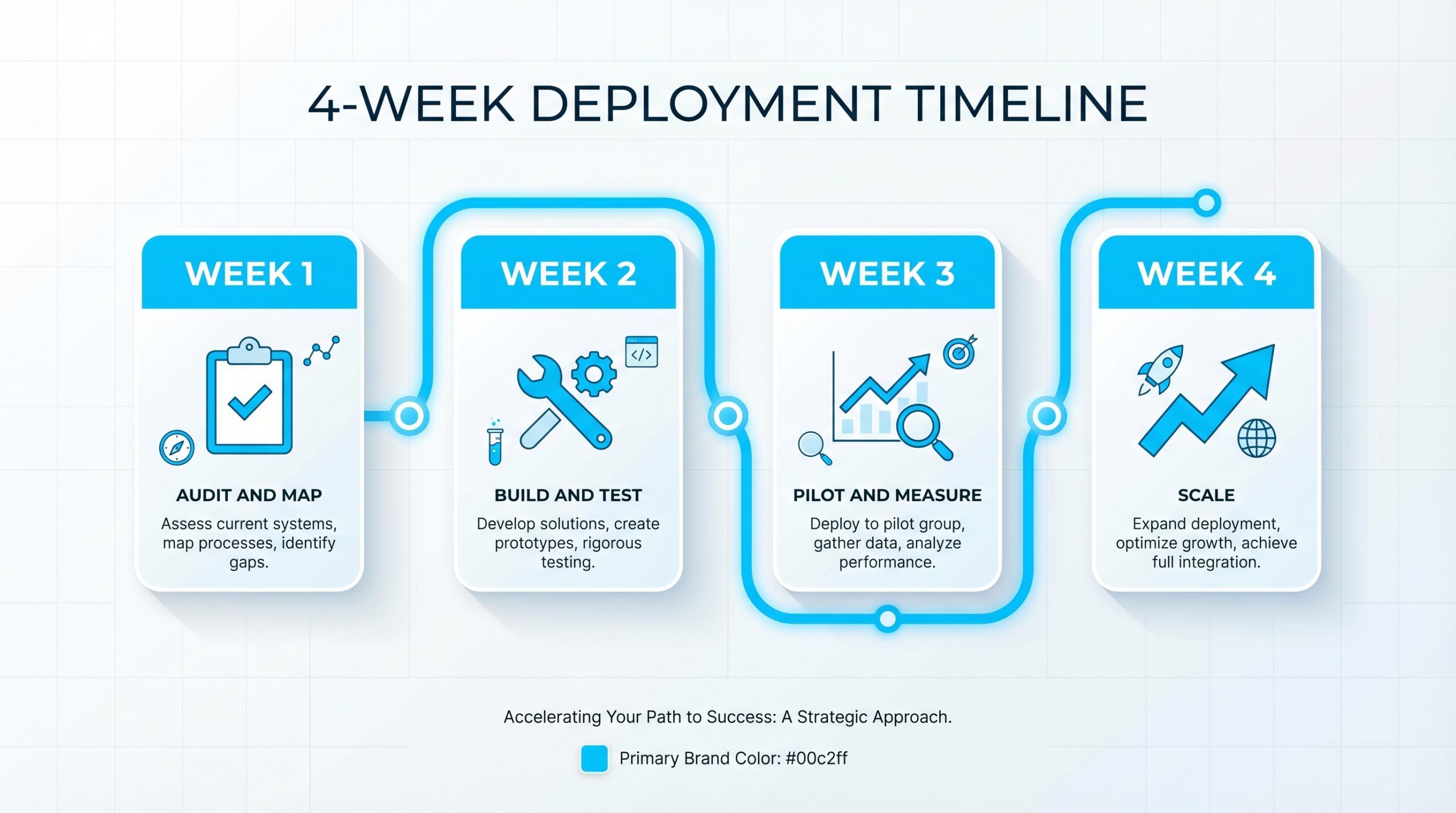
Here is the deployment sequence that guarantees results:
Week One: Audit and Map
Identify your top 10 call reasons by volume. For most enterprises, five of those ten are fully automatable — status checks, scheduling, payment processing, FAQs, and basic account changes. The remaining five need partial automation with intelligent escalation.
Week Two: Build and Test
Design visual flows and voice AI scripts in the Agent Studio. Run them against recorded call transcripts to validate accuracy. Adjust tone, pacing, and response logic based on real interaction data — not assumptions.
Week Three: Pilot and Measure
Route 20% of inbound traffic through the new system. Measure abandonment rate, self-service completion, escalation rate, and customer satisfaction against your IVR baseline. Every enterprise we have seen hits positive ROI within the pilot phase.
Week Four: Scale and Optimize
Expand to 100% of traffic. Monitor, iterate, and optimize. The visual flows and AI scripts are living assets — your team updates them in minutes as new patterns emerge. No engineering tickets. No waiting.
Limited availability: enterprise onboarding slots for Q3 are filling fast.
Join the 10,000+ contact center leaders who have already made the switch. Get your custom deployment blueprint — at no cost.
Why Better Than IVR Is the Wrong Bar — And the Breakthrough Benchmark That Actually Matters
Beating a traditional IVR system is easy. A voicemail box is better than a traditional IVR system. The real benchmark is not “better than IVR.” It is “better than your best human agent on their best day — at scale, at 3 AM, in Portuguese.” That is the bar NewVoices sets.
A SaaS company with 12 SDRs replaced 10 of them with NewVoices voice AI agents and kept two senior reps for complex enterprise negotiations. The AI agents handled initial outreach, qualification, objection handling, and meeting booking — in English, Spanish, French, and German. The result: 300% more meetings booked in Q1, 94% lead response rate up from 31%, and $1.8 million in new pipeline generated from after-hours inquiries that previously went unanswered.
The two remaining human reps closed at a higher rate because every meeting on their calendar was pre-qualified, contextualized, and warm. The AI did not replace their skill — it amplified it by removing everything that was not selling.
Quick Tip
The enterprise that scales fastest is the one that decoupled growth from headcount. Adding 10 human agents costs $450,000 to $700,000 annually in loaded compensation. Scaling NewVoices to handle 10x your current volume costs a fraction of one headcount — because the AI does not need a desk, benefits, management, or a two-week onboarding ramp.
| Capacity Strategy | Cost / 10,000 Calls Monthly | Response Time | Languages | Availability |
|---|---|---|---|---|
| Add 10 Human Agents | $52,000–$70,000/mo | 2–8 min avg. | 1–2 (hiring-dependent) | Business hours + OT |
| Upgrade IVR Routing | $15,000–$25,000/mo | 74–110 sec nav + queue | Limited by recordings | 24/7 but resolution-limited |
| Visual IVR + Voice AI (NewVoices) | $8,000–$14,000/mo | 3 seconds | 20+ languages | 24/7 full resolution |
The Security Question Nobody Asks Until It Is Too Late — And the Answer That Satisfies Every Auditor
Every enterprise evaluating an IVR replacement asks about uptime, integration, and cost. Almost none ask the question that will define regulatory survival over the next three years: how does this system authenticate callers without creating a new attack surface?
Traditional IVR authentication is a liability. “Please enter your date of birth followed by the pound sign” is not security — it is a social engineering invitation. Voice biometrics carry risks that CISA explicitly warns about in their Hybrid Identity Solutions Guidance. And SMS-based one-time passwords — the default for most visual IVR implementations — are classified as a restricted authenticator by NIST SP 800-63B due to SIM-swap and interception vulnerabilities.
NewVoices builds authentication into the interaction architecture itself. A fintech company processing $200 million in monthly transactions deployed NewVoices with this layered authentication model. Fraud attempts through the voice channel dropped 91% in the first quarter. Customer verification time fell from 48 seconds to 7 seconds. Security improved while friction disappeared. That is not a tradeoff. That is an upgrade.
Compliance Credentials — Industry-Leading Security Standards
SOC 2 Type II
Certified
HIPAA
Compliant
GDPR
Aligned
NIST 800-63
IAL2+ Ready
The Contact Center Five Years From Now — And the Enterprises Already Operating There Today
Five years from now, nobody will debate visual IVR vs. traditional IVR. The phone tree will be a museum exhibit next to the fax machine and the rotary dial. The question is not whether your enterprise will make this transition. It is whether you will lead it or be dragged into it after your competitors have already captured the customers you lost to hold music.
The convergence is already happening. Voice AI handles the conversation. Visual interfaces handle information density. Intelligent routing — real routing, based on AI-captured context rather than keypad guesses — handles the 20-30% of interactions that genuinely need a human. And the human agent, finally freed from password resets and order status checks, does what humans do best: build relationships, solve novel problems, and close complex deals.
The enterprises already operating this way are not waiting for the technology to mature. The technology is mature. NewVoices agents handle 90% of Tier-1 support tickets autonomously — in 20+ languages, across every time zone, with full CRM integration into Salesforce, HubSpot, Zendesk, and Stripe. The agents do not call in sick. They do not need coaching on tone. They do not lose patience with the fourth billing inquiry in a row.
Quick Tip
The math is settled. The deployment timeline is weeks, not quarters. The ROI is positive before the pilot ends. The only remaining variable is when you decide to stop bleeding revenue through a phone tree that your customers and your competitors have already moved past.
What Contact Center Leaders Are Saying
“We went from a 31% abandonment rate to under 9% in six weeks. The cost savings alone covered the entire year of NewVoices in the first quarter. I wish we had done this three years ago.”
VP of Operations, Regional Insurance Carrier
“Our NPS went from 31 to 54. Our agents are happier because every call they take is actually something they can help with. And the AI handles everything else better than our old IVR ever could.”
CX Director, Multi-Location Healthcare Network
Your IVR is bleeding revenue right now. The fix takes four weeks.
Join 10,000+ enterprise contact center leaders who replaced their phone trees with NewVoices — and never looked back. Positive ROI is guaranteed before your pilot ends.
Limited enterprise onboarding slots available this quarter. Act now to secure your deployment timeline.
No commitment required. No engineering resources needed. Positive ROI before your pilot ends — or we make it right.