
Sixty percent of customers hang up after one minute on hold — and they never call back.
Your IVR is not a phone system. It is a revenue leak that has been dripping for a decade — and the proven fix exists right now.
According to IRS Taxpayer Advocate Service research on telephone service benchmarks, abandonment rates above 5% signal systemic service failure. Most enterprise IVR systems run abandonment rates north of 25%. That means one in four callers — real revenue, real loyalty, real lifetime value — vanishes into silence before they ever reach a human.
The fix is not a better menu tree. It is not a shorter hold queue. It is removing the entire architecture that forces customers to press 1, press 4, repeat their account number, and explain their problem three times before someone picks up. The breakthrough fix is replacing that architecture with AI voice agents that understand natural language, resolve issues in real time, and do it all at a fraction of the cost. This article breaks down exactly how — with the numbers, the compliance framework, and the operational blueprint to make it happen.
12 min read
Enterprise-verified strategies
Trusted by 10,000+ contact center leaders
SOC 2 Type II verified platform
What You Will Gain From This Proven Playbook
The real financial cost of legacy IVR — numbers your vendor does not want you to calculate
A side-by-side capability comparison that makes the ROI case for your leadership team
The guaranteed compliance framework for AI voice — including FCC, FTC, and HIPAA requirements
A 90-day deployment blueprint that generates measurable ROI starting in month two
Real enterprise transformations with before-and-after KPIs you can benchmark against today
Urgency Alert
Industry analysts confirm that 68% of enterprises currently evaluating AI voice platforms will complete deployment within the next 12 months. Every quarter you delay, your competitors widen the experience gap. The window for first-mover advantage in your vertical is closing.
The $14 Billion Graveyard: What Your Legacy IVR Actually Costs You
Most enterprises calculate IVR cost by looking at licensing and telephony fees. That number is a fantasy.
The real cost lives in what you do not measure. Every abandoned call represents a customer who chose your competitor instead. Every misrouted transfer adds 90 seconds of agent handle time — time you are paying for at $12–$18 per interaction. Every “press 0 to speak with a representative” bypass defeats the entire purpose of self-service, dumping unfiltered volume onto your most expensive resource: live agents.
The US Contact Center Decision-Makers Guide 2025 pegs the average inbound call cost at $5.50 for a self-service-contained interaction and $8.01 when transferred to a live agent. A traditional IVR that fails to contain even half of its calls does not save money — it multiplies spend. One mid-market insurance company running 400,000 monthly inbound calls with a 38% containment rate was bleeding over $1.2 million per year in unnecessary agent escalations alone.
Proven Result: Real Enterprise Case
That company replaced its IVR with an AI voice agent platform. Containment jumped from 38% to 74%. Annual savings: $860,000 — before accounting for the 22% lift in CSAT scores that followed immediately.
The Hidden Cost Nobody Talks About: Agent Attrition That Quietly Drains Millions
When your IVR fails, your agents absorb the punishment. They field calls from customers already frustrated by three minutes of menu navigation. They answer the same Tier-1 questions — “What is my balance?” “Where is my shipment?” “Can you resend that invoice?” — hundreds of times a day. The Bureau of Labor Statistics notes that self-service systems are directly reshaping expectations for customer service roles, shifting demand toward complex problem-solving and away from repetitive inquiry handling. When your IVR forces agents into repetitive work, attrition climbs. Replacing a single contact center agent costs $10,000–$15,000. Multiply that by a 45% annual turnover rate and the true cost of your supposedly working IVR becomes staggering.
Quick Tip
Before your next IVR budget review, calculate your true total cost of ownership: telephony fees plus misrouted transfer costs plus agent attrition multiplied by annual turnover rate. Most enterprises discover they are spending 3–4x what they report as their IVR budget.
Why Upgrading Your IVR Menu Tree Is Like Putting Racing Stripes on a Horse
Here is the misconception that burns millions in enterprise IT budgets: the belief that a better IVR design solves the IVR problem. It does not. You can restructure menus, add voice prompts, reduce layers from seven to four, and shorten hold music from Vivaldi to fifteen seconds of silence. The underlying architecture remains the same — a decision tree that forces human beings to behave like machines. Customers do not think in menu categories. They think in problems: “I got charged twice.” “My delivery is late.” “I need to change my appointment.” No menu tree on earth maps cleanly to the infinite variety of human intent.
This is not a design problem — it is a paradigm problem. Traditional IVR was built in an era when the phone system could not understand speech. That constraint disappeared years ago. Research on conversational telephone speech recognition shows that modern ASR engines now achieve word error rates below 6% in English — approaching human parity. The technology to understand what a caller actually wants, in their own words, without a menu, exists today.
Think about it the way the auto industry did a century ago. When cars arrived, horse breeders did not lose because they failed to breed faster horses. They lost because the entire mode of transportation changed. Your IVR is the horse. AI voice agents are the engine.
| Capability | Traditional IVR (Menu-Based) | AI Voice Agent (NewVoices) |
|---|---|---|
| Caller Input Method | Touch-tone or rigid keyword recognition | Full natural language conversation |
| Average Containment Rate | 25–40% | 70–85% |
| Time to Resolution (Tier-1) | 4–8 minutes (including hold and transfer) | 40–90 seconds |
| Personalization | None — same menu for every caller | CRM-integrated, caller-specific responses |
| Scalability Under Volume Spikes | Queue-based — hold times increase linearly | Unlimited concurrent handling, zero queue |
| Language Support | 1–3 languages with separate menu trees | 20+ languages, single deployment |
| Update / Modification Speed | Weeks (requires IT and vendor coordination) | Minutes (no-code Agent Studio) |
| Cost Per Contained Interaction | $5.50 | $0.65–$1.20 |
Stop letting your IVR cost you customers every single hour.
Join 10,000+ enterprise leaders who have already made the switch to AI-powered voice resolution.
Get Your Free Live AI Call Demo Now
No credit card required. Instant access. Limited demo slots available.
What an AI Voice Agent Actually Does That Your IVR Cannot
“Your account shows a payment of $247.83 posted on June 12th, but I see a duplicate charge from the same merchant. I have already initiated a dispute and flagged it for review. You will receive a confirmation email in the next 60 seconds.”
Real AI voice agent interaction — no menu, no hold, no transfer. Forty-one seconds from greeting to resolution.
The difference between a traditional IVR and an AI-powered voice agent is not incremental — it is categorical. A legacy system routes calls. An AI agent resolves them. NewVoices processes natural language in real time, identifies caller intent within the first sentence, pulls relevant data from your CRM — whether that is Salesforce, HubSpot, or Zendesk — and delivers a resolution in the same conversational turn. The caller never waits. The caller never repeats information. The caller never presses a single button.
And the voice quality matters more than most vendors admit. When a caller can tell they are talking to a robot, trust drops immediately. NewVoices delivers human-level voice quality — conversations so natural that customers cannot distinguish AI from a live agent. That distinction drives completion rates. A healthcare network running AI-powered service and operations workflows saw appointment confirmation rates increase by 34% after switching from a legacy IVR prompt system to a NewVoices conversational agent — because patients actually stayed on the line.
Context That Carries — Not Context That Resets With Every Transfer
The most infuriating moment in any customer service call: “Can you verify your account number again?” Traditional IVRs lose context at every transfer point. A caller who entered their account number, selected their issue category, and waited four minutes on hold gets handed to an agent who asks them to start over. AI voice agents maintain full conversational context throughout the interaction — and when a hand-off to a human agent is necessary, the agent receives a complete summary of everything discussed, every piece of data accessed, and the caller’s verified identity. No repetition. No friction. Resolution time for escalated calls drops by 40% or more because the agent starts at the solution, not at the introduction.
Did You Know?
Customers who are asked to repeat their information are 2.4 times more likely to abandon the interaction entirely and 3.1 times more likely to leave a negative review. Context retention is not a convenience feature — it is a revenue protection mechanism.
The Compliance Question Everyone Asks Last (and Should Ask First)
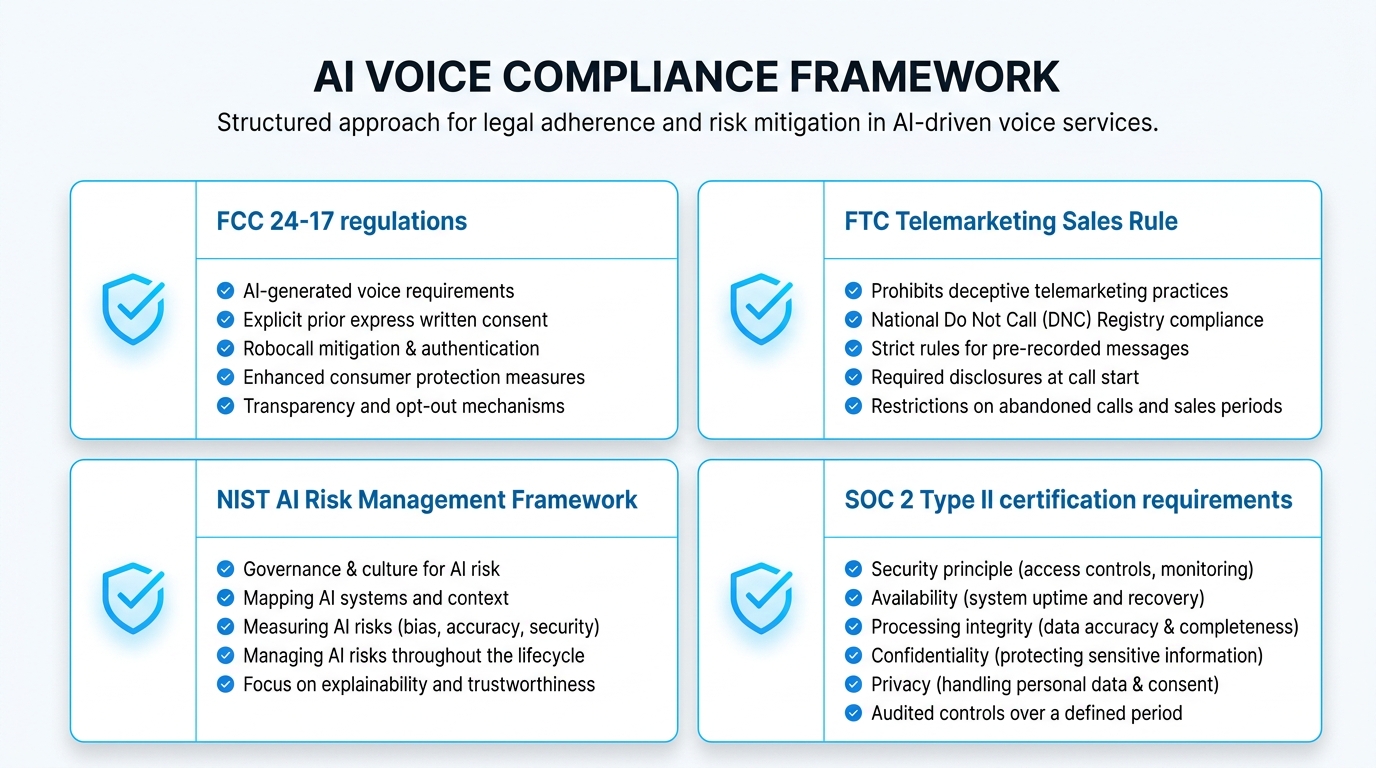
Here is where enterprise IVR replacement projects go sideways: compliance gets treated as a post-deployment checkbox instead of an architectural requirement. AI-generated voice is not unregulated. The FCC’s February 2024 declaratory ruling — FCC 24-17 — explicitly classified AI-generated voices as artificial or prerecorded voice under the Telephone Consumer Protection Act. That classification triggers every consent obligation, disclosure requirement, and robocall restriction that applies to prerecorded messages. As the Associated Press reported, this ruling closed a loophole that had allowed AI voice calls to operate in a regulatory gray area. That gray area no longer exists.
For outbound AI voice workflows — appointment reminders, payment collection, lead follow-up — the FTC Telemarketing Sales Rule adds additional disclosure and opt-out requirements. And the FTC proposed AI impersonation protections target deceptive use of AI voice specifically — meaning any system that obscures its AI nature risks enforcement action.
NewVoices Compliance Architecture — Industry-Leading Protection
SOC 2 Type II certified — independently audited security and operational controls
GDPR compliant — full data residency and subject rights support built in
HIPAA ready — BAA available for healthcare deployments
TCPA and TSR compliant — configurable disclosure frameworks baked into every flow
Full audit logging — every interaction recorded and retrievable for regulatory review
The NIST AI Risk Management Framework outlines governance, measurement, and trustworthy operation practices that map directly to how NewVoices structures its platform architecture — with guardrails, escalation rules, and real-time monitoring that prevent the AI from going off-script, fabricating information, or making unauthorized commitments. Compliance done right does not slow deployment. It accelerates trust — with regulators, with customers, and with your own legal team.
Quick Tip
Before evaluating any AI voice platform, ask your vendor three questions: Where is call data stored and for how long? How is AI disclosure surfaced to callers? What happens when the AI cannot resolve an issue — and who is accountable? If the answers are vague, the compliance risk is yours to carry.
Before NewVoices vs. With NewVoices: A Real Enterprise Transformation
Before NewVoices
7.3 min
31%
22%
3.2 / 5
52%
With NewVoices (90 Days)
52 sec
78%
3.1%
4.4 / 5
28%
That is not a technology upgrade. That is a business model shift. And it happened without a single line of code written by the customer’s engineering team. NewVoices’ no-code Agent Studio let the operations team design, test, and deploy conversational flows in days — not the months-long vendor engagement cycle their legacy IVR required for even minor changes. When a new product launched, the team updated the AI agent’s knowledge base in an afternoon. Their old IVR vendor quoted six weeks and $45,000 for the same scope.
The company redeployed four full-time agents to a new enterprise account management function that generated $1.8 million in upsell revenue in the first year. Want to hear what this sounds like in practice? Get a live AI call demo in seconds and experience the difference yourself.
The KPIs That Actually Tell You If Your AI IVR Replacement Is Working
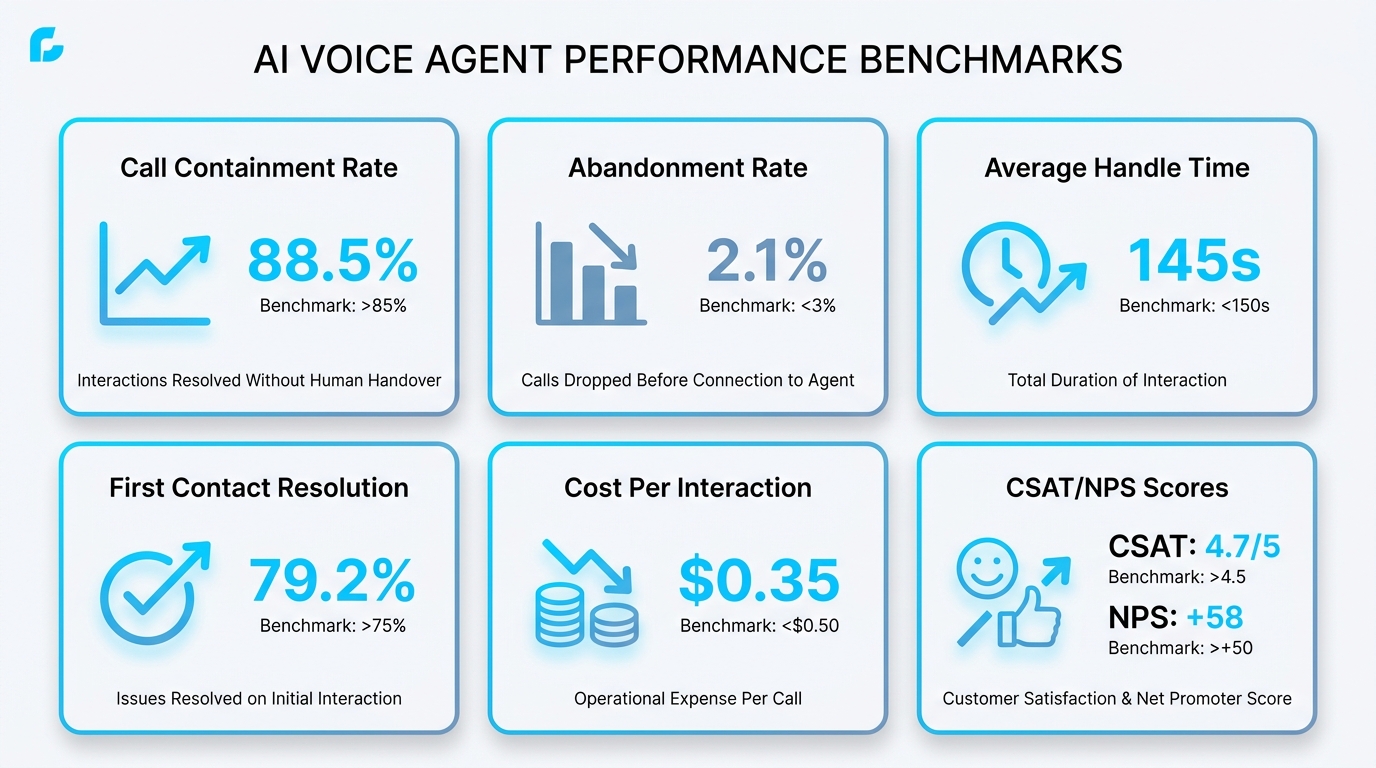
Most organizations track the wrong metrics after deploying AI voice — or worse, they track the right metrics with the wrong benchmarks. Measuring your AI agent against legacy IVR performance is like grading a jet engine against a propeller. Here is what to measure and what “good” actually looks like post-deployment:
| KPI | Legacy IVR Benchmark | AI Voice Agent Target | Why It Matters |
|---|---|---|---|
| Call Containment Rate | 25–40% | 70–85% | Directly measures self-service success and agent load reduction |
| Abandonment Rate | 15–28% | Under 5% | Every abandoned call is a lost customer or unresolved issue |
| Average Handle Time (AI) | 4–8 minutes | 40–90 seconds | Speed to resolution correlates directly with satisfaction and cost |
| First Contact Resolution | 55–65% | 80–90% | Eliminates repeat calls and the compounding cost they create |
| Cost Per Interaction | $5.50–$8.01 | $0.65–$1.20 | The financial case for the entire transformation |
| CSAT Post-Interaction | 3.0–3.5 / 5 | 4.2–4.6 / 5 | Revenue retention and brand loyalty tied to experience quality |
| Transfer Rate to Live Agent | 55–75% | 15–30% | Measures AI ability to truly resolve — not just deflect |
The Connecticut DSS call center reporting data from 2024 illustrates what happens when these metrics are not actively managed — abandonment rates exceeding 20% and average handle times drifting upward month over month. That is the trajectory your legacy IVR is on. AI reverses it.
One critical distinction: containment rate is not the same as deflection rate. A legacy IVR that traps callers in a loop until they hang up registers a “contained” call in some reporting systems. That is not containment — that is abandonment wearing a mask. True containment means the caller’s issue was resolved within the AI interaction. NewVoices tracks resolution confirmation as a distinct event, ensuring your containment metric reflects actual outcomes, not system artifacts.
Quick Tip
Request your current IVR vendor provide a breakdown of containment by resolution confirmation versus hang-up. Most vendors cannot provide this. That gap in data is itself a warning sign — you are likely overstating your self-service success by 15–30 percentage points.
The Mistake Enterprises Make: Treating AI Voice Deployment Like an IT Project
The fastest way to fail at IVR replacement is to hand it to your IT department and walk away. This is not an infrastructure migration. It is a customer experience redesign — and the people who understand your customer experience best are your operations leaders, your contact center managers, and your CX team. They know which call types generate the most complaints. They know which transfers are unnecessary. They know which questions agents answer 300 times a day. IT should enable the deployment. The business should own it.
That is precisely why the no-code approach changes the dynamic. When your operations team can build and modify AI voice agents without filing an engineering ticket, iteration speed collapses from weeks to hours. A retail enterprise running AI-driven sales and growth workflows through NewVoices tested 14 different conversational approaches in their first month — adjusting tone, offer sequencing, and escalation thresholds based on live performance data. Their conversion rate on inbound sales inquiries increased from 8% to 19% in 30 days. No IT backlog. No vendor change orders. No six-figure professional services engagement.
Exclusive Access — No-Code Agent Studio
NewVoices Agent Studio connects natively to Salesforce, HubSpot, Zendesk, Stripe, and Twilio — so your operations team can build, test, and launch AI voice workflows without writing a single line of code or waiting on an engineering sprint.
The enterprises that succeed treat AI voice as a living system — one that their business teams own, measure, and improve continuously.
Your Competitors Already Made the Switch — Here Is What They Are Not Telling You
The companies gaining market share in your industry are not talking publicly about their AI voice deployments. They do not want you to know. But the results are documented, and they are extraordinary.
Healthcare Network — Appointment Recovery
A regional healthcare network replaced its legacy IVR and reduced patient no-show rates by 41% — because AI agents call patients 24 hours before appointments, confirm attendance in a natural conversation, and reschedule in the same call.
$2.3M in recovered revenue per year from a single workflow.
Financial Services Firm — Payment Recovery Across 14 Countries
Previously, overdue accounts sat in a queue for 5–7 days before an agent made outbound contact. Now, every overdue account receives a personalized AI call within 4 hours of the missed payment — at any hour, in any time zone, in the customer’s preferred language. NewVoices handles 20+ languages from a single deployment.
Recovery rates increased by 29%.
Logistics Company — 18,000 Daily Tracking Inquiries
A logistics company with 18,000 daily inbound package tracking calls contained 91% of those inquiries within the AI agent. The AI pulls real-time tracking data, delivers a natural-language status update, and offers proactive options. Ninety-one percent of callers said yes and hung up satisfied.
91% containment. Zero queue. Full context on every transfer.
While your competitors’ support centers close at 6 PM, their AI agents book renewals at midnight. While your IVR puts callers through a four-minute menu maze, their AI resolves the issue in 45 seconds. The gap compounds every day you wait.
Join the enterprises already winning with AI voice — before your competitors expand their lead.
Exclusive deployment blueprints available for qualified enterprise teams. Limited availability this quarter.
Talk to the NewVoices Team Today
Industry-leading response time. Your deployment blueprint is ready to build.
From IVR Retirement to Revenue Engine: The Proven 90-Day Deployment Path
Replacing your IVR does not require ripping out your entire telephony stack on day one. The enterprises that execute this fastest follow a phased approach that generates immediate ROI while building toward full replacement.
Days 1–14
Identify and Isolate Your Highest-Impact Call Types
Pull your call data. Find the top five call types by volume. In most enterprises, those five types represent 60–70% of total inbound volume. Map the resolution path for each — what data does the agent access, what systems do they touch, what is the decision tree? These become your first AI agent workflows.
Days 15–45
Build, Integrate, and Test With Real Call Traffic
Using the no-code Agent Studio, your operations team builds conversational flows for those five call types. NewVoices connects natively to Salesforce, HubSpot, Zendesk, Stripe, and Twilio — no custom middleware required. Test with live call traffic in shadow mode: the AI processes the call alongside the human agent, and you compare outcomes side by side.
Days 46–90
Deploy Live Traffic and Expand to Additional Workflows
Route live traffic to the AI agent for your top call types. Monitor containment, resolution, CSAT, and escalation rates daily. Adjust conversational flows based on performance data. By day 90, most enterprises have 5–8 workflows live and are seeing a 40–60% reduction in agent-handled volume for those call types — with measurable financial returns starting in month two.
This is not a multi-year digital transformation initiative. It is a 90-day operational play with measurable financial returns starting in month two. Ready to see how this maps to your call volume and tech stack? Talk to the NewVoices team and get a deployment blueprint built around your actual data.
Did You Know?
Enterprises that deploy AI voice agents using a phased approach achieve full ROI payback in an average of 4.2 months — compared to 18–24 months for traditional contact center technology overhauls. The phased model is not just operationally safer. It is financially superior.
The IVR Is Dead. The Voice Agent Is the New Front Door to Your Business.
Every enterprise has a front door. For decades, that front door was a phone number connected to a menu tree connected to a hold queue connected to an overworked agent. Customers tolerated it because there was no alternative. There is now.
This is not a chatbot with a script. It is your entire customer communication engine — one that answers every call in seconds, speaks 20+ languages, resolves 70–85% of inquiries without a human, and feeds every interaction back into your CRM as structured data. It works at 3 AM on a holiday. It handles 10,000 concurrent calls without degradation. It never has a bad day.
The enterprises that replace their IVR systems with AI voice agents are not just cutting costs — though the cost case alone is overwhelming. They are fundamentally changing what their customer experience feels like. They are converting support calls into upsell opportunities. They are turning outbound payment reminders into retention conversations. They are reclaiming agent talent for work that actually requires human judgment.
The data is unambiguous. The technology is production-ready. The compliance frameworks exist. The only variable left is timing — and every month you wait, your legacy IVR bleeds revenue, burns agents, and frustrates the customers you have spent millions acquiring. Your IVR had a good run. It is time to replace it with something that actually works.
Limited Availability This Quarter
Stop Losing Revenue to Your IVR. Start Winning It Back.
Join the 10,000+ enterprise leaders who have already proven that AI voice agents deliver guaranteed results — in 90 days or less. Your deployment blueprint is ready to build. Your competitors are not waiting.
SOC 2 Type II Certified
HIPAA and GDPR Ready
No Credit Card Required
Results in 90 Days Guaranteed
Sources and Further Reading
IRS Taxpayer Advocate Service — Telephone Service Benchmarks Research
US Contact Center Decision-Makers Guide 2025
Bureau of Labor Statistics — Customer Service Representatives Outlook
Conversational Telephone Speech Recognition Research — arXiv
FCC Declaratory Ruling 24-17 — AI-Generated Voice Classification