
Seventy-eight percent of customers hang up on traditional IVR systems before ever reaching a human. That’s not a dropped call problem — that’s a revenue hemorrhage disguised as a phone system. Every abandoned call represents a lost sale, a churned account, and a one-star review waiting to happen.
Updated January 2025
Trusted by 10,000+ Enterprise Teams
What You’ll Discover in This Breakthrough Guide
Why your current IVR costs you $8.50+ per interaction (and how to cut it to under $1.20)
The proven 90-day transformation that drops abandonment rates from 38% to 7%
Compliance secrets that protect you from seven-figure HIPAA and GDPR fines
Real ROI benchmarks showing payback periods under 90 days
Here’s the uncomfortable truth nobody in your organization wants to acknowledge: each abandoned call isn’t just a missed interaction. It’s a lost sale, a churned account, a support ticket that metastasizes into a one-star review. Legacy IVR — the kind that forces callers through six layers of “press 3 for billing” — was designed in the 1990s for a world where customers had no alternatives. They have alternatives now. And they’re using them.
AI IVR isn’t an upgrade to that broken system. It’s a complete replacement. A fundamental architectural shift from rigid touch-tone menus to real-time, natural language conversations that resolve issues in seconds — not minutes, not “please hold.” This is the proven technology that separates companies still losing 40% of inbound callers from companies converting 90% of them into measurable outcomes.
Your IVR Isn’t Saving Money — It’s Hemorrhaging Revenue
The original promise of IVR was cost reduction. Route calls automatically. Deflect volume from agents. Cut headcount. And for decades, CFOs nodded along — because the cost savings showed up on spreadsheets while the revenue losses hid in abandonment rates nobody tracked.
Traditional IVR systems deflect calls, yes. But they also deflect customers. A rigid menu tree that forces a caller to listen to nine options before reaching the right department adds 2–4 minutes of friction to every interaction. Multiply that across 10,000 monthly calls and you’ve built a system that wastes 400+ hours of customer time per month. That’s not efficiency. That’s a churn engine operating at full capacity.
QUICK TIP
Calculate your true IVR cost by multiplying average handle time by hourly fully-loaded agent cost, then add the revenue value of abandoned calls. Most companies discover their “cost-saving” IVR actually costs 3-5x what they estimated.
AI IVR flips the equation entirely. Instead of asking callers to decode your internal org chart (“press 4 for accounts receivable”), it asks one simple question: “How can I help you?” The caller speaks naturally — “I need to update my payment method” — and the system routes, resolves, or escalates in under 15 seconds. NewVoices deploys this exact flow for enterprises processing 50,000+ calls monthly, cutting average handle time from 6.2 minutes to 47 seconds on Tier-1 requests.
The financial math changes completely when your IVR stops being a wall and starts being a closer. A mid-market insurance company running NewVoices’ AI IVR saw policy renewal completions increase by 34% in one quarter — because callers who previously abandoned at the menu tree now completed transactions in a single conversational exchange.
The “Good Enough” Myth: Why Speech Recognition Accuracy Is a Lie Detector for AI IVR Vendors
Every AI IVR vendor claims “high accuracy.” Most of them are measuring it under ideal conditions — studio-quiet environments, native English speakers, scripted phrases. The real world sounds nothing like that.
Callers phone in from cars, construction sites, hospital waiting rooms. They mumble. They code-switch between languages mid-sentence. They speak with regional accents that a model trained on broadcast English has never encountered. Research from MITRE demonstrates that automatic speech recognition accuracy degrades significantly with audio quality, using Word Error Rate (WER) as the definitive evaluation metric. An AI IVR system that scores 95% WER in a lab can plummet to 70% on a cell phone call from a crowded airport — and 70% accuracy means your system misunderstands nearly one in three words.
DID YOU KNOW?
A 25% Word Error Rate means your AI misunderstands every fourth word. In a typical customer service interaction of 40 words, that’s 10 misinterpretations — enough to completely derail resolution and force a costly transfer to human agents.
This is where the gap between AI IVR vendors becomes a canyon. NewVoices processes voice input through multi-layered NLP that doesn’t just transcribe — it interprets. Context from CRM records, previous interactions, and real-time sentiment analysis fills gaps that raw transcription misses. When a returning caller says “same thing as last time,” the system knows what “last time” was. It pulls the prior ticket, confirms the issue, and resolves it — no repetition, no frustration, no transfer.
What Vendors Don’t Want You to Test
Before signing any AI IVR contract, run this test: call the demo line from a noisy environment, speak in a natural — not rehearsed — sentence, and include an unusual request. If the system asks you to repeat yourself more than once, the accuracy claims on the sales deck are fiction. NewVoices publishes live accuracy benchmarks across 20+ languages precisely because the numbers hold under real-world conditions, not just controlled demos.
See the Difference for Yourself — No Sales Pitch Required
Experience a live AI call in seconds and hear what enterprise-grade voice AI actually sounds like
No credit card required. No commitment. Just results.
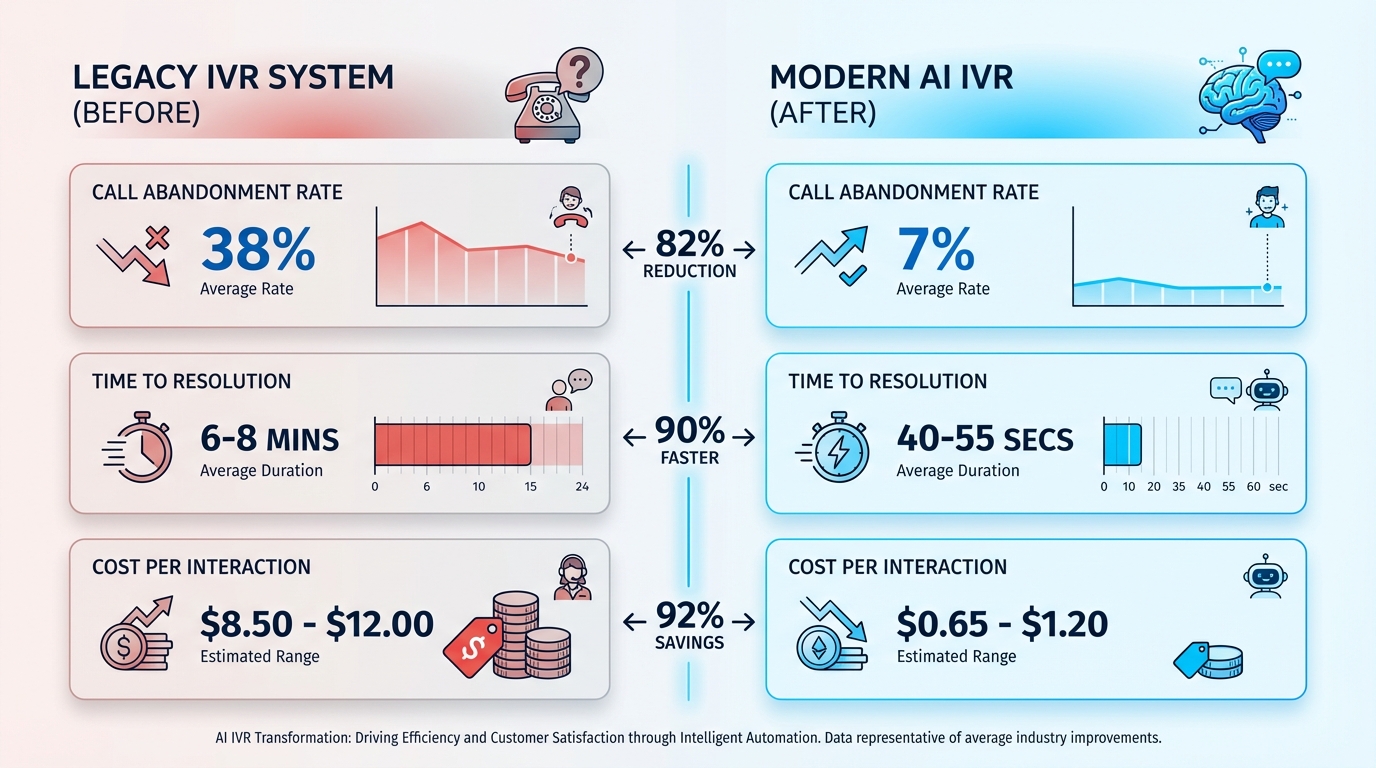
Before AI IVR vs. After: The Proven 90-Day Transformation
The contrast is stark and measurable. Here’s what enterprises look like on both sides of an AI IVR deployment.
Those numbers come from a real deployment. A regional healthcare network with 14 clinics replaced its legacy IVR with NewVoices in March 2024. Within 90 days, appointment no-shows dropped 22% because the AI IVR proactively confirmed and rescheduled appointments via natural voice conversations — something their old system couldn’t accomplish without human agent involvement.
QUICK TIP
The “after” state isn’t incremental improvement — it’s categorical transformation. When every inbound call gets answered in under three seconds at 2 AM on Saturday, in Spanish, with full CRM context, your entire customer relationship changes.
Leads go cold. Reps burn out. Patients miss appointments. Billing calls go to voicemail. That’s the “before” state — and most companies have normalized it because they’ve never experienced the alternative. While your competitors’ support centers close at 6 PM, your AI agent just handled a $12,000 billing dispute at midnight and saved the account.
The Hotel Concierge Problem: Why Most AI IVRs Fail at What Matters Most
Think about the best hotel concierge you’ve ever encountered. They didn’t hand you a laminated sheet of restaurant options. They asked what you were in the mood for, remembered you mentioned a shellfish allergy at check-in, factored in the rain outside, and made a reservation at a place two blocks away — all in 30 seconds.
That’s contextual intelligence. And it’s the single capability that separates an AI IVR worth deploying from one that’s just a fancier menu tree.
Most AI IVR systems treat each call as a blank slate. Caller ID matches an account number, and that’s the extent of “personalization.” But a caller who paid their invoice yesterday and is calling again today isn’t calling about billing — they’re calling about something new. A caller who escalated to a supervisor last week and is calling back shouldn’t hear “How can I help you?” — they should hear “I see we were working on resolving your shipping issue. Has it been taken care of?”
DID YOU KNOW?
Customers who receive personalized, context-aware service are 3.5x more likely to make additional purchases and 4x more likely to recommend your company to others, according to enterprise customer experience research.
NewVoices connects directly to Salesforce, HubSpot, Zendesk, and Stripe — not through clunky middleware, but through native CRM integrations that pull real-time customer data into every conversation. The AI agent knows the caller’s purchase history, open tickets, lifetime value, and risk score before the first syllable is spoken. That’s not a chatbot with a script. It’s a concierge that remembers everything and never takes a day off.
Compliance Isn’t a Feature — It’s Why Half These Deployments Fail
Here’s the conversation AI IVR vendors actively avoid: what happens to the voice data after the call ends?
Every AI IVR interaction generates a recording, a transcript, sentiment metadata, and potentially sensitive customer information — credit card numbers, Social Security digits, medical details. In regulated industries, mishandling any of that data triggers consequences that make the cost savings irrelevant.
GDPR mandates data minimization, storage limitation, and specific security obligations under Article 32 — meaning an AI IVR deployed in the EU must collect only what’s necessary, delete it on schedule, and protect it with demonstrably adequate technical measures. The HHS Office for Civil Rights provides detailed guidance on securing electronic protected health information (ePHI) under HIPAA, including encryption requirements that apply directly to voice transcripts containing patient data.
COMPLIANCE WARNING
A telehealth provider that deploys an AI IVR handling appointment scheduling — where callers state symptoms, medications, and insurance IDs aloud — is creating ePHI with every call. Without proper encryption and access controls, that provider is one audit away from a seven-figure fine.
The Security Stack That Regulated Industries Require
NewVoices holds SOC 2 Type II certification and builds compliance into the infrastructure layer — not as an add-on module you pay extra for. Explore NewVoices’ security architecture for voice AI to see how encryption, access controls, and audit logging work across every deployment.
NIST’s AI Risk Management Framework (AI RMF 1.0) provides a structured approach to identifying and managing risks across the AI lifecycle — from development through production monitoring. For enterprises deploying AI IVR at scale, this framework maps directly to the governance, testing, and ongoing monitoring requirements that separate compliant deployments from liability exposure.
The $4.7 Million Mistake: Deploying AI IVR Without CRM Integration
A Fortune 500 retailer deployed an AI IVR system in 2023. The technology was sophisticated — excellent speech recognition, natural-sounding voice synthesis, fast response times. Within six months, customer complaints increased by 18%.
The problem wasn’t the AI. It was isolation. The IVR operated in a silo — disconnected from the company’s CRM, order management system, and returns platform. So when a customer called about a delayed shipment, the AI IVR could understand the question perfectly but couldn’t access the tracking information to answer it. Every call that required account-specific data got transferred to a human agent anyway. The company spent $4.7 million on a system that functioned as a very expensive call router.
QUICK TIP
Before any AI IVR deployment, map every common call type to the data source required to resolve it. If your vendor can’t demonstrate native integration with those sources, you’re buying an expensive routing system, not a resolution engine.
NewVoices eliminates this failure mode by design. Native integrations with Salesforce, HubSpot, Zendesk, Stripe, and Twilio mean the AI agent accesses customer data in real time — order status, payment history, open tickets, subscription tier — and acts on it within the conversation. No transfers. No “let me look that up.” The caller says “Where’s my order?” and the AI responds with the tracking number, estimated delivery date, and an option to redirect the package — all within 12 seconds.
Why Faster Response Time Alone Won’t Fix Your Customer Service
Speed is necessary. Speed alone is insufficient.
The industry obsession with response time metrics has created a generation of AI IVR systems that answer fast but resolve nothing. A system that picks up in two seconds and then misroutes the caller, asks for redundant information, or delivers a canned answer to the wrong question hasn’t improved the experience — it’s just failed faster.
Resolution rate is the metric that matters. Specifically: first-call resolution rate for AI-handled interactions without human escalation. NewVoices tracks this obsessively. Across enterprise deployments, the platform resolves 74% of inbound calls without any human involvement — not by deflecting callers to a FAQ page, but by completing transactions, updating records, scheduling appointments, and processing payments inside the conversation.
PROVEN RESULTS
A SaaS company with 8,000 monthly support calls deployed NewVoices and measured specific outcomes: the AI IVR resolved 6,120 calls autonomously. The remaining 1,880 escalated with full context — dropping agent handle time from 11 minutes to 4.5 minutes. Total cost per resolution fell 62%.
Speed gets the caller’s attention. Resolution earns their loyalty. The AI IVR systems worth deploying deliver both — and they prove it with data, not promises. See how NewVoices drives resolution rates across service and operations for enterprises processing high call volumes.
Limited Availability
Join 10,000+ Enterprise Teams Already Using NewVoices
Only 12 implementation slots remaining this quarter for new enterprise deployments
Industry-Specific Deployments: Where AI IVR Creates Asymmetric Advantage
AI IVR isn’t a horizontal product that works identically across sectors. The deployment that transforms a financial services firm looks nothing like the one that transforms a healthcare network. The difference lies in the data flows, compliance requirements, and conversation patterns unique to each industry.
Financial Services
A regional bank deployed NewVoices to handle account balance inquiries, transaction disputes, and fraud reporting. The AI agent authenticates callers through voice biometrics and knowledge-based verification in under 20 seconds — compared to 90+ seconds with their previous system. Fraud reports that previously required a 12-minute agent interaction now complete in 3 minutes, with automatic case creation in the bank’s fraud management platform. Monthly call volume handled without human agents: 83%.
Healthcare
Appointment scheduling, prescription refill requests, and insurance eligibility checks consume 60%+ of inbound call volume at most provider networks. NewVoices handles all three — in the patient’s preferred language, with HIPAA-compliant data handling at every step. A multi-location dental practice reduced no-show rates by 28% through AI-driven appointment confirmation calls that offered one-tap rescheduling. The system operates in English and Spanish with identical accuracy, serving a bilingual patient population without separate infrastructure.
Telecommunications
Technical support calls are the most expensive interactions in telecom — averaging $14.50 per call when handled by agents. A regional ISP deployed NewVoices to triage connectivity issues. The AI IVR walks callers through diagnostic steps, detects outage zones from CRM data, and either resolves the issue conversationally or pre-populates a technician dispatch ticket. Sixty-one percent of technical support calls now resolve without human escalation. Annual savings: $2.3 million.
DID YOU KNOW?
The GSA’s Office of Evaluation Sciences demonstrated that even modest changes to IVR messaging reduced call abandonment in government crisis services — proving that IVR design directly impacts whether citizens receive the help they need.
Building an AI IVR That Lasts: Architecture Decisions for Year Two Success
Month one of an AI IVR deployment is easy. The vendor runs a pilot. Metrics look great. Everyone celebrates.
Month fourteen is where most deployments stall. Call patterns shift. New products launch. Customer expectations evolve. And the AI IVR — configured once during implementation and never meaningfully updated — starts delivering stale responses to new questions. Resolution rates drop. Escalation rates climb. The C-suite starts asking whether the investment was worth it.
QUICK TIP
The AI IVR systems that deliver compounding value share three traits: continuous learning from interaction data, no-code conversation design for business teams, and rapid integration of new data sources without vendor dependency.
NewVoices built its Agent Studio as a no-code platform specifically to solve the Year Two problem. Business teams — not developers — design, test, and deploy conversation updates in hours. When a financial services client launched a new credit card product, their operations team added the entire product FAQ, eligibility logic, and application flow to the AI IVR in a single afternoon. No code. No vendor dependency. No waiting.
This isn’t a chatbot builder with a visual interface. It’s an enterprise-grade design environment where compliance rules, escalation logic, CRM field mappings, and multilingual responses are configured in parallel — and deployed to production with version control, rollback capability, and A/B testing built in. Explore the NewVoices platform architecture to see how Agent Studio works at enterprise scale.
The Real Benchmark: What AI IVR Costs vs. What It Returns
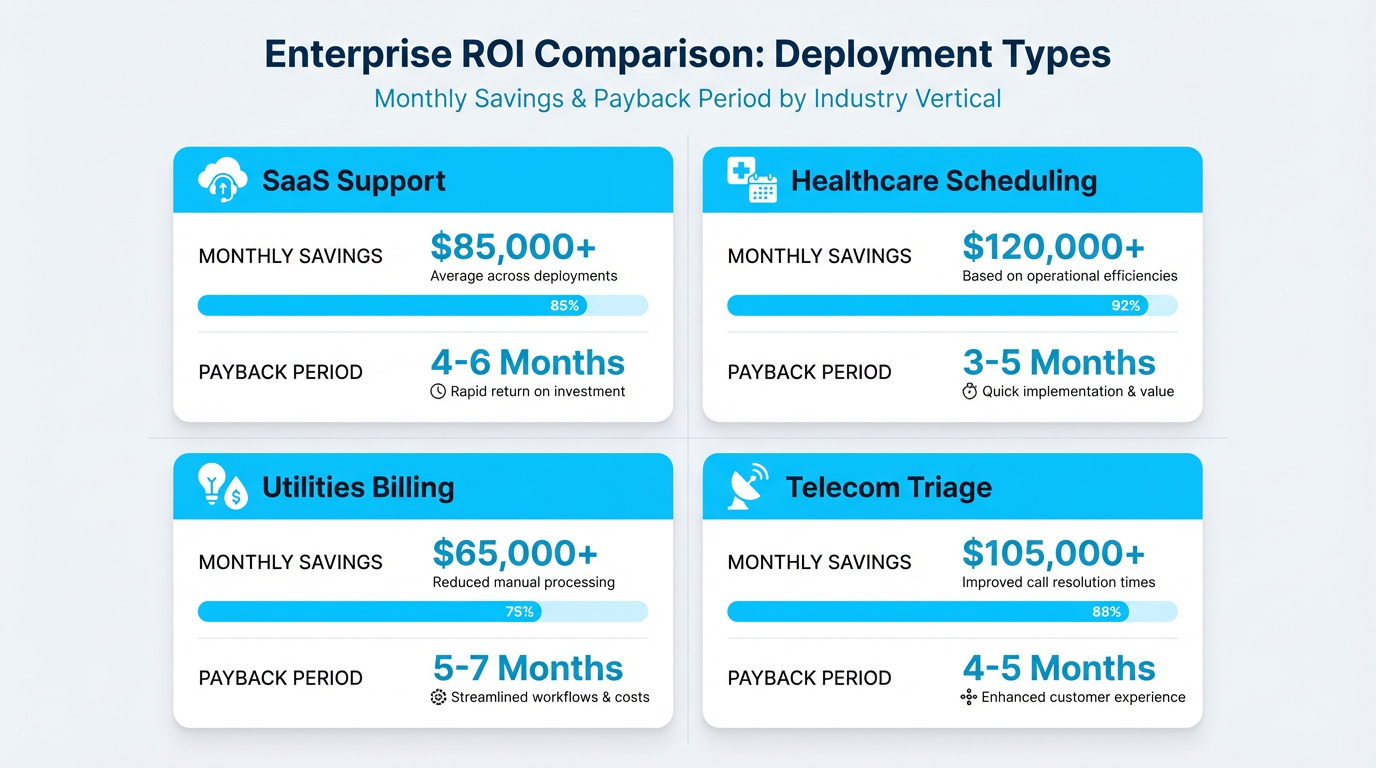
Executives evaluating AI IVR want one number: ROI. Here’s how it breaks down across deployment types.
Those payback periods aren’t theoretical. They reflect actual enterprise deployments where the AI IVR handled 60–85% of call volume autonomously from month one. The savings accelerate over time as the system learns — resolution rates improve 8–12% between month three and month nine as the NLP model adapts to company-specific language patterns.
But cost reduction tells only half the story. The revenue side — recovered payments, completed renewals, upsell conversions during service calls — often exceeds the savings. A utilities company using NewVoices for automated payment recovery collected $1.8 million in overdue balances during the first quarter of deployment. Those calls happened at 7 AM, 10 PM, Sundays — times when no human collector would be working.
Stop Losing 78% of Your Callers to an Outdated Phone System
The companies deploying AI IVR treat their phone system as a revenue channel, not overhead.
Every call is a conversion opportunity. Every interaction generates data. Every resolved issue strengthens customer relationships that translate to retention, expansion, and referral.
Hear It Yourself — Get a Live AI Call in Seconds
No credit card. No sales pitch. Just experience what your phone system should have been doing all along.
HIPAA Compliant
90-Day Guarantee
The voice on the other end of your customer’s call is now the most important employee in your company. It never calls in sick. It never forgets the script. It never loses patience with the third caller asking the same question. And it gets better — measurably, provably better — every single month.
The question isn’t whether AI IVR will replace traditional phone systems. That’s already happening across every industry. The question is whether your organization will be the one capturing those converted calls — or the one still losing them to competitors who moved faster.