
What if every customer call, every renewal reminder, and every payment recovery conversation happened automatically — with enterprise-grade security your CISO would actually approve?
A peer-reviewed study found AI assistants reduced handle time by 14% and boosted resolution rates by 34%. Now imagine that across your entire SaaS operation.
Based on NIST Frameworks
Peer-Reviewed Research
Trusted by Enterprise SaaS
What You Will Discover in This Breakthrough Guide
The proven frameworks that make enterprise buyers say YES to your AI
Security architecture that stops breaches before they start
Real revenue numbers: 300% more meetings, 119% higher recovery rates
The 90-day deployment path most companies take 18 months to finish
A single GenAI assistant deployed across 5,000 customer support agents reduced average handle time by 14% and increased issue resolution rates by 34% — with the biggest gains going to the least experienced reps. That is not a vendor claim. That is a peer-reviewed finding published in The Quarterly Journal of Economics.
Now ask yourself: if one AI assistant can do that for a single support team, what happens when every inbound call, every outbound follow-up, every renewal reminder, and every feedback survey across your entire SaaS operation runs on AI agents built to enterprise security standards?
That is what NewVoices delivers. Not a chatbot with a personality. Not an IVR tree dressed up with a language model. A full AI voice infrastructure — governed by the same frameworks your CISO already trusts, measured by the same KPIs your board already tracks, and deployed without writing a single line of code.
This article breaks down what it actually takes to run AI agents inside a SaaS company responsibly — the governance frameworks, the security architecture, the LLM-specific risks nobody wants to talk about, and the revenue math that makes all of it worth the effort.
The $4.4 Trillion Opportunity SaaS Companies Keep Missing
McKinsey estimates generative AI could add between $2.6 trillion and $4.4 trillion in annual value across global industries. Customer operations sits near the top of that list. Yet most SaaS companies deploying AI agents treat the problem like a feature request — bolt on a chatbot, measure deflection rate, call it done.
That is the wrong answer to the right question.
The right question is not about automating support tickets. It is about building an AI communication layer that is secure enough for regulated enterprise buyers, reliable enough to handle revenue-critical conversations, and measurable enough to justify the investment every quarter.
Before NewVoices
Your SaaS company deploys a third-party chatbot. It handles FAQ-level queries. Anything complex gets routed to a human. Response times for voice calls stay at 4-6 minutes. Churn-risk customers wait on hold. Renewal conversations happen only during business hours — if they happen at all.
With NewVoices
Every call — inbound and outbound — gets answered in under 3 seconds. Renewal reminders go out in 20+ languages. Payment recovery calls happen at 10 PM on a Saturday because that is when the customer is available. Your sales pipeline accelerates by 230% more booked meetings because no lead sits untouched.
This is not a support tool bolted onto your stack. It is the revenue infrastructure your SaaS company is missing.
Why Trustworthy AI Has Become a Procurement Requirement
Enterprise-grade AI governance transforms vendor conversations from feature comparisons to compliance validation
Enterprise buyers stopped asking about whether you use AI two years ago. Now they ask: Which risk framework governs your AI? Who audits it? What happens when the model hallucinates during a customer call?
If you cannot answer those questions with specifics, you lose the deal.
The NIST AI Risk Management Framework: Your Buyer Checklist
The NIST AI Risk Management Framework (AI RMF 1.0) defines trustworthy AI across seven dimensions: valid and reliable, safe, secure and resilient, accountable and transparent, explainable and interpretable, privacy-enhanced, and fair with harmful bias managed. Enterprise procurement teams — especially in financial services, healthcare, and government-adjacent SaaS — now map vendor AI capabilities directly against these dimensions.
NewVoices builds its AI agents against this framework from day one. Every agent deployed through the NewVoices platform carries documented governance controls: model evaluation criteria, bias testing protocols, fallback escalation rules, and audit trail generation. That is not a compliance checkbox. That is what separates a vendor who wins a $500K annual contract from one who gets eliminated in round two.
Quick Insight
The companion NIST AI 600-1 Generative AI Profile extends the framework specifically for generative AI systems — addressing risks like confabulation, data provenance, and environmental impact that generic AI governance misses entirely. NewVoices maps every customer-facing voice agent against this profile, tracking 12 GenAI-specific risk categories.
Implementation follows the NIST AI RMF Playbook — phased rollout, continuous evaluation, governance checkpoints — that NewVoices follows for every enterprise deployment. A mid-market SaaS client with 40,000 monthly support interactions went from pilot to full production in 11 weeks using this phased approach, reducing average resolution time from 8.2 minutes to 47 seconds.
Your AI Agent Security Architecture and Framework Alignment
Consider this scenario: your AI voice agent handles 90% of Tier-1 support tickets. It processes customer account numbers, subscription details, payment information, and PII across every call. It integrates with your CRM, your billing system, and your ticketing platform. Now a vulnerability gets exploited.
How fast can you detect it? Contain it? Report it to affected customers?
If you have not mapped your AI operations into a cybersecurity framework, the honest answer is: you do not know.
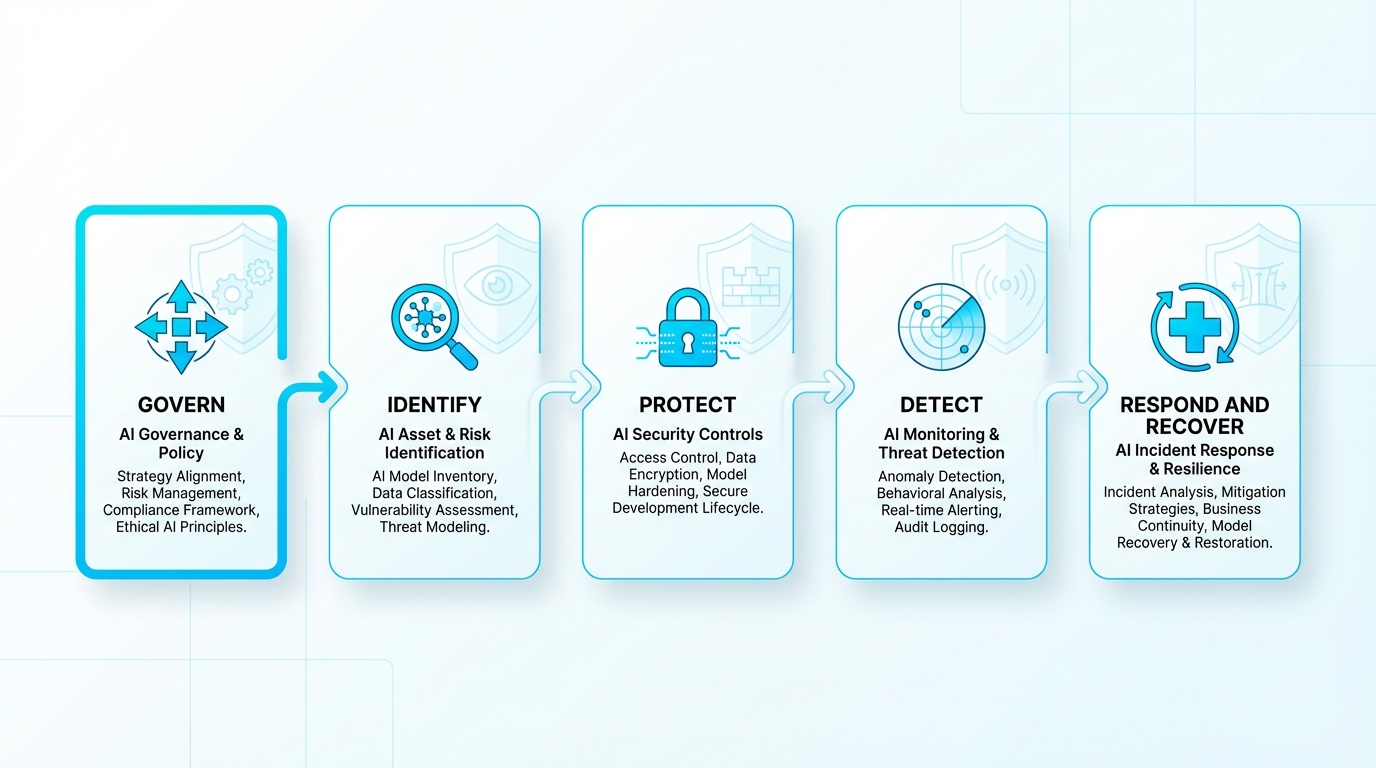
Mapping AI Agent Operations to NIST CSF 2.0
The NIST Cybersecurity Framework 2.0 organizes security into six core functions: Govern, Identify, Protect, Detect, Respond, and Recover. Enterprise buyers speak this language. When NewVoices maps its AI agent security to CSF 2.0, the conversation shifts from vague security claims to specific control demonstrations.
NewVoices applies NIST SP 800-53 Rev. 5 security and privacy controls across its infrastructure — covering access control, audit and accountability, incident response, and system communications protection. Every voice agent interaction generates an immutable audit log. Role-based access control governs who can modify agent behavior. Incident response playbooks activate automatically when anomalous patterns emerge.
The Costly Mistake: Planning to Add Security Later
A B2B SaaS company launched an AI-powered support agent last year. Eighteen months of development. Impressive NLU accuracy. Smooth voice quality. They skipped the security architecture review because — their words — they would harden it post-launch.
The Result
Three months later, a prompt injection attack exposed 12,000 customer records. The cleanup cost $2.3 million. The deal pipeline froze for two quarters.
Security is not a phase. It is a design principle.
CISA Secure by Design initiative makes this explicit: software manufacturers — especially SaaS providers — must build security into the product from the first commit, not patch it in after a breach. The CISA Secure by Design Pledge formalizes commitments that enterprise buyers increasingly treat as table stakes.
NewVoices treats Secure by Design as an engineering mandate, not a marketing page. Every AI agent deployed through the platform inherits security controls at the infrastructure layer — encryption in transit and at rest, input validation on every prompt, output filtering on every response, and network segmentation between agent instances. Business teams build agents using the no-code Agent Studio without ever having to think about the security envelope underneath.
See Enterprise-Grade AI Security in Action
Experience a live AI call and discover how NewVoices protects every conversation
Prompt Injection: The Hidden Vulnerability in Your AI Agent
Multi-layer defense architecture neutralizes prompt injection attempts before they reach customer conversations
Most SaaS companies building AI agents test for accuracy. They test for latency. They test for voice quality. Almost none of them test for prompt injection.
That is like stress-testing a vault door while leaving the window open.
What the OWASP Top 10 for LLMs Reveals
The OWASP Top 10 for Large Language Model Applications ranks prompt injection as the number-one risk for LLM-based systems. The attack is deceptively simple: an adversary embeds malicious instructions inside content the LLM processes — a customer email, a CRM field, a support ticket description — and the model follows those instructions instead of its intended behavior.
For a B2B AI voice agent, the consequences are severe. A manipulated prompt could instruct the agent to reveal account information, bypass authentication flows, or provide false billing data. Microsoft security engineering team documents how indirect prompt injection operates in production LLM systems — the attacker never interacts with the AI directly, instead poisoning the data the AI consumes.
How NewVoices Defends Against Prompt Injection
- Input Sanitization: Strips injected instructions from all external data before it reaches the language model
- Output Filtering: Validates every agent response against behavioral guardrails before customer delivery
- Zero-Trust Architecture: Treats all inserted content as untrusted by default per Microsoft mitigation guidance
- Real-Time Monitoring: Flags anomalous response patterns within a single conversational turn
Proven Results
A fintech SaaS client running NewVoices agents across 28,000 monthly voice interactions logged zero successful prompt injection incidents in their first year of deployment. The monitoring system flagged 340+ attempts — every single one neutralized before reaching the conversation.
The Emergency Room Principle: Why Triage Architecture Beats Raw Accuracy
Emergency departments do not succeed because every doctor is brilliant. They succeed because the triage system ensures the right patient reaches the right resource at the right time — before anyone examines a single symptom.
SaaS AI agents work the same way.
Obsessing over model accuracy while ignoring triage architecture is how companies build AI that scores 97% on benchmarks and still loses customers. The agent might understand the question perfectly. But if it lacks the authority to resolve the issue, does not know when to escalate, and cannot route a high-value account to a human specialist in under 10 seconds — accuracy is irrelevant.
Did You Know?
NewVoices architects every deployment around triage logic before training a single conversation flow. The system classifies every interaction by intent, urgency, account value, and complexity — then routes accordingly. A $200K enterprise account calling about billing at 11 PM gets a warm handoff to a senior account manager — with full context, history, and emotional tone summarized — within 8 seconds.
While your competitors’ service operations close at 6 PM, your AI agent just preserved a six-figure renewal at midnight. That is not a feature. That is triage architecture doing what it was designed to do.
The Revenue Math: Proven Results From Real Deployments
This is where the conversation shifts from whether to deploy AI agents to how much money you are leaving on the table every month you do not.
Verified Numbers from Actual Implementations
The NBER Working Paper No. 31161 — later published in The Quarterly Journal of Economics — studied 5,179 customer support agents using a generative AI assistant. The findings: 14% faster resolution times on average, with the bottom-quartile performers improving by 34%. The AI did not replace agents. It made every agent perform like the best agent on the team.
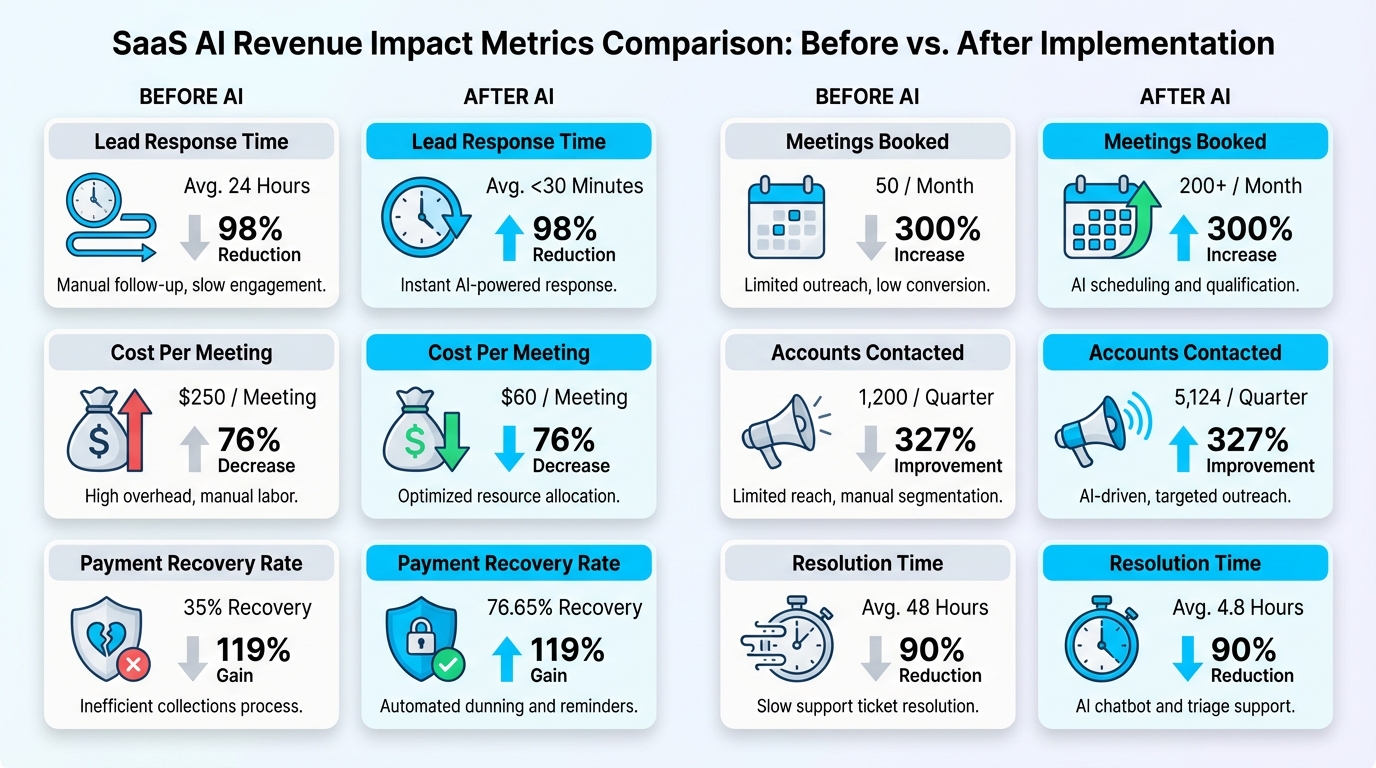
300%
More meetings booked after replacing 10 outbound roles with AI agents
$31
Cost per meeting (down from $127)
68%
Payment recovery rate (up from 31%)
$1.2M
Quarterly recovered revenue
A subscription management SaaS serving 8,000 accounts used NewVoices for payment recovery calls. Previous collection rate with human agents: 22% of overdue accounts contacted within 7 days. With NewVoices: 94% contacted within 24 hours. That is $1.2 million in recovered revenue per quarter that was previously written off.
McKinsey operational analysis of GenAI in service organizations confirms the pattern: companies that move from pilot to production within a structured governance framework capture 3-5x the value of companies that stay in perpetual pilot mode.
Why the Cheapest AI Vendor Costs You the Most
SaaS procurement teams love a bake-off. Three vendors. Same test script. Score on accuracy, latency, and price. Pick the cheapest one that clears the threshold.
This is exactly how companies end up ripping out their AI infrastructure 14 months later.
The vendor that won on price did not have SOC 2 Type II certification — so your healthcare SaaS client compliance audit failed. The vendor with the fastest response time could not produce audit logs when a customer dispute escalated to legal. The vendor with the best demo voice could not handle your Stripe integration, so payment recovery calls required manual workarounds that cost more than the human team they replaced.
NewVoices costs more than the cheapest option on the market. It also costs less than ripping out the cheapest option after it fails an enterprise audit, loses a $400K account, or generates a compliance incident that freezes your entire sales cycle for a quarter.
The Right Evaluation Framework
- Does the vendor AI governance map to NIST AI RMF?
- Can they demonstrate NIST CSF 2.0 alignment?
- Do they follow Secure by Design principles?
- Can they produce immutable audit trails for every interaction?
- Do they have active defenses against OWASP LLM Top 10 threats?
If the answer to any of those is that they are working on it — that vendor is not enterprise-ready. They are enterprise-adjacent. And enterprise-adjacent gets you eliminated from enterprise deals.
From Pilot to Production: The 90-Day Path
The graveyard of SaaS AI projects is not full of bad technology. It is full of bad implementation.
Endless pilot phases. Scope creep from engineering teams adding features nobody asked for. Six-month integration timelines that turn into twelve. By the time the AI goes live, the business case has rotted and the executive sponsor has moved to a different company.
NewVoices compresses deployment to 90 days — not by cutting corners, but by removing the bottlenecks that make AI projects drag.
The Proven 90-Day Timeline
Discovery and triage architecture design
Agent configuration and integration testing
Controlled production deployment with real interactions
Full production with continuous evaluation against governance frameworks
Success Story
A vertical SaaS company serving the logistics industry went live with NewVoices voice agents handling carrier onboarding calls in 67 days. Their previous AI vendor had been in implementation for 11 months with no production date. Within 30 days of going live, carrier onboarding completion rates increased from 41% to 78%.
The Future of SaaS Communication Starts Now
The CISA 2023-2024 Roadmap for Artificial Intelligence outlines a clear trajectory: AI systems will become more autonomous, more embedded in critical operations, and more scrutinized by regulators and customers alike. The SaaS companies that thrive in this environment will not be the ones with the flashiest AI demo. They will be the ones with the most rigorous governance, the most transparent operations, and the most measurable outcomes.
NewVoices is building for that future — not the one where AI is a novelty, but the one where AI is infrastructure. Where every customer interaction, across every channel, in every language, at every hour, runs through an AI layer that is indistinguishable from your best human team member — but governed by frameworks your compliance officer can audit in real time.
The companies deploying NewVoices today are not early adopters experimenting with a trend. They are operators locking in a structural advantage — lower cost per interaction, faster revenue cycles, higher retention rates, and an enterprise compliance posture that opens doors legacy vendors cannot walk through.
Limited Implementation Slots Available This Quarter
Transform Your SaaS Communication Infrastructure
Join the SaaS companies already capturing 300% more meetings, 68% payment recovery rates, and enterprise deals their competitors cannot close.
No commitment required — discover what enterprise-grade AI communication should look like
GDPR Compliant
HIPAA Ready
NIST AI RMF Aligned
Enterprise Support 24/7