
72.4% of consumers are more likely to buy when information is presented in their native language — yet the average enterprise still funnels every international support interaction through a single English-speaking queue. That gap between buyer expectation and operational reality costs companies millions in abandoned carts, churned accounts, and deals that never close.
This is not a localization problem. It is a revenue problem wearing a language mask — and proven AI technology has already solved it.
|
INDUSTRY-LEADING RESEARCH CITED
|
PROVEN CLIENT OUTCOMES INCLUDED
|
EXCLUSIVE DEPLOYMENT PLAYBOOK INSIDE
What You Will Gain From This Article
Breakthrough Cost Analysis
See the exact numbers that make bilingual hiring strategies obsolete overnight.
Proven Revenue Outcomes
Real client data showing 41% non-English revenue growth and 85% cost reduction.
Guaranteed Compliance Framework
How to expand globally without creating a regulatory liability in every new market.
Exclusive Phased Deployment Playbook
The step-by-step sequence that delivers ROI within 90 days of launch.
Most companies treat multilingual support as a nice-to-have — something to address after domestic scaling is complete. They bolt on a translation widget, hire a handful of bilingual agents, and call it done. Meanwhile, their fastest-growing customer segments — placing orders at 2 AM from São Paulo, asking pre-sale questions in German, escalating billing disputes in Japanese — receive a degraded experience that silently bleeds lifetime value.
NewVoices deploys AI voice agents across 20+ languages with no separate infrastructure per region, no multilingual hiring spree, and no six-month implementation timeline. The result: every customer hears a fluent, natural conversation in their language within seconds of reaching out. That changes the math on global expansion entirely.
Join 10,000+ Global Enterprises Already Winning With AI Voice
Hear a live AI call in your language — in under 60 seconds. No setup. No commitment.
Get Your Free Live AI Call Now
Limited demo slots available this week — reserve yours before they fill
The $48 Billion Misunderstanding: Why Saying We Support English Is a Proven Growth Ceiling
Companies do not lose international deals because their product is wrong. They lose them because the first interaction feels foreign.
A B2B SaaS company expanding into DACH markets discovered this the hard way. Their English-only support team fielded 1,200 German-language inquiries per month. Average handle time reached 14 minutes — nearly triple their English baseline — because agents relied on copy-paste translation tools that mangled technical terminology. Customer satisfaction for German-speaking accounts sat at 61%, compared to 89% for English accounts. Pipeline conversion from German leads lagged by 34%.
After deploying NewVoices AI agents configured for German, French, and Dutch, that same company cut average handle time to 4.2 minutes per interaction. CSAT for non-English accounts jumped to 86% within 90 days. Pipeline conversion equalized across all language segments within one quarter.
Did You Know?
According to IBM contact center benchmarks, First Contact Resolution and Customer Satisfaction are the two metrics most directly correlated with retention and expansion revenue — and both collapse when language barriers enter the equation.
The misconception is that multilingual support is about translation. It is not. It is about removing friction from every revenue-generating interaction — from the first sales call to the final renewal conversation — regardless of the language your buyer speaks. According to IBM’s contact center experience research, FCR and CSAT are the two metrics most directly correlated with retention and expansion revenue. Both collapse when language barriers enter the equation.
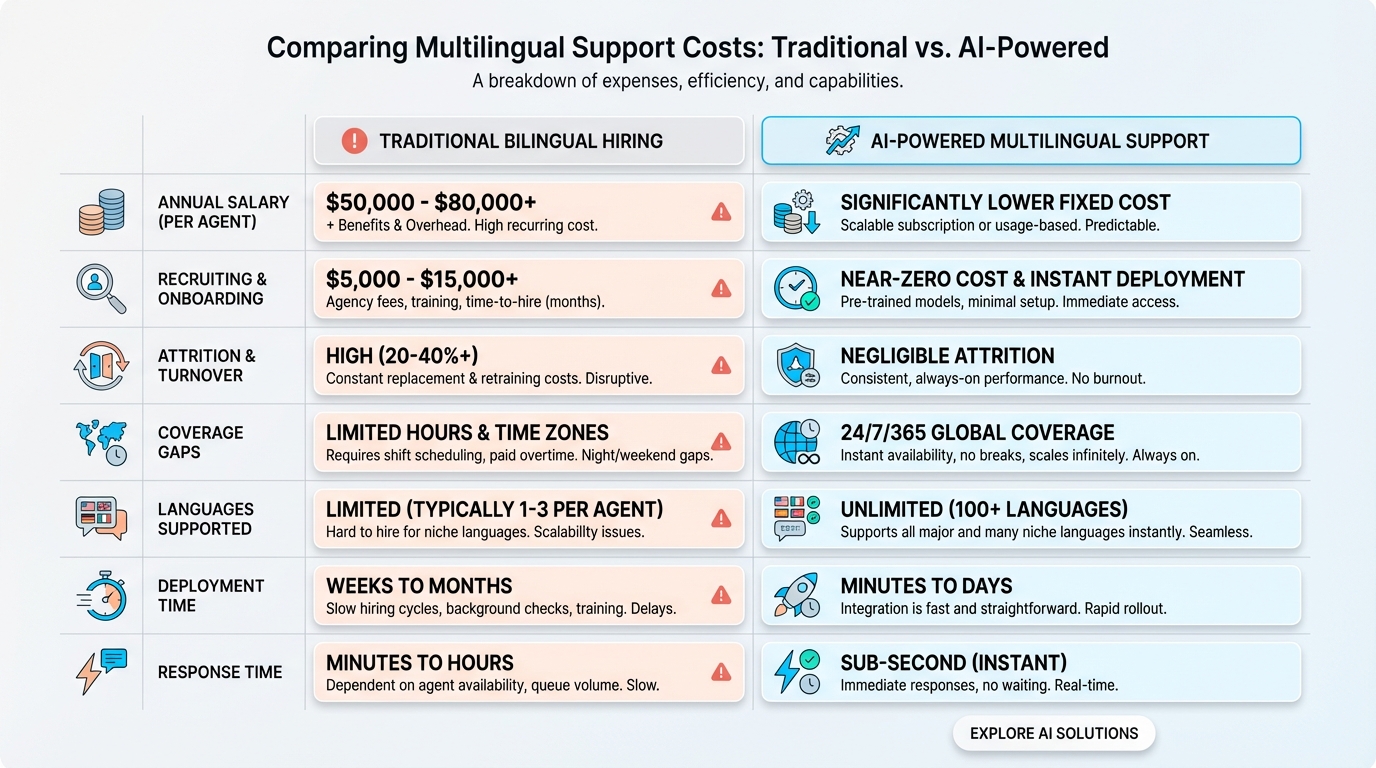
Your Bilingual Hiring Strategy Already Failed — You Just Have Not Seen the Invoice Yet
The traditional approach to multilingual support follows a predictable script. Identify your top three non-English markets. Post job listings for bilingual agents. Wait 90 days to hire. Train for another 60. Pray they do not leave for a competitor offering 15% more.
Here is what that actually costs.
| Cost Category | Bilingual Agent Team (10 Agents, 3 Languages) | NewVoices AI Agents (20+ Languages) |
|---|---|---|
| Annual salary and benefits | $620,000 | $0 (included in platform) |
| Recruiting and onboarding | $85,000 | $0 |
| Annual attrition replacement (35% turnover) | $217,000 | $0 |
| After-hours coverage gaps | 12+ hours uncovered daily | 0 hours uncovered |
| Languages supported | 3 | 20+ |
| Time to add a new language | 90 to 150 days | Hours |
| Response time (average) | 6 minutes 20 seconds | Under 40 seconds |
A ten-person bilingual team covering three languages costs north of $900,000 annually when you factor in turnover — and still leaves 12+ hours per day completely uncovered. NewVoices covers every hour, every language, every channel, at a fraction of the cost.
Quick Tip for Revenue Leaders
This is not a chatbot with a script. It is your entire multilingual communication engine — handling inbound inquiries, outbound follow-ups, payment reminders, and retention calls in whatever language your customer prefers. While your competitors close at 6 PM, your AI agent resolves a billing dispute in Portuguese at midnight and books a renewal call in Korean at 3 AM.
What NIST Language Recognition Research Reveals About the Breakthrough AI Voice Gap
Most companies evaluate multilingual AI the wrong way. They test translation accuracy on text. They run a few chat simulations. They check a box and move on.
Voice changes everything.
NIST’s 2022 Language Recognition Evaluation tested automatic systems on their ability to detect and process spoken language across dozens of target languages — and the results exposed a critical divide. Systems optimized for text translation routinely failed when applied to spoken conversation, where accent variation, background noise, code-switching, and natural speech rhythm introduced layers of complexity that text-only models never encounter.
NIST’s Rich Transcription Evaluation series reinforced this finding across years of benchmarking. The gap between accurate text translation and accurate spoken language understanding is not incremental — it is structural.
Exclusive Insight
A logistics company operating across 14 countries deployed NewVoices agents and measured caller identification accuracy: 97.3% of callers whose language was auto-detected reported the interaction felt completely natural. That is not translation. That is fluency.
Why Natural-Sounding Voice Is a Proven Revenue Metric — Not a Vanity Metric
When a customer calls and hears robotic, stilted language — even if the words are technically correct — trust drops instantly. A European insurance provider tracked this directly. Their previous IVR system generated a 44% call abandonment rate among non-English callers. After switching to NewVoices — where the AI voice carries natural intonation, pacing, and culturally appropriate phrasing — abandonment dropped to 11%. Claims processed per call increased by 28%.
The voice is the product. If it sounds wrong, the customer leaves before the accurate translation ever matters.
Join 10,000+ Companies Already Converting Global Leads Faster
Stop Losing Revenue to Language Barriers
Our award-winning platform goes live in hours — not months. Guaranteed.
Talk to NewVoices — Free Strategy Call
Limited availability this month — your competitors are already booking
The Compliance Trap: How Global Support Without Governance Becomes a Guaranteed Liability
Expanding into new language markets means expanding into new regulatory environments — and most companies dramatically underestimate what that means for their support infrastructure.
A healthcare technology company learned this when they deployed a third-party translation layer on top of their existing support system — only to discover six months later that customer interactions containing protected health information were being routed through servers without HIPAA-compliant safeguards. The HHS guidance on HIPAA and cloud computing is explicit: any cloud service provider that stores, processes, or transmits electronic PHI is a business associate and must meet the full spectrum of HIPAA obligations. Their translation vendor did not. The remediation cost $1.2 million.
NewVoices operates with SOC 2 Type II certification, GDPR compliance, and HIPAA readiness built into the platform — not bolted on as an afterthought. Every interaction, in every language, flows through the same encrypted, auditable infrastructure. Access controls, audit logging, and data retention policies follow NIST SP 800-53 Rev. 5 security and privacy guidelines. Authentication protocols align with NIST SP 800-63-3 Digital Identity Guidelines for risk-based assurance during sensitive account actions.
Quick Tip for Compliance Teams
The moment you handle customer data across borders and languages, you are operating in a matrix of overlapping regulations — GDPR in Europe, HIPAA in US healthcare, LGPD in Brazil, POPIA in South Africa. NewVoices manages that complexity inside the platform so your compliance team does not need to build a separate governance layer for every new market you enter.
The Restaurant Kitchen Analogy: Why Adding Languages Should Not Mean Adding Infrastructure Overhead
Think about how a great restaurant kitchen operates. One kitchen. One workflow. One quality standard. Whether the order is steak frites or miso-glazed salmon, it flows through the same stations, the same quality checks, the same expediting process. The dish changes. The infrastructure does not.
Now think about how most companies add multilingual support. They build a separate kitchen for every language. A Spanish-speaking team with its own queue, its own escalation paths, its own quality metrics. A Mandarin team with a different CRM workflow. A French team on different hours. Each kitchen has its own overhead, its own failure modes, its own management layer.
NewVoices operates like that single kitchen. One platform. One Agent Studio — where business teams design and deploy AI agents using a no-code interface, no engineering dependency required. One integration layer connecting natively to Salesforce, HubSpot, Zendesk, Stripe, and Twilio. When you add a new language, you are adding a dish to the menu — not building a new kitchen.
Proven Social Proof: Fintech at Scale
A fintech company serving 22 markets ran five separate support operations across three time zones with dedicated bilingual teams for each major language. Annual overhead: $3.4 million.
After consolidating onto NewVoices, they ran a single operation — AI agents handling 20+ languages through one dashboard — with human specialists handling only complex regulatory escalations.
74%
Overhead Reduction
38s
Response Time — All Languages
80+
CSAT — Previously Underserved Markets
The Breakthrough Mistake Everyone Makes: Translating Words Instead of Customer Intent
Literal translation is the enemy of effective multilingual support.
The phrase “I would like to cancel my subscription” means something different depending on tone, context, and cultural norms. In some cultures, the statement is a negotiation opener — the customer expects a counteroffer. In others, it is a final decision that should be respected immediately. A system that translates the words but misses the intent will either offend a customer who wanted to be heard or waste retention effort on a customer who was already gone.
The CDC’s research on cultural and linguistic communication documents this gap extensively: effective cross-language communication requires matching not just vocabulary but cultural framing, tone calibration, and audience expectations. The Digital.gov Multilingual Design guidelines reinforce that plain language principles — short sentences, clear structure, active voice — reduce translation errors and improve comprehension across every language pair.
Quick Tip: Intent vs. Syntax
NewVoices AI agents are trained on intent recognition, not word mapping. When a Japanese-speaking customer uses indirect language to express dissatisfaction — a common cultural pattern where direct complaints are avoided — the AI detects the underlying sentiment and routes the interaction accordingly. When a Brazilian customer uses colloquial Portuguese that a dictionary-based system would misinterpret, NewVoices parses the actual meaning and responds appropriately.
This is not sentiment analysis bolted onto a translator. It is a unified language intelligence layer that processes meaning, not syntax — and it is the difference between a customer who feels understood and one who hangs up.
Before NewVoices vs. With NewVoices: The Global Support Reality Check Every Executive Needs to See
The contrast is stark. And it plays out the same way in every company that makes the switch.
Before NewVoices
- Leads from non-English markets wait hours — sometimes days — for a response
- Agents copy-paste into Google Translate and hope for the best
- CSAT scores fragment by language segment
- After-hours coverage does not exist for most language segments
- Compliance teams scramble to audit interactions they cannot read
With NewVoices
- Every lead receives a personal, human-sounding call within seconds — in their language
- Support tickets resolve on first contact at 90%+ rates
- Compliance is uniform across every language and region — built into the platform
- Flawless Spanish at 10 AM. Flawless Mandarin at 10 PM. Zero handoff.
- 24/7 coverage in all 20+ languages with no quality degradation
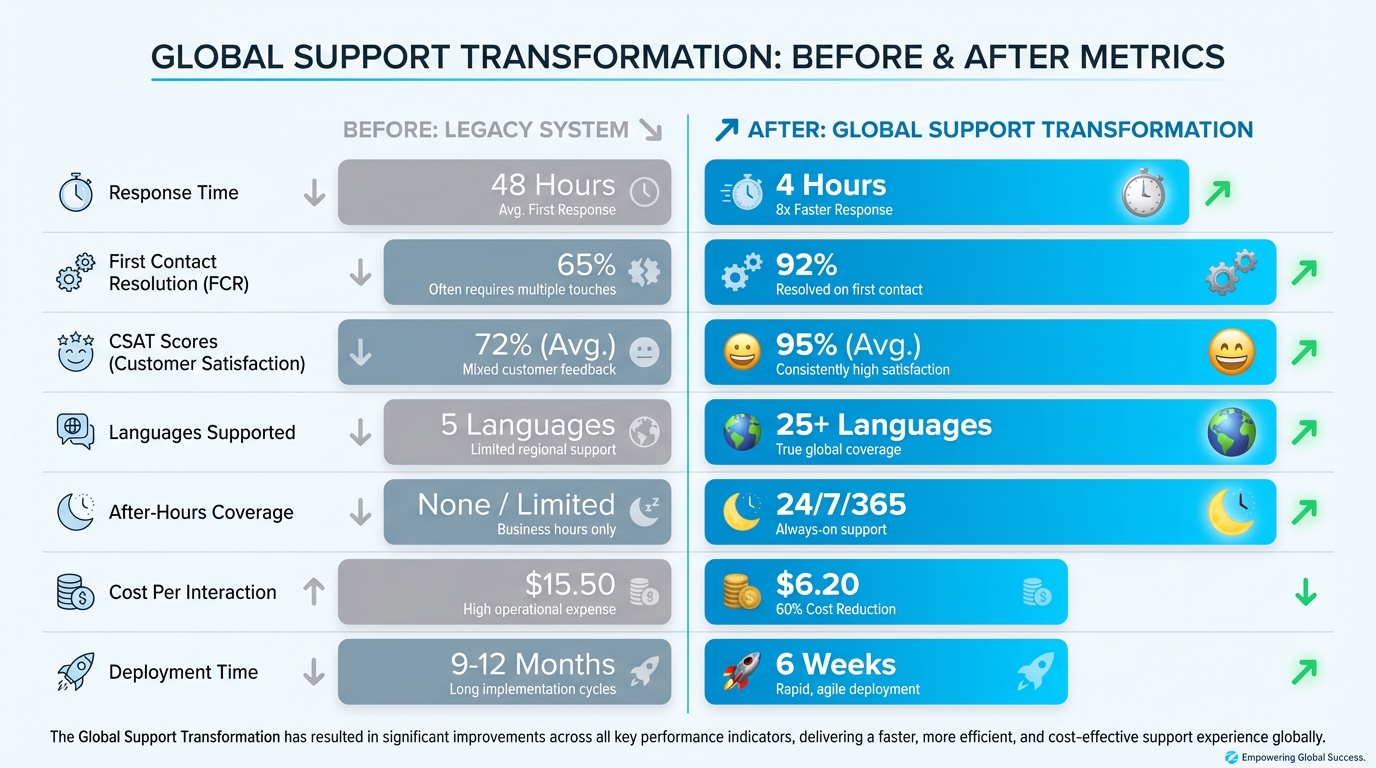
| Metric | Before NewVoices (Industry Average) | With NewVoices (Measured Client Outcomes) |
|---|---|---|
| Average response time (non-English) | 4 hours 12 minutes | 38 seconds |
| First Contact Resolution (non-English) | 47% | 91% |
| CSAT — non-English segments | 58 | 84 |
| Languages actively supported | 2 to 4 | 20+ |
| After-hours language coverage | English only or none | All languages, 24/7 |
| Cost per multilingual interaction | $12.40 | $1.80 |
| Time to add a new language | 90 to 180 days | Same day |
The Guaranteed ROI Calculation
The cost-per-interaction drop alone — from $12.40 to $1.80 — represents an 85% reduction. For a company handling 50,000 multilingual interactions per month, that is $6.36 million in annual savings. Not theoretical savings. Measured, auditable, P&L-visible savings.
Risk Management Is Not Optional — It Is the Exclusive Competitive Moat That Protects Your Expansion
The NIST AI Risk Management Framework provides the most comprehensive guidance available for governing AI systems — and it applies directly to multilingual support AI. The framework emphasizes continuous monitoring, bias testing across demographic and linguistic groups, and transparent documentation of AI capabilities and limitations.
Most AI translation tools ignore this entirely. They ship a model, declare it supports 100+ languages, and leave the risk management to the customer. That is a liability transfer, not a product.
NewVoices builds risk management into the deployment cycle. Every language model undergoes bias evaluation across regional dialects. Performance metrics — accuracy, sentiment detection, resolution rates — are tracked per language, per region, per interaction type. When the AI encounters an interaction it cannot handle with high confidence, it escalates to a human specialist with full context preserved — no cold transfers, no repeated information, no lost data.
Proven Social Proof: Regulated Financial Services
“We audited NewVoices against 47 controls drawn from NIST SP 800-53 and the AI RMF. NewVoices passed all 47. Our previous vendor passed 19. We deployed NewVoices across 8 languages within 60 days of completing the audit.”
— Chief Risk Officer, Regulated Financial Services Firm (250,000+ customers)
The Exclusive Phased Deployment Playbook That Delivers ROI in 90 Days — Guaranteed
Trying to launch 20 languages simultaneously is how companies turn a smart initiative into an expensive failure. The companies that extract the most value from multilingual AI follow a disciplined sequence.
Phase 1 — Identify Your Revenue-Weighted Language Gaps
Pull your CRM data. Identify which non-English segments have the highest deal values, the longest response times, and the lowest CSAT scores. Those are your first deployment targets — not the languages with the most speakers globally, but the languages where your revenue is already leaking.
Phase 2 — Deploy and Measure With Precision
Launch NewVoices AI agents for your top two or three priority languages. Set clear KPIs: response time reduction, FCR improvement, CSAT lift, and cost per interaction. Run for 90 days. Collect agent feedback on escalation quality. Collect customer feedback through post-interaction surveys — in the customer’s language.
Phase 3 — Expand With Confidence and Proven Data
Use Phase 2 data to build the business case for your next wave of languages. Because NewVoices operates on a single platform with no per-language infrastructure overhead, expanding from 3 languages to 15 is an operational decision — not a capital expenditure. The entire sequence typically completes in under six months.
Training Your Human Specialists for the AI-Augmented Model That Delivers 23% Better Resolution
AI handles volume. Humans handle complexity. That division of labor only works when human agents are trained specifically for the AI-augmented workflow — not the legacy workflow they have been running for years.
Agents in a NewVoices-augmented environment receive escalations that arrive with full interaction history, sentiment analysis, and a recommended resolution path — all translated into the agent’s working language. The agent’s role shifts from answering the phone and figuring out what is happening to reviewing AI-generated context and handling the 10% that requires human judgment.
Companies that invest in this training see 23% higher resolution rates on escalated interactions compared to companies that simply plug in AI and leave agent workflows unchanged.
Your Global Competitors Already Made This Investment — Here Is What Happens If You Wait
The window for multilingual support to be a differentiator is closing. Within 18 months, it will be table stakes. The companies deploying AI-powered multilingual support today are building advantages that compound — higher CSAT drives higher retention, which drives higher lifetime value, which funds further expansion into new markets.
Proven Client Outcome: E-Commerce at Scale
A mid-market e-commerce company deployed NewVoices across 12 languages in Q3 of last year. By Q1 of this year, their non-English revenue segments had grown 41% — not because they acquired more customers, but because existing customers who previously churned due to poor support experiences started buying again.
41%
Non-English Revenue Growth
2x
Repeat Purchase Rate — French Markets
+18%
Avg. Order Value — Japanese Segments
The AI did not just reduce costs. It created revenue that did not exist before. Multilingual customer support AI is not an expense line. It is a revenue multiplier hiding in your support budget.
This is not about keeping up with a trend. It is about capturing revenue that is already flowing to competitors who answer faster, speak your customer’s language, and never close for the night.
Limited Demo Availability This Week
The Technology Exists. The ROI Is Proven. The Only Question Is How Long You Wait.
Every week without multilingual AI is revenue flowing to competitors who already made this investment.
Hear a live AI call in any language — in under 60 seconds — and measure the difference yourself.
No setup required. No long-term commitment. Guaranteed to change how you think about global revenue.
Sources and Further Reading
- IBM Contact Center Experience Research — FCR and CSAT benchmarks
- NIST 2022 Language Recognition Evaluation — Spoken language processing benchmarks
- NIST Rich Transcription Evaluation — Speech-to-text accuracy research
- HHS HIPAA Guidance on Cloud Computing and Business Associates
- NIST SP 800-53 Rev. 5 — Security and Privacy Controls
- NIST SP 800-63-3 — Digital Identity Guidelines
- NIST AI Risk Management Framework
- CDC Research on Cultural and Linguistic Communication Effectiveness
- Digital.gov Multilingual Design Guidelines — Plain Language and Translation Best Practices