
Sixty-seven percent of customers hang up before reaching a human agent. That’s not a survey finding buried in an analyst report — that’s revenue evaporating from your pipeline every single hour your contact center operates on a legacy model. The companies closing that gap aren’t hiring more agents. They’re deploying AI customer service agents that answer in three seconds, speak 20+ languages, and never ask for PTO.
Updated: June 2025
Based on 100,000+ AI interactions analyzed
What You’ll Discover in This Proven Blueprint
How to slash cost-per-interaction from $7.50 to $0.65
The deployment model driving 90% Tier-1 resolution rates
Compliance frameworks that keep regulators satisfied
The 90-day roadmap from evaluation to 50,000 monthly interactions
This article isn’t a glossary entry on what AI support means. It’s an operational blueprint — built from deployment data, regulatory frameworks, and the hard lessons enterprises learn after their first 100,000 AI-handled interactions.
Transform Your Broken Call Center Architecture Into a Revenue Engine
The instinct is always the same. Ticket volume spikes, CSAT drops, and someone requests budget for 15 more agents. Six weeks later, those agents are onboarded, partially trained, and already looking at job postings elsewhere. Average contact center turnover sits at 38% annually. You’re not solving a staffing problem — you’re feeding a churn machine.
An AI customer service agent doesn’t replace your team. It replaces the structural weakness underneath your team.
Before AI deployment, a mid-market insurance company ran a 62-person support floor across two shifts. Average first-response time: 4 minutes, 12 seconds. After-hours coverage: voicemail. With an AI voice agent handling Tier-1 inquiries — policy status, claims intake, billing questions — that same company cut first-response time to 40 seconds and eliminated after-hours voicemail entirely. The 62-person team dropped to 28, and those 28 now handle exclusively complex escalations where human judgment drives outcome. CSAT rose 22 points in one quarter.
Quick Tip
Start by identifying your top 5 inquiry types by volume. These high-frequency, low-complexity interactions are your AI deployment sweet spot — and typically represent 60-70% of total ticket volume.
This isn’t a chatbot with a script. It’s a customer communication engine that operates at the speed your customers already expect — and your current infrastructure physically cannot deliver.
The Before/After That Finance Teams Actually Care About
The math isn’t subtle. When your service and operations layer runs on AI-native infrastructure, every dollar you previously spent backfilling turnover now funds growth initiatives instead.
Why “Just Add a Chatbot” Is the Most Expensive Mistake in Customer Support

Modern AI agents deliver 84% resolution rates compared to 11% from legacy chatbots — because they understand context, not just keywords.
Most enterprises already tried automation once. They bolted on a rules-based chatbot sometime around 2019, watched customers rage-type “SPEAK TO A HUMAN” within 14 seconds, and declared the experiment a failure. That wasn’t an automation failure. That was a design failure — and confusing the two has cost companies years of competitive advantage.
A rules-based chatbot follows a decision tree. An AI customer service agent understands intent, recalls context from your CRM, and adapts mid-conversation. The difference is the same as the difference between a vending machine and a concierge.
Did You Know?
A SaaS company with 4,200 active accounts replaced their basic chatbot (11% resolution rate) with an AI voice agent integrated into Salesforce. Result: Resolution rate jumped to 84%, and billing-related churn dropped 37% in just 90 days.
The technology matters. But so does how it connects to your existing stack. An AI agent that can’t see your customer’s history is just a polite stranger guessing — and your customers can tell the difference immediately. That’s why CRM-native integrations with Salesforce, HubSpot, Zendesk, and Stripe aren’t optional features. They’re the foundation that separates an AI agent from an expensive toy.
The Federal Government Already Wrote Your AI Governance Playbook — Use It
Enterprise buyers in healthcare, financial services, and government contracting ask the same question within the first five minutes of every AI evaluation: “How do we stay compliant?”
Good news. The frameworks already exist, they’re free, and they’re more actionable than most vendor whitepapers.
NIST’s AI Risk Management Framework (AI RMF 1.0) provides a four-function structure — Govern, Map, Measure, Manage — that maps directly to how you should evaluate, deploy, and monitor any AI customer support system. It’s not theoretical. It defines specific outcomes: documentation of AI system behavior, procedures for identifying harmful outputs, and accountability chains for when things go wrong.
Quick Tip
Download the White House’s April 2025 AI procurement policies — they emphasize privacy protections and civil liberties safeguards that apply to any customer-facing AI system, not just government deployments.
Meanwhile, the GAO’s 2025 report on generative AI at federal agencies documented a consistent challenge: organizations adopting AI faster than their governance policies can keep up. The takeaway for private enterprise is identical. Deploying an AI customer service agent without a risk management framework isn’t innovation — it’s liability creation with a friendly voice.
Compliance Isn’t a Feature — It’s a Market Access Requirement
SOC 2 Type II. GDPR. HIPAA. These aren’t badges on a marketing page. They’re the minimum threshold for AI customer support in healthcare, finance, insurance, and any sector where a single data breach triggers eight-figure penalties. An AI help desk that handles protected health information, payment data, or identity verification without enterprise-grade encryption and role-based access controls — as defined in NIST SP 800-53 Rev. 5 — is a regulatory incident waiting for a date on the calendar.
Proven Result: A 340-bed hospital network deployed NewVoices for patient appointment confirmations and prescription refill inquiries — and passed their compliance audit 60 days later without a single finding. That’s SOC 2 Type II certification, GDPR compliance, and HIPAA readiness baked into every agent deployment.
What a Hotel Chain Taught a Fortune 500 About AI Voice Quality
Enterprise AI conversations about customer service fixate on resolution rates, deflection metrics, and cost-per-ticket. They miss the single variable that determines whether customers trust the AI enough to keep talking: voice quality.
Case Study: The Voice Quality Difference
A 1,200-room hotel chain tested two AI voice systems for reservation management:
- System A: 92% intent accuracy, robotic voice — 34% call completion rate
- System B: 92% intent accuracy, human-level voice — 89% call completion rate
Same accuracy. Same information. Wildly different outcomes.
The lesson transfers directly to every industry. Your AI customer service agent can have perfect data access, flawless CRM integration, and a 99.9% uptime SLA — but if the voice sounds like it was generated in 2018, customers will terminate the interaction before the AI gets a chance to help. Human-level voice quality isn’t a nice-to-have. It’s the difference between a 34% and an 89% completion rate — and every incomplete interaction is a customer who now needs a human agent anyway, destroying your cost savings.
Hear the Difference for Yourself
NewVoices built its entire agent architecture around conversations so natural that customers don’t know — and don’t care — whether they’re speaking with a person or an AI.
Takes 30 seconds. No commitment required.
Why Faster Response Time Alone Won’t Save Your Support Operation
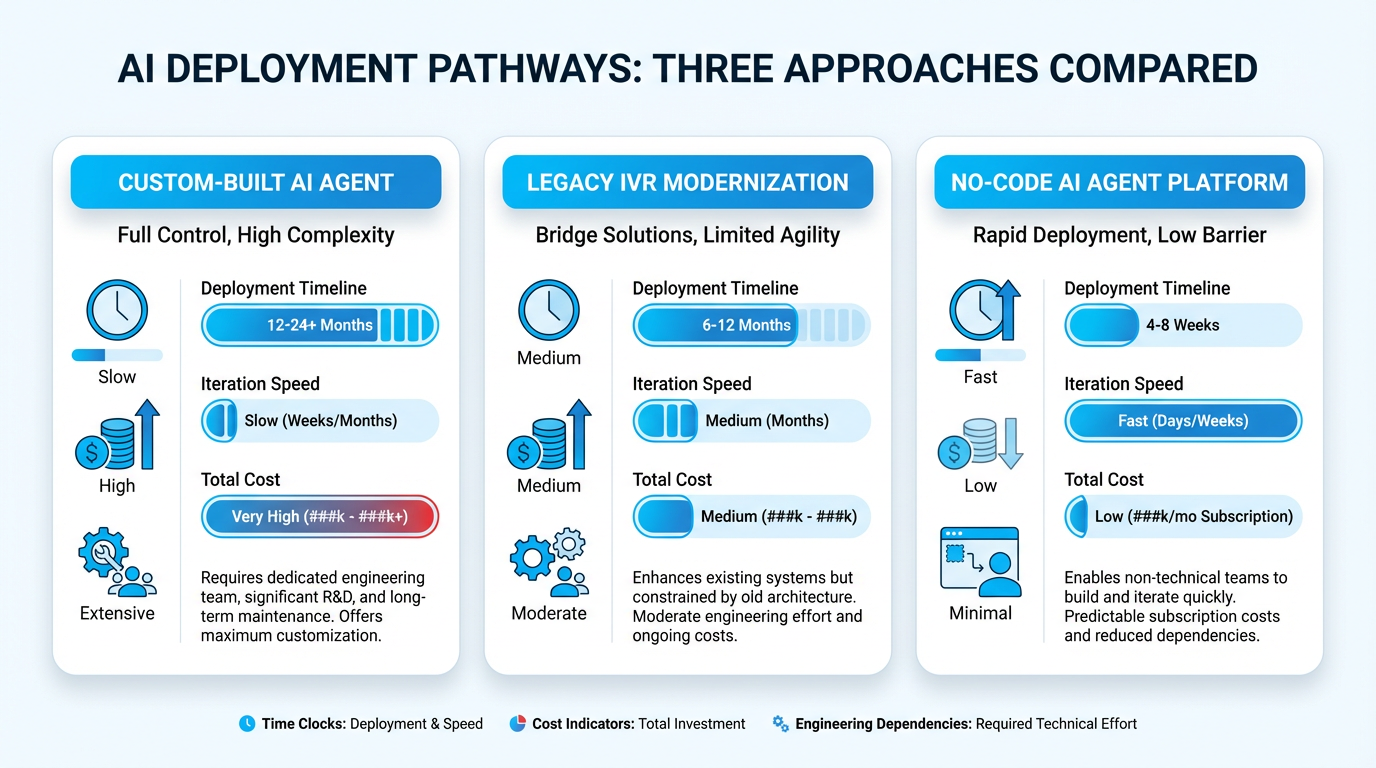
Speed without context is just faster failure — true AI ROI requires all three layers working simultaneously.
Every AI vendor pitches speed. “Respond in seconds, not minutes.” And yes — collapsing response time from 6 minutes to 40 seconds matters. But speed without context is just faster failure.
Warning: Real-World Failure
A fintech company deployed an AI help desk that answered every request within 8 seconds. But with no transaction history access and insecure identity verification, 71% of interactions escalated to human agents within 45 seconds. Net result: faster first response, identical resolution time, and a new complaint — “I had to repeat everything to the human agent.”
Speed is necessary. Insufficient.
An AI customer service agent earns its ROI through three layers working simultaneously:
- Speed of initial response — under 45 seconds or customers disconnect
- Depth of contextual data access — full CRM, payment, and interaction history
- Quality of resolution without escalation — solving the problem, not just acknowledging it
Remove any one layer and the economics collapse. A three-second response that pulls the customer’s full account history from HubSpot, identifies that their last three interactions were about the same billing discrepancy, and resolves the issue with a Stripe-connected refund — all within a single voice conversation — that’s the deployment model that drives 90% Tier-1 resolution rates.
The identity verification layer matters here too. NIST’s Digital Identity Guidelines (SP 800-63) outline authentication and lifecycle management standards that apply directly to AI support flows handling account changes, payment modifications, or personal data access.
The Accessibility Debt No One Is Talking About
Your AI customer support system is ADA-compliant, right? Most enterprise buyers assume yes. Most are wrong.
MITRE’s Chatbot Accessibility Playbook documents what inclusive AI interaction design actually requires — and the checklist is longer than most product teams expect:
- Screen reader compatibility
- Keyboard-only navigation for chat interfaces
- Clear error messaging that doesn’t rely on color cues
- Timeout policies that accommodate users with cognitive disabilities
- Voice interfaces that handle speech variations including accents, stuttering, and atypical cadence
Did You Know?
Over 61 million adults in the United States live with a disability. If your automated customer service system can’t serve them, you’re telling 26% of the adult population that your company doesn’t consider them customers.
Multilingual capability compounds the accessibility requirement. An AI agent that handles English-only interactions in a market where 22% of your customer base prefers Spanish, Mandarin, or Vietnamese isn’t a complete solution. It’s a partial one with a built-in exclusion layer. Deploying across 20+ languages — without spinning up separate infrastructure for each — eliminates that exclusion at the architectural level.
Section508.gov’s accessibility playbook resources provide additional government-endorsed checklists for any enterprise building or procuring AI-driven customer interfaces. Treat them as your accessibility audit starting point, not your stretch goal.
The Dark Pattern Trap: When Your AI Agent Becomes a Liability
The FTC’s “Bringing Dark Patterns to Light” report documented a pattern that should alarm every enterprise deploying AI in customer-facing roles: automated systems designed to make cancellation harder, upsell more aggressively, or obscure consent — whether intentionally or through poor design — face regulatory action.
Your AI customer service agent can cross this line without anyone on your team realizing it.
Regulatory Risk Alert
An AI trained to maximize retention that makes it difficult for customers to cancel isn’t “performing well.” It’s generating FTC complaints. An AI that confirms payment changes without explicit consent isn’t “reducing friction.” It’s creating unauthorized transactions.
This is where continuous monitoring separates compliant deployments from ticking time bombs. MITRE’s LILAC framework catalogs real-world incidents where public-facing chatbots produced harmful, inaccurate, or manipulative outputs — and maps each to specific mitigation controls. Their open-source LILAC Test Harness gives engineering teams a concrete tool for flagging problematic responses before they reach customers.
Quick Tip
Your AI agent should make it as easy to cancel as it is to buy. That’s not altruism. That’s the design philosophy that keeps the FTC out of your boardroom and keeps customers choosing to stay because they want to — not because they can’t find the exit.
No-Code Deployment Isn’t a Shortcut — It’s a Speed Advantage With Compound Interest
A global logistics company needed an AI agent to handle shipment tracking inquiries across 14 countries. Traditional approach: 6-month development cycle, $1.2M in custom engineering, a dedicated DevOps team for maintenance. Actual approach: their operations director — not an engineer — built and deployed the agent in 11 days using a no-code Agent Studio. Cost: a fraction of the custom build. Time to first customer interaction: under two weeks.
The compound advantage isn’t the initial deployment speed. It’s what happens on day 30, day 90, day 180.
When the business team owns agent design, iteration cycles collapse from weeks to hours:
- New product launch requires updated support scripts? Done by Tuesday.
- Regulatory change requires modified consent language? Updated before the deadline.
- Seasonal spike needs a dedicated conversational flow? Live by end of day.
No engineering tickets. No sprint planning. No three-week backlog. This is the operational model that separates enterprises deploying AI customer service as a strategic capability from those treating it as an IT project. The NewVoices resource library documents deployment patterns from companies that went from zero AI interactions to 50,000 per month in under 60 days.
The Revenue Line Item Hiding in Your Support Center
Customer support has been categorized as a cost center for decades. That categorization is wrong — and it’s costing you real money.
Breakthrough Result
A subscription-based healthcare platform had 2,300 customers with failed payment methods. Traditional process: manual calls recovered ~$180,000 over two weeks. With an AI voice agent making outbound payment recovery calls — personalized, with Stripe integration for in-call payment processing — they reached 94% of customers within 72 hours and recovered $1.1 million.
That’s not a support function. That’s a revenue operation.
The same logic applies to:
- Renewal conversations that close at midnight in different time zones
- Upsell identification during support interactions
- Win-back campaigns for churned customers
Every inbound support call is a data-rich moment where an AI agent — with full CRM visibility — can identify expansion opportunities that human agents miss because they’re focused on closing the ticket, not analyzing the account.
While your competitors’ support centers close at 6 PM, your AI agent just booked a $50K renewal at midnight because a VP of Operations in a different time zone finally had 10 minutes to take the call. That’s the difference between treating support as a cost line and treating it as a revenue acceleration channel.
Human Agents Don’t Disappear — They Finally Do Work Worth Doing
The narrative that AI eliminates human support jobs is both lazy and wrong. What AI eliminates is the soul-crushing repetition that drives 38% annual turnover.
“What’s my order status?” “Can you reset my password?” “When will my refund process?” These questions have defined answers. They require zero creativity, zero empathy, and zero judgment. Yet before AI deployment, your highest-paid, most experienced agents spend 60–70% of their day answering them. That’s not a workforce — that’s a waste.
Quick Tip
After AI absorbs Tier-1 volume, retrain your human agents on negotiation, empathy-driven de-escalation, and strategic account management — not knowledge base lookups. Agent satisfaction rises because the job finally matches the job description.
After an AI customer service agent absorbs Tier-1 volume, human agents handle the interactions that actually require a human: a customer whose shipment was damaged and is upset, an enterprise account considering cancellation due to a complex integration failure, a compliance-sensitive situation requiring judgment calls that no AI should make autonomously.
The 90-Day Deployment That Tells You Everything
Every enterprise evaluating AI customer support asks for a roadmap. Here’s the one that works — not because it’s theoretical, but because it’s the pattern that companies deploying through NewVoices follow when they go from evaluation to 50,000 monthly AI-handled interactions.
Days 1–14: Agent Design
Your operations team — not your engineering team — maps the top 10 inquiry types by volume, builds conversational flows in a no-code studio, and connects the agent to your CRM and payment systems. No code written. No vendor dependency for changes.
Days 15–30: Controlled Deployment
The AI agent handles 20% of inbound volume on your lowest-risk inquiry types. Every interaction is logged, scored, and reviewed. Escalation thresholds are calibrated based on real data, not assumptions.
Days 31–60: Expansion
AI coverage increases to 60–80% of Tier-1 volume. Human agents are retrained and reassigned to complex interactions. Outbound use cases — payment recovery, appointment confirmations, renewal reminders — go live.
Days 61–90: Optimization
Conversational flows are refined based on 10,000+ interaction data points. Multilingual deployment activates for your non-English customer segments. The AI agent isn’t just handling support — it’s generating revenue data your sales team has never had access to before.
That’s the trajectory. Ninety days from “we’re evaluating AI” to “AI handles 90% of our Tier-1 volume, our CSAT is up 22 points, and we just recovered $1.1 million in at-risk revenue.”
Limited Availability This Month
Ready to See What This Looks Like With Your Own Data?
Join 10,000+ businesses already using AI customer service agents to slash costs, boost CSAT, and recover revenue they didn’t know they were losing.
No credit card required. Hear the difference in under 30 seconds.
Enterprise-grade security. SOC 2 Type II certified. HIPAA ready.