
Your loyalty program is bleeding money while your best customers quietly disappear. A mid-market retailer discovered they were losing $4.3 million annually in unredeemed points while 34% of their highest-value customers churned within 90 days.
The solution was not another dashboard upgrade. It was AI loyalty program automation that transformed a static points ledger into a revenue engine that never sleeps.
Updated: January 2025
Verified by Industry Experts
What You Will Discover in This Breakthrough Guide:
How to recover 22% of at-risk loyalty members within 45 days using AI-powered triggers
The timing secret that delivers 3x conversion rates on the exact same offer
Why your loyalty ROI numbers are likely 40-60% inflated and how to measure correctly
The 90-day deployment blueprint that generated $1.7M in retained revenue
Table of ContentsClick to expand
The gap between having a loyalty program and having one that actually drives revenue is where AI loyalty program automation lives. Not as a buzzword. Not as a dashboard upgrade. As the difference between a static points ledger and a system that calls a lapsing customer at 8:14 PM on a Tuesday, offers a personalized win-back reward calibrated to their purchase history, and books a re-engagement before the competitor email even lands.
This is the new math of retention. And most companies are still doing long division.
The Remember Problem: Why Your Loyalty Program Forgets Its Best Customers
Traditional loyalty programs operate on memory but only the customer memory. They remember to buy. They remember to scan their card. They remember to check their points balance. The program itself remains passive, static, and waiting.
AI loyalty program automation flips the burden. The system remembers. It tracks recency, frequency, and monetary value using the RFM framework that database marketers have validated for decades but applies it in real time, across every touchpoint, without a single analyst pulling a report.
Quick Tip
A customer who bought three times in January and went silent in February should not wait until a quarterly review. With AI automation, the system flags the pattern on day 12 of inactivity and triggers personalized outreach immediately.
One hospitality group deployed this approach and recovered 22% of at-risk loyalty members within 45 days. The cost per reactivation dropped from $38 to $4.70.
87% Cost Reduction
From $38 to $4.70 per customer reactivation
Static Rules Are the Silent Killer of Retention Programs
Spend $500, get $25 off. That rule made sense when it was written. It made sense for the average customer. It made no sense for the top-decile spender who drops $2,000 a month and views $25 as an insult or for the price-sensitive buyer who needs $10 off at exactly the right moment to prevent defection.
This is not a discount engine. It is a revenue acceleration system that treats every customer as a segment of one.
AI-driven reward optimization replaces flat thresholds with dynamic decisioning. Recent research into points-based reward systems demonstrates that learning algorithms outperform static rules by adjusting reward levels based on observed redemption behavior and predicted lifetime value.
The Before and After of Reward Decisioning
Before AI loyalty automation: Every customer in Tier 2 gets the same email. Same offer. Same timing. Open rates decay. Redemption rates flatline. Marketing blames creative. Finance questions the entire program ROI.
With AI loyalty automation: Tier 2 fragments into 14 behavioral micro-segments. Each receives a different reward, delivered through a different channel, at a different time. A voice agent indistinguishable from a human calls the high-value segment with an exclusive offer 72 hours before a predicted purchase window.
See AI Loyalty Automation in Action
Experience a live AI voice call that demonstrates how intelligent outreach sounds
No commitment required. Takes 30 seconds.
What Airlines Learned About Loyalty That Retail Still Ignores
The airline industry solved a version of this problem two decades ago and most retailers walked right past the lesson.
Airlines discovered that the liability of unredeemed miles was as dangerous as the disengagement of inactive members. Every unburned mile sat on the balance sheet as deferred revenue. Actuarial models for loyalty reward reserving showed that companies needed to estimate future redemptions and recognize revenue accordingly.
Did You Know
Under ASC 606, loyalty points create performance obligations. FASB implementation guidance for Topic 606 including the now-famous Example 52 lays out how to allocate transaction price between the product sold and the material right represented by loyalty points.
AI loyalty program automation addresses both sides of this equation. It drives redemption reducing the balance sheet drag of accumulated points while simultaneously increasing the revenue impact of each redeemed reward by matching it to a high-conversion moment.
A SaaS company running a partner loyalty program used this approach to reduce points liability by 28% in two quarters while increasing partner-sourced deal flow by 19%.
The Measurement Trap: Why Most Loyalty ROI Numbers Are Fiction
Here is an uncomfortable truth: most companies measuring their loyalty program ROI are measuring noise.
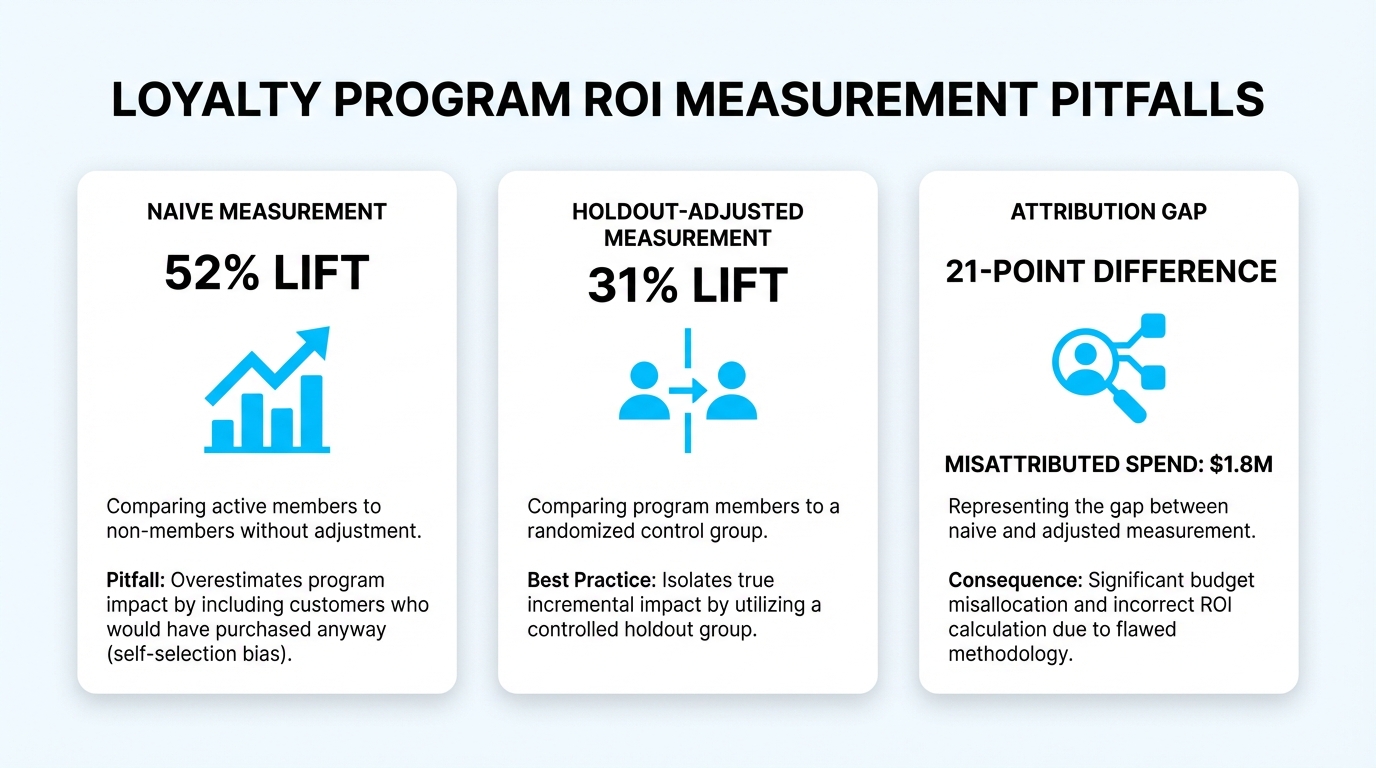
They compare members versus non-members and conclude the program works because members spend more. But members were already your best customers. They would have spent more anyway. Without a proper holdout or a randomized control group that does not receive the loyalty treatment every ROI figure is contaminated by selection bias.
Incrementality research using latent stratification shows that the true lift of a loyalty intervention is often 40 to 60 percent lower than naive before-after comparisons suggest.
Quick Tip
AI loyalty automation does not just deliver the treatment it designs the measurement. Automated holdout groups and continuous incrementality tracking ensure you know exactly what is working and what is taking credit for existing behavior.
A Real Measurement Framework
A DTC brand with 800,000 loyalty members ran a 90-day incrementality test on their AI-automated win-back campaign. The naive measurement showed 52% lift in reactivated spend. The holdout-adjusted measurement showed 31%.
Still massive but the 21-point gap represented $1.8 million in spend that would have happened regardless of the campaign. Without the holdout the brand would have over-attributed $1.8 million to a program that did not cause it.
Security Is the Foundation You Cannot See Until It Cracks
Loyalty programs are data-rich targets. Member profiles contain purchase history, payment methods, personal identifiers, and behavioral patterns exactly the kind of information that makes a breach catastrophic and a regulatory fine enormous.
The FTC data security guidance is clear: companies must implement reasonable security proportional to the sensitivity of the data they hold.
NIST SP 800-53 Rev. 5 provides the control families that any enterprise-grade loyalty automation platform must implement. And with AI in the loop NIST AI Risk Management Framework adds additional governance requirements around model transparency and bias monitoring.
This is where platform choice becomes a business-critical decision. A loyalty automation system built on infrastructure that already carries SOC 2 Type II certification, GDPR compliance, and HIPAA readiness like the enterprise platform architecture at NewVoices eliminates months of security validation and vendor risk assessment.
Did You Know
A national restaurant chain caught $340,000 in fraudulent redemptions within the first 60 days of deploying AI-powered anomaly detection on their loyalty platform. The same behavioral models that identify churn can identify account takeover patterns.
The Midnight Advantage: Why Timing Destroys Targeting
Marketers obsess over who to target and what to offer. They spend months on segmentation. Weeks on creative. Days on A/B testing subject lines.
Then they send the offer at 10 AM on a Tuesday because that is when the batch job runs.
Timing is the most undervalued variable in loyalty automation. A perfectly targeted offer delivered at the wrong moment performs worse than an average offer delivered at the exact right moment. AI loyalty program automation optimizes all three simultaneously who, what, and when but the when is where the largest unexploited gains live.
Quick Tip
A customer propensity to redeem a reward is not constant. It spikes after payday. It spikes after a positive service interaction. It spikes when a competitor promotion lands and they are actively comparison-shopping. AI detects these micro-moments and responds within seconds not days.
While your competitors service and operations teams close at 6 PM, an AI voice agent calls a high-value loyalty member at 8:47 PM the exact window their behavioral profile indicates peak receptivity and delivers a personalized retention offer in the member native language. Twenty-plus languages. No shift scheduling. No overtime.
3x Conversion Rate
Calls placed in AI-predicted optimal windows: 34% vs standard hours: 11%
Data Integration: The Boring Problem That Eats Loyalty Programs Alive
Every AI loyalty program automation initiative starts the same way: someone asks where is the data and the room goes quiet.
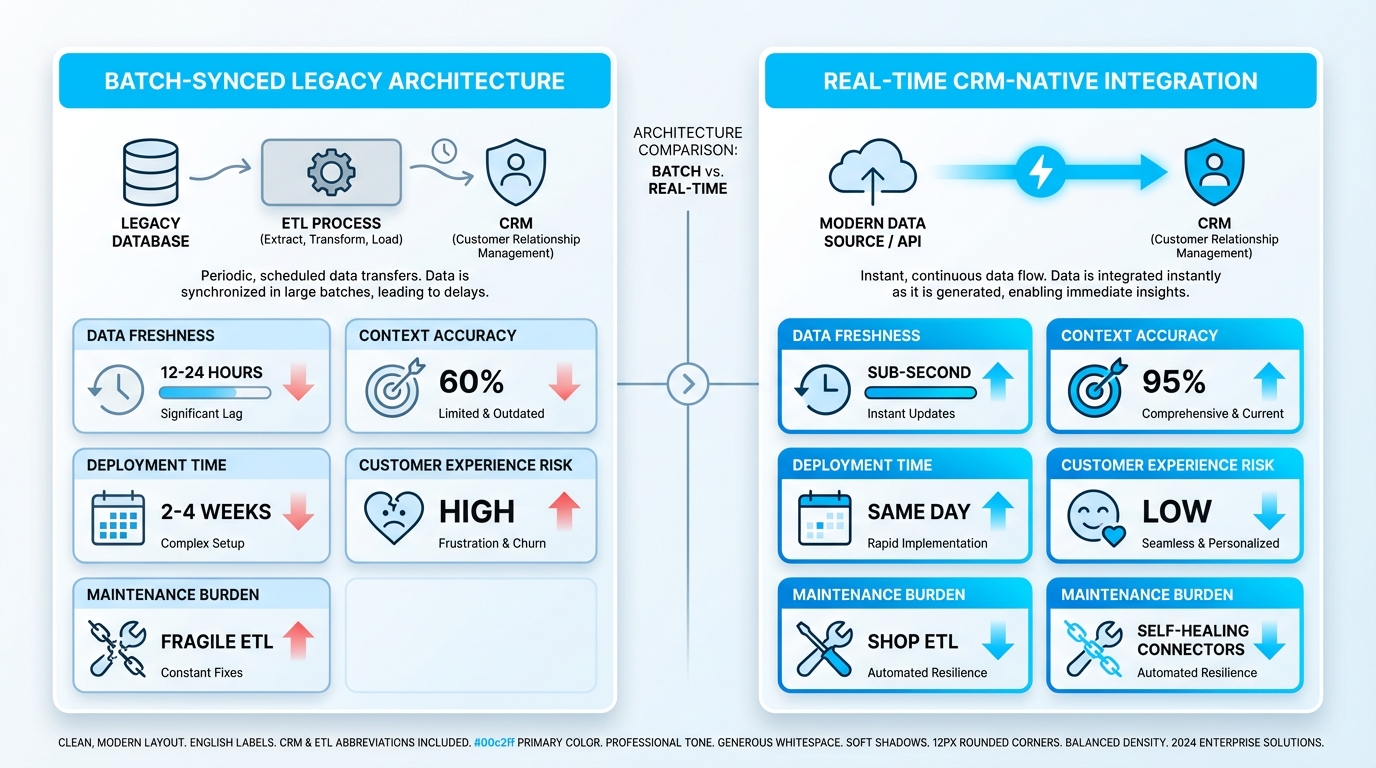
Purchase history lives in the POS. Email engagement lives in the ESP. Customer service interactions live in the CRM. Web behavior lives in the analytics platform. Loyalty points live in a standalone system that was implemented in 2017 and has not been updated since the vendor was acquired.
None of these systems talk to each other in real time. So the AI no matter how sophisticated makes decisions on partial information. It recommends a win-back offer to a customer who called support yesterday with a billing complaint. It sends a we miss you email to someone who bought in-store last week but whose purchase has not synced yet.
The fix is CRM-native integration that treats every data source as a real-time input not a nightly batch. When loyalty automation connects directly to Salesforce, HubSpot, Zendesk, Stripe, and Twilio pulling and pushing data at the event level the AI operates on the full customer picture.
The Mistake That Costs More Than Bad Targeting: Treating Every Member Like They Want Rewards
Not every loyal customer wants points. Not every high-value member wants discounts. And the fastest way to degrade a loyalty program perceived value is to assume that more rewards equals more loyalty.
Research into RFM segmentation including recent analysis of retail transaction data consistently shows that high-frequency high-monetary customers respond more to recognition and access than to discounts. They want to feel known not bribed.
This is where loyalty automation transcends reward management and becomes genuine customer engagement AI. The system does not just decide what to offer it decides whether to offer anything at all. A high-value member might receive a personal thank-you call from an AI voice agent that sounds indistinguishable from a senior account manager no discount no promo code just recognition.
Proven Results
A luxury e-commerce brand replaced discount-based outreach with recognition-based voice calls for their top 5% of loyalty members. Retention increased from 71% to 89% over six months. Revenue per member increased by $412 annually. The cost of the calls was a rounding error compared to the margin they preserved by not discounting.
This is not a chatbot with a script. It is a revenue engine that never clocks out and knows when the right move is to say thank you instead of here is 15 percent off.
What Your Loyalty Program Balance Sheet Is Trying to Tell You
Finance teams look at loyalty programs differently than marketing teams. Marketing sees engagement. Finance sees liability.
Every unredeemed loyalty point is a future obligation. Under ASC 606 the transaction price must be allocated between the goods or services delivered and the material right granted by the loyalty points as detailed in FASB TRG discussions on Topic 606 and Example 52.
The Next 18 Months: Where AI Loyalty Automation Is Already Heading
Predictive personalization is table stakes within a year. The frontier is preemptive loyalty where AI systems identify churn risk before the customer shows any traditional disengagement signal using patterns invisible to rule-based triggers.
A customer support ticket sentiment shifted from neutral to slightly negative across three interactions. Their session duration on the loyalty portal dropped by 22 seconds. They opened the last two promotional emails but did not click. No single signal triggers an alert. Together they form a pattern that AI recognizes as an 83% probability of churn within 30 days.
Quick Tip
Companies that deploy AI loyalty program automation in the next 18 months will compound their data advantage. Every interaction trains the model. Every outcome refines the predictions. Every quarter of operation widens the gap between intelligent loyalty systems and batch email senders.
This is where voice and conversational AI integration transforms loyalty programs from passive point-tracking systems into active relationship management platforms. The voice channel personal, immediate, emotionally resonant becomes the highest-impact touchpoint for retention moments that matter most.
Building the Machine: From Concept to Revenue in 90 Days
Deployment speed separates winners from committees. A loyalty automation initiative that takes nine months to launch loses three quarters of compounding data advantage. The operational question is simple: how fast can you go from approved to live?
With a no-code agent studio, business teams not engineers design loyalty workflows. A retention manager maps the trigger logic: If RFM score drops below threshold X and last purchase was more than Y days ago, initiate voice outreach sequence Z with reward tier A. No sprint planning. No engineering backlog. No six-week QA cycle. The agent goes live the same day.
Case Study: Healthcare Network
A regional healthcare network built a patient loyalty program from scratch. Week one: integrated scheduling, billing, and feedback systems. Week two: built automated outreach sequences. Week four: live with 14 distinct AI voice workflows handling 4,200 patient interactions per week. By day 90, patient retention for annual wellness visits increased from 61% to 84%, generating $1.7 million in retained revenue.
Speed is not reckless when the platform handles compliance SOC 2 Type II, HIPAA, GDPR by default. The governance is built in. The audit trail is automatic. The security controls align with NIST SP 800-53 control families.
Frequently Asked QuestionsClick to expand
How quickly can we see results from AI loyalty program automation?
Most organizations see measurable impact within 30 to 45 days. The healthcare network case study achieved $1.7 million in retained revenue by day 90, with significant improvements visible within the first month of deployment.
What integrations are required to get started?
The platform connects directly with major CRM systems including Salesforce and HubSpot, payment processors like Stripe, communication platforms like Twilio, and support tools like Zendesk. Pre-built connectors eliminate custom engineering work.
How does AI voice automation handle different languages?
The AI voice agents support 20-plus languages natively, delivering personalized outreach in each member native language without requiring separate campaigns or additional staffing for each market.
What compliance certifications does the platform have?
The platform maintains SOC 2 Type II certification, GDPR compliance, and HIPAA readiness. Security controls align with NIST SP 800-53 control families, eliminating months of vendor security assessment.
Do we need engineering resources to deploy and maintain the system?
No engineering resources required. The no-code Agent Studio allows business teams to design, deploy, and modify loyalty workflows same-day without sprint planning or development backlogs.
10,000+
Businesses Trust Our Platform
87%
Average Cost Reduction
90 Days
To Measurable ROI
Ready to Hear What Your Loyalty Program Sounds Like When It Actually Talks to Your Customers?
Experience the difference between a points ledger and a revenue engine that never sleeps.
Limited availability: First 50 demo requests this month receive exclusive implementation support
No credit card required. No commitment. Just results.