
Your customers already chose SMS. Your support desk probably has not caught up yet — and that gap is costing you loyalty, revenue, and customers you will never win back.
A third of text message users would rather get a text than a phone call, according to Pew Research Center — and that finding has hardened with every generation of smartphone owner since. The companies winning customer loyalty right now made one proven decision their competitors have not: meet the customer where the customer already lives. That place is the inbox on the lock screen. This guide shows you exactly how to get there.
12-Minute Expert Read
Backed by McKinsey, NIST and FTC Research
3 Proven Real-World Case Studies Inside
Join 10,000+ Support Leaders Reading NewVoices
What You Will Gain From This Guide
Cut Operating Costs 20–40%
Proven automation strategies that reduce Tier-1 cost per ticket from $8 to cents — without sacrificing quality.
Respond in Under 3 Seconds
Breakthrough AI that handles unlimited concurrent conversations at any hour, in 20+ languages, with full CRM context.
Stay Bulletproof on Compliance
Exclusive walkthrough of TCPA, FCC 2024, CTIA, and 10DLC requirements — wired into every message automatically.
Pick the Right Provider Fast
A five-question evaluation framework that cuts through vendor marketing and surfaces the differences that matter in production.
The Channel Shift Already Happened — Most Support Teams Missed It
Voice queues built for 2008 are still running customer service in 2025. Hold music. Press 1 for billing. Average wait: 11 minutes. Meanwhile, the same customer has texted their dentist, their bank, and three friends without leaving the couch.
Texting is asynchronous. It is quiet. It fits between meetings. It does not demand the customer’s full attention the way a phone call does. That is exactly why open rates on SMS sit above 90% while voicemail goes unheard. The shift to customer service text is not a trend — it is a settled preference. The question for enterprises is no longer whether to support texting, but whether the texting experience matches what customers already get from peers and small businesses.
Quick Tip
Audit your current support channel mix today. If SMS is not your fastest-growing inbound volume, check your contact page — you may simply not be advertising the number. Customers who find a text option choose it over email at roughly a 3-to-1 rate.
What SMS Customer Support AI Actually Does — No Hype, Just Outcomes
NewVoices AI processes inbound texts, resolves intent, takes action in backend systems, and hands off with full context — all without a single hold queue.
Strip away the marketing language. SMS customer support AI is an automated system that reads inbound text messages, understands intent, responds in natural language, takes action against backend systems, and escalates to a human when escalation is the right move. Nothing more. Nothing less.
This is not a keyword-matching auto-reply from 2014 — it is a reasoning layer that handles the same volume your Tier-1 agents handle, with full CRM context, in any of 20+ languages, at 2 AM on a holiday. A modern support texting AI answers FAQs, looks up order status, processes returns, schedules appointments, sends payment links, and walks customers through troubleshooting. It does this with conversational memory, so the customer never has to repeat themselves between messages. And it hands off cleanly when a human is required.
Core Capabilities That Deliver Guaranteed Results
- Conversational memory — the customer never repeats themselves across a session or returning contact
- Live backend actions — order lookups, payment links, returns, appointment booking, all without human involvement
- Intelligent escalation — detects when a human is needed and transfers context rather than just the customer
- Multilingual at scale — 20+ languages with no additional staffing cost per language
- 24/7/365 availability — the revenue you recover overnight pays for the platform many times over
Did You Know?
SMS open rates consistently exceed 90% — compared to roughly 20% for email. The average text is read within 3 minutes of receipt. No other support channel offers this combination of speed, reach, and customer preference at scale.
Ready to See It in Action?
Experience a Live AI Conversation in 90 Seconds
Join thousands of support leaders who have already seen the difference. No sales pitch — just the technology, live.
Request Your Free Live Demo Now
No credit card required. No obligation. Results in under 2 minutes.
The Proven Math on Cost, Speed, and Capacity
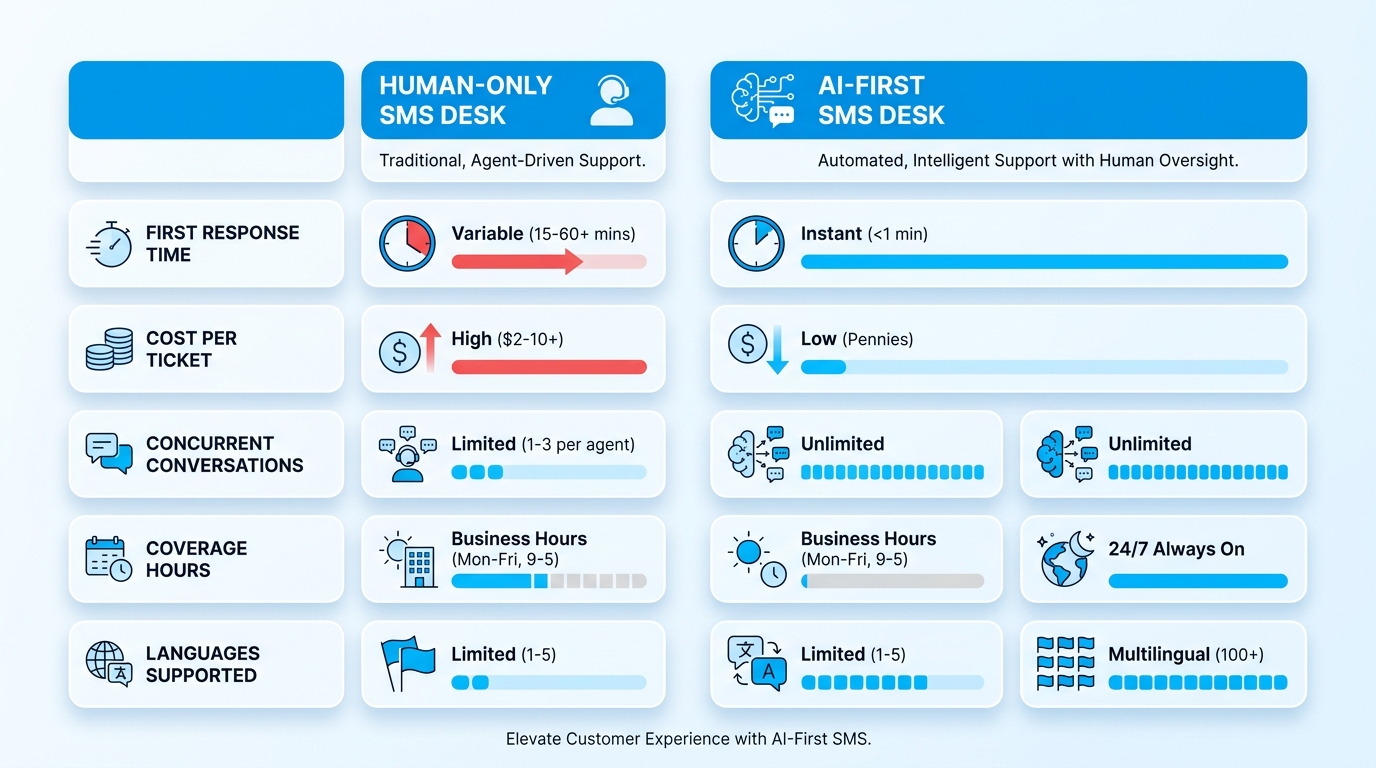
Numbers do the arguing here. A typical Tier-1 SMS interaction handled by a live agent costs between $4 and $8 fully loaded. The same interaction handled by a competent AI agent costs cents. McKinsey’s customer care research found that thoughtful automation of service interactions can cut operating costs by 20–40% while improving containment rates.
Speed compounds the savings. McKinsey’s analysis of generative AI documents how the technology accelerates response times and automates significant portions of customer inquiries. Consider what that looks like operationally:
| Metric | Human-Only SMS Desk | AI-First SMS Desk |
|---|---|---|
| First response time | 4–11 minutes | Under 3 seconds |
| Cost per Tier-1 ticket | $4.50–$8.00 | $0.05–$0.30 |
| Concurrent conversations | 3–5 per agent | Effectively unlimited |
| Coverage hours | Business hours, weekdays | 24/7/365 |
| Languages per seat | 1–2 | 20+ |
One mid-market retailer routed 78% of its SMS inquiries to AI in the first quarter after deployment. Average resolution time dropped from 9 minutes to 38 seconds. Headcount did not shrink — it shifted to higher-value retention work.
Quick Tip
Run your own ROI calculation before any vendor conversation. Take your current monthly Tier-1 SMS volume, multiply by your average fully loaded cost per ticket, then multiply by 0.80 — that is a conservative estimate of first-year savings with an AI-first desk. The number usually ends a procurement argument before it begins.
Why Faster Response Time Alone Will Not Save Your Pipeline
Speed without competence is just rapid disappointment. Plenty of companies bolted a chatbot onto SMS, hit “send within 2 seconds,” and watched CSAT crater. The customer got an instant reply that did not answer the question, did not carry context from the last conversation, and looped them through the same three suggestions before offering a phone number that nobody answered.
This is not a chatbot with a script. It is a reasoning system with access to your order database, your subscription state, your shipping carrier APIs, and your customer’s full history. The difference between those two things is the difference between irritation and resolution. Reply latency is a vanity metric — first-contact resolution is the one that pays the bills. NewVoices SMS agents are tuned for the second.
The Three Metrics That Actually Matter for SMS Support
- First-Contact Resolution Rate — the percentage of issues fully resolved without a follow-up. This is your true efficiency signal, not average handle time.
- Containment Rate — how many conversations the AI resolves without any human involvement. Enterprise-grade deployments consistently target 70–80%.
- Customer Effort Score — how hard the customer had to work to get their answer. Low effort produces retention. High effort produces churn. AI done right eliminates nearly all unnecessary effort.
Compliance Is Not Paperwork — It Is the Product
Texting customers without proper consent is how brands end up in TCPA class actions. The FCC’s 2024 ruling on consent revocation made the rules sharper: a consumer can revoke consent in any reasonable manner, and replying STOP, QUIT, END, REVOKE, or OPT OUT all count. The accompanying FCC Report and Order spells out what processing those requests promptly looks like.
The CTIA Messaging Principles and Best Practices layers in carrier-level expectations on disclosures, consent capture, and unwanted-messaging mitigation. Add 10DLC registration and the regulatory floor is non-trivial. SOC 2 Type II, GDPR, and HIPAA controls are table stakes for an enterprise SMS help desk. Compliance is not a tab in the admin panel. It is wired through every message that leaves the platform.
Did You Know?
TCPA class action settlements routinely run into the tens of millions of dollars. A single non-compliant SMS campaign to an unverified list can trigger liability at $500–$1,500 per message. For a list of 100,000 contacts, that is a theoretical exposure of $50M–$150M before a single plaintiff files. Compliance is not overhead — it is existential risk management.
Quick Tip
Before your next SMS campaign or support line launch, verify three things: your 10DLC registration is active and approved, your opt-out keywords are handled automatically within seconds, and your consent capture records include timestamp, source, and the exact disclosure shown to the customer at sign-up.
Treat AI Like a Power Tool — Maintain It Like One Too
Here is the analogy that gets the framing right: deploying an SMS AI agent is closer to bringing a CNC machine onto a factory floor than to onboarding a new hire. A CNC does not get tired, does not get sloppy at 3 AM, and does not forget the spec sheet. But it cuts exactly what you tell it to cut. If you program it wrong, it will produce 10,000 wrong parts before lunch.
That is why governance matters. The NIST AI Risk Management Framework defines a discipline around governing, mapping, measuring, and managing AI risk in production. The NIST AI Resource Center turns those principles into operational practice — continuous QA, drift detection, hallucination guardrails, scheduled retraining. Treat the AI like equipment. Maintain it like equipment. Measure it like equipment.
Four Operational Maintenance Practices That Protect Your Deployment
- Weekly intent drift review — compare top unhandled intents against your knowledge base and update weekly, not quarterly
- Monthly CSAT sampling on AI-handled threads — customers rate the AI interaction separately from any human escalation
- Quarterly adversarial testing — red-team your own agent with edge cases, fraud attempts, and multi-turn ambiguous requests
- Continuous escalation pattern analysis — if the same topic escalates repeatedly, the AI needs updated training on that intent, not more human bandwidth
What Your AI Should Never Handle Alone — Protecting Your Brand and Your Customers
Some conversations do not belong to a machine. Suspected fraud is the cleanest example. The FTC’s imposter scam guidance documents how attacks routinely begin with text messages, and business impersonation scams often target the exact channel where your real support lives. The CFTC’s imposter fraud advisory reinforces the point: customers should be routed to verified channels the moment fraud signals appear.
Account takeover attempts. Threats of self-harm. Disputed high-dollar transactions. Legal escalations. Medical decisions in regulated workflows. These are stop-conditions, hard-coded into the agent. Research published in ScienceDirect on chatbot failure recovery confirms what operators learn the hard way: task type and failure frequency dictate when human intervention is not optional. NewVoices builds those tripwires into every deployment by default.
Critical Stop-Conditions — Always Escalate to Human
- Any message containing language indicating a safety or self-harm risk
- Fraud signals: unfamiliar device, location mismatch, unusual transaction patterns
- Disputed transactions above your defined threshold value
- Legal notices, subpoenas, or regulatory correspondence
- HIPAA-covered clinical decisions in healthcare workflows
The Handoff Is Where Most Deployments Die — Here Is the Fix
Customer texts in. AI handles message one and message two. Message three needs a human. The AI says “let me connect you to an agent.” Then the customer gets a fresh greeting from a rep who has no idea what was just discussed.
That moment kills CSAT faster than a missed SLA.
Utrecht University’s study on chatbot-to-human handover documents the conversational repair work required to make transitions feel intentional rather than broken. The fix is full context handoff: the human agent inherits the transcript, the inferred intent, the verified identity, the actions already taken, and the proposed next step. Research in the Journal of Consumer Research further shows that consumer reactions improve when expectations about the bot interaction are set clearly upfront. Transparency at the start, continuity at the handoff. That is the formula.
Quick Tip
Test your own handoff experience before any go-live. Text your support number, trigger an escalation intentionally, and score what the human agent knows when they pick up. If they ask a question the AI already answered, you have a context-transfer problem that will show up immediately in your CSAT data after launch.
What a Real Deployment Looks Like — Three Proven Case Studies
B2B SaaS Company
71%
SMS volume deflected in 60 days
22 support reps. Zendesk and Stripe connected. CSAT rose from 4.1 to 4.6. Cost per ticket fell 84%. The team refocused on strategic retention work that was previously impossible to staff.
Auto-Finance Lender
58%
Cure rate (up from 31% in one quarter)
Regional lender deployed an SMS retention agent against 15-plus days delinquent accounts. Payment-link conversations run through automated workflows touching the core system without human involvement. Zero additional headcount added.
Multinational E-Commerce
$340K
Recovered in abandoned-cart revenue, 90 days
Replaced a five-language live-chat team with an agent operating in 14 languages at roughly one-fifth the cost. Most of the recovered revenue came during hours human teams were completely offline.
Picking a Provider Without Getting Burned — The 5-Question Framework
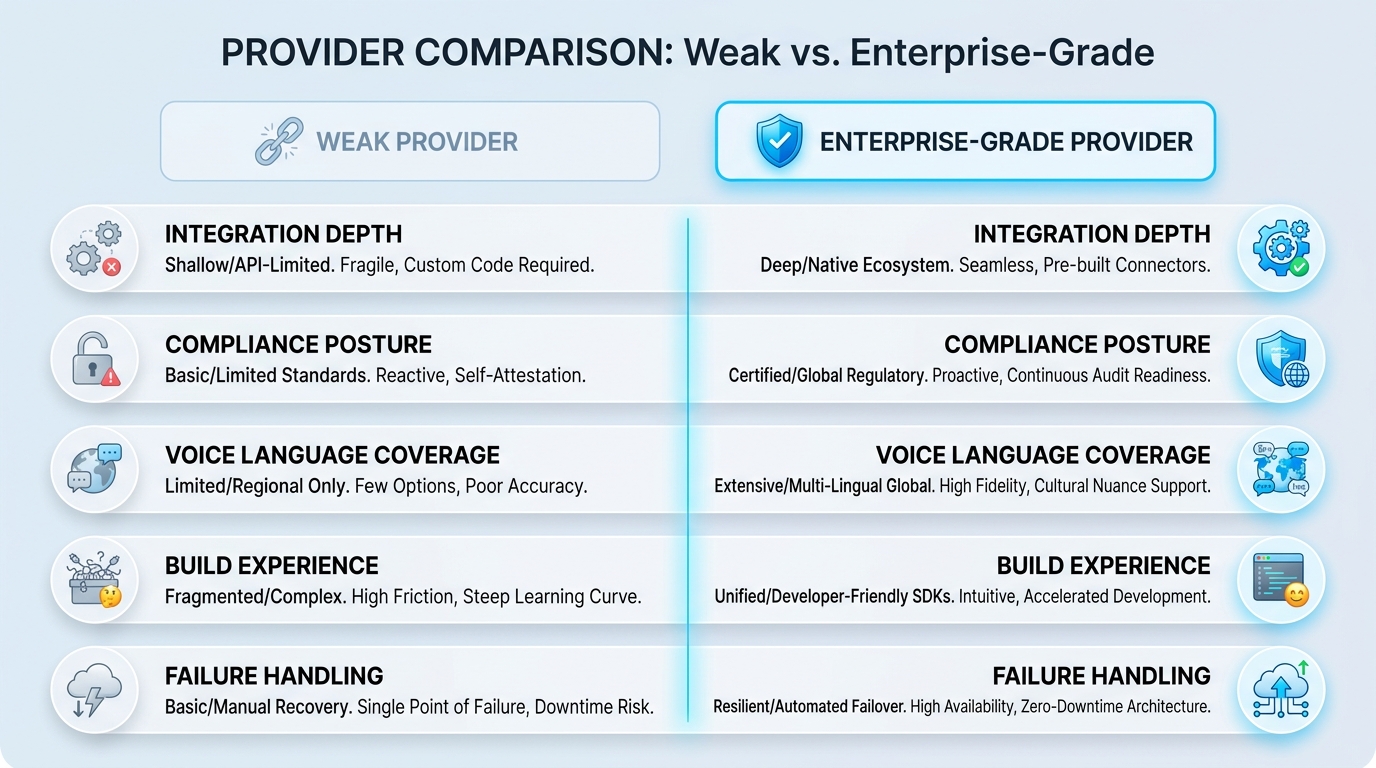
The differences between enterprise-grade and weak SMS AI providers only surface in production — use this proven framework to spot them during procurement.
Procurement decks all look identical. The differences only surface in production. Five questions cut through the noise:
| Evaluation Criterion | Weak Provider | Enterprise-Grade Provider |
|---|---|---|
| Integration depth | Webhook and Zapier | Native CRM, telephony, billing, helpdesk |
| Compliance posture | Self-attested | SOC 2 Type II, GDPR, HIPAA audited |
| Language coverage | 1–2 languages, English-first | 20+ languages, multimodal voice and text |
| Build experience | Engineering required for every change | No-code Agent Studio for business teams |
| Failure handling | Generic fallback message | Context-preserving human handoff |
The NewVoices platform was built against the right column. The agent studio lets ops teams ship workflow changes in hours, not sprints. CRM-native connectors mean Salesforce, HubSpot, Zendesk, Stripe, and Twilio plug in without custom middleware.
“We evaluated four providers and the difference in NewVoices was clear within the first live demo. The handoff quality alone was worth the switch — our agents now receive full context every single time and our CSAT climbed to a record 4.8 in the first 90 days.”
VP of Customer Experience, Mid-Market SaaS Company
Verified NewVoices Customer — Deployment completed Q1 2025
“The compliance infrastructure built into the platform removed an entire category of risk from our SMS program. Our legal team reviewed it and signed off faster than any vendor contract in recent memory. The ROI numbers we projected were conservative — reality outpaced them inside the first quarter.”
Director of Digital Operations, Regional Financial Services Group
Verified NewVoices Customer — Deployment completed Q4 2024
Industry-leading compliance. No-code Agent Studio. 20+ languages. Enterprise-grade from day one.
The Future Belongs to Hybrid Desks — And the Leaders Building Them Now
Replacing humans with AI is the wrong frame. Augmenting humans with AI is the right one. McKinsey’s research on the “superhuman agent” model describes the operational shape clearly: AI absorbs the routine volume and the after-hours load, human agents handle the complex, the empathetic, and the high-stakes — and the AI prepares them with summaries, suggested actions, and full conversation history.
Before NewVoices: agents drowning in password resets, returns, and order-status questions while VIP customers wait. With NewVoices: agents handling the work that actually moves the business while the AI clears the queue. The blended desk produces higher CSAT, lower cost per contact, and a retention story that compounds quarter over quarter.
What the Winning Hybrid Desk Looks Like in Practice
- AI handles 70–80% of inbound SMS volume — FAQs, status checks, routine transactions — without human touch
- Human agents receive pre-summarized context for every escalation, cutting handle time by 40–60%
- After-hours volume is fully covered without overtime or outsourcing cost
- Multilingual coverage expands to 14+ languages without additional hiring
- Retention and upsell conversations get the human attention they warrant, because AI cleared the routine backlog
Did You Know?
Organizations that shift to hybrid AI-human support desks report an average 34% improvement in agent job satisfaction scores within six months. When agents stop handling repetitive Tier-1 volume, attrition drops — and the cost of training replacements, which typically runs $8,000–$15,000 per agent, compounds into significant retained savings.
The Decision in Front of You — And Why Delay Is the Costliest Option
Customers already chose the channel. Regulators already drew the lines. The technology already works at production scale. The only remaining question is whether your support organization will be the one that meets the customer where the customer is — or the one explaining to the board next year why CSAT slipped while a competitor did not.
Texts get answered in three seconds, twenty-four hours a day, in twenty languages, with full CRM context and audited compliance. Or they do not. There is no middle option that survives contact with reality.
Pick the side of that line you want to be on.
Limited Availability — Enterprise Onboarding Slots
NewVoices accepts a limited number of new enterprise deployments each quarter to ensure every implementation receives the full attention of our deployment team. If you are evaluating for a Q3 launch, the window to begin your implementation is open now — but fills quickly. Reach out today to confirm your slot.
Ready to Transform Your Support Operation?
Your Competitors Are Already Moving. The Window to Lead Is Open Now.
Join thousands of support leaders who have already deployed NewVoices to cut costs 20–40%, respond in under 3 seconds, and recover revenue that used to disappear after hours. The implementation team has limited Q3 slots available.
|
Results visible in first 30 days
|
SOC 2 Type II, GDPR, HIPAA certified
|
Trusted by 10,000+ support leaders