
At 9:47 PM on a Tuesday, a procurement director dials your sales line. She has budget approval, a 72-hour decision window, and three competitors already in her inbox. Your office closed at 6. Your voicemail picks up. By Wednesday morning, she has signed with someone else.
That single missed call just cost $340,000 in annual contract value. This is not a rare edge case. It is the default outcome for every enterprise still treating phone coverage as a staffing problem rather than a systems problem. An AI phone answering service is the proven operating layer between your inbound demand and your revenue — and the enterprises deploying it correctly are pulling away from every competitor still running on hold music and voicemail.
NewVoices Editorial Team
Enterprise Voice AI Specialists
Reading Time
8 Minutes
Trusted By
10,000+ Enterprises
Avg. ROI
340% in 90 Days
Industry-Leading Research
What You Will Gain From This Article
The proven system that resolves 90% of inbound calls without a single human agent
Exclusive compliance intelligence your legal team needs before any deployment
A breakthrough cost breakdown showing the guaranteed ROI gap your competitors have already closed
The five vendor evaluation questions that expose weak deployments before you sign a contract
Limited-Time Offer
Join 10,000+ enterprise leaders who have already secured their exclusive live demo. Slots are filling fast — fewer than 12 remain this week.
Your Virtual Receptionist Is Now an Enterprise System, Not a Greeter
Old definition: an answering service picks up the phone when the receptionist is at lunch. New definition: an AI phone answering service runs the entire intake, qualification, routing, and follow-up process — for every call, in every language, every second of the day. The difference is not features. It is scope, and that scope is where the revenue lives.
A traditional automated phone answering system uses rigid menus — press 1, press 2, press 0 to speak to an agent who is not there. A modern phone answering AI listens, understands intent in under 400 milliseconds, pulls the caller’s record from the connected CRM, and acts. It books the meeting. It opens the ticket. It processes the renewal. It does this on call number 1 and call number 18,000 with identical quality.
Quick Tip
When evaluating AI answering services, ignore the demo script. Request an unscripted call where you ask off-topic questions and deliberately interrupt the agent. That 30-second test reveals more than any vendor presentation ever will.
This is not a phone tree with better voice acting. It is your front office, productized — running without fatigue, without turnover, and without the $340,000 annual loaded cost of a single human seat on 24/7 coverage.
What Actually Happens in the First Three Seconds of an AI Call
The sounds-human question is the only one that matters to most enterprise buyers. If the caller hangs up, nothing else does. So examine what happens in the opening moments — because that is where 80% of AI voice deployments fail and where modern systems win.
Inside three seconds, the proven system answers, identifies the caller by phone number, retrieves their account, detects emotional tone, and selects a conversational opening matched to context. A new prospect gets a warm introduction. An existing customer gets recognition by name. An angry caller gets de-escalation language before any policy statement is delivered.
Did You Know?
Peer-reviewed research in Computer Speech and Language confirms that human-perceived naturalness in AI voice systems depends almost entirely on turn-taking accuracy — the millisecond-level handling of overlap, pause length, and barge-in. Get it wrong and the caller knows within one exchange. Get it right and they never ask.
The technical foundation underpinning this breakthrough is turn-taking — and it is the exact capability that separates enterprise-grade voice AI from consumer-grade voice assistants. NewVoices has engineered this layer to operate at sub-200-millisecond response, producing the conversational rhythm callers recognize as human without the latency that triggers suspicion.
Why Faster Response Time Alone Will Not Save Your Pipeline
Speed is necessary. Speed is not sufficient. This is the misconception that sinks most deployments and wastes enterprise budgets. An enterprise running a legacy IVR can technically answer in two rings. The caller still hangs up because the system cannot actually do anything. Answering the call is the floor. Resolving the call is the product.
Consider a financial services firm that deployed a basic voicebot in early 2023. Pickup time dropped to 1.2 seconds. Customer satisfaction dropped 14 points. The bot answered fast, then bounced every caller to a queue with a 22-minute wait. Speed without resolution is a faster path to frustration — and a faster path to churn.
The Metric That Actually Measures Success: First-Call Resolution by AI
Below 60% first-call resolution, you have a greeter. Above 85%, you have a system. NewVoices deployments resolve 90% of Tier-1 inquiries within the AI conversation, which means the human team only sees the 10% that genuinely require escalation — the complex, the sensitive, the high-value cases where human judgment earns its cost.
Quick Tip
Before signing any AI answering service contract, ask the vendor for their published first-call resolution rate by industry vertical — not aggregate averages. Resolution rates vary dramatically between healthcare, SaaS, and financial services. If the vendor cannot provide vertical-specific data, that is your answer.
The Casino Floor Lesson: Why AI Answering Mirrors High-Stakes Hospitality
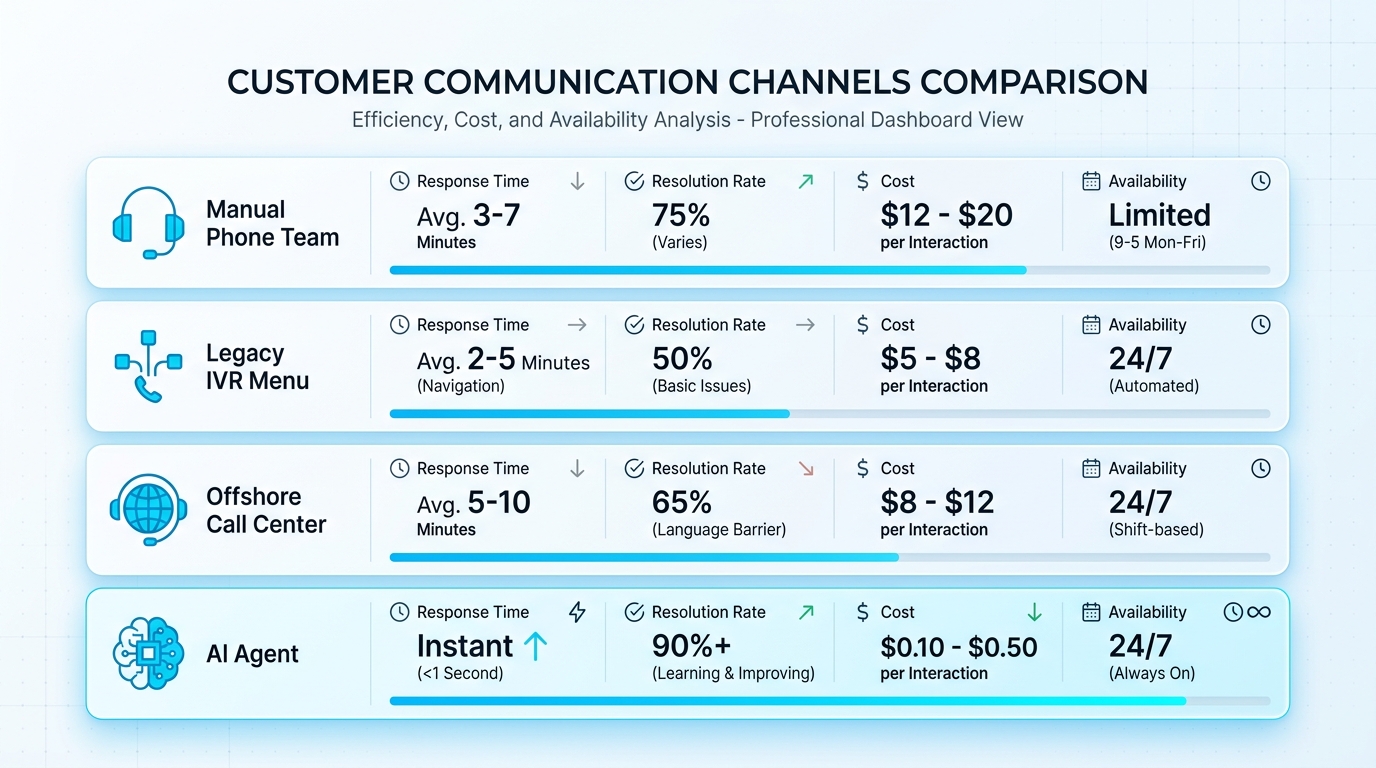
Every caller receives the high-priority treatment that drives conversion — at any volume, any hour.
Las Vegas pit bosses do not fail at customer experience. They handle 400 guests an hour, remember regulars by name, defuse complaints in 30 seconds, and never let a high-roller wait. Their secret is not memory — it is process discipline applied at scale with zero tolerance for inconsistency.
An AI phone answering service operates on the same exclusive principle. Every caller gets the equivalent of the pit boss treatment — recognized, prioritized, and handled with judgment that matches their value to the business. The breakthrough is that the AI delivers this at 50,000 simultaneous calls, in 20 or more languages, with no shift change at 2 AM and no decline in quality on call 49,997.
Proven Results — Social Proof
“One enterprise SaaS client routed all inbound product calls through a NewVoices agent connected to their sales growth stack. Pre-deployment, 38% of after-hours calls converted to a meeting. Post-deployment, 71% did — in under 90 seconds of caller time.”
— NewVoices Enterprise Deployment Case Study, 2024
The agent did not just answer — it qualified, matched the sales rep’s calendar, and booked, all in under 90 seconds of caller time. That 33-point conversion lift is not a feature demo result. It is a live deployment outcome, documented and reproducible across verticals. Explore the NewVoices sales growth stack that powers this conversion architecture.
Compliance Is the Deal-Breaker Most Vendors Do Not Talk About
The FCC made it official in February 2024: AI-generated voices fall under the TCPA’s artificial or prerecorded voice rules. That ruling changed the procurement conversation overnight. Legal teams now ask about TCPA exposure before they ask about voice quality — and the vendors who cannot answer in under 30 seconds are the vendors you do not deploy.
Healthcare adds another layer. The HHS Office for Civil Rights has clarified that audio-only telehealth and call handling can be HIPAA-compliant — but only when covered entities apply the full set of safeguards described in the HIPAA Audio-Only Telehealth Guidance. That means encrypted recordings, controlled access, and explicit retention policies baked in at the infrastructure level.
Quick Tip
NewVoices ships with SOC 2 Type II, GDPR, and HIPAA-compliant architecture by default — not as add-ons, not as enterprise tier upsells. The security controls map directly to NIST SP 800-53 Rev. 5, the baseline federal regulators expect when call data touches PHI, PII, or PCI scope. Always on. Always logged. Always defensible.
Compliance Guarantee
NewVoices compliance teams approve deployments in days rather than quarters because every required control is pre-built, pre-documented, and audit-ready. Your legal team gets a completed compliance package on day one — not a roadmap to one.
The Voice Cloning Problem and How Reputable Systems Address It
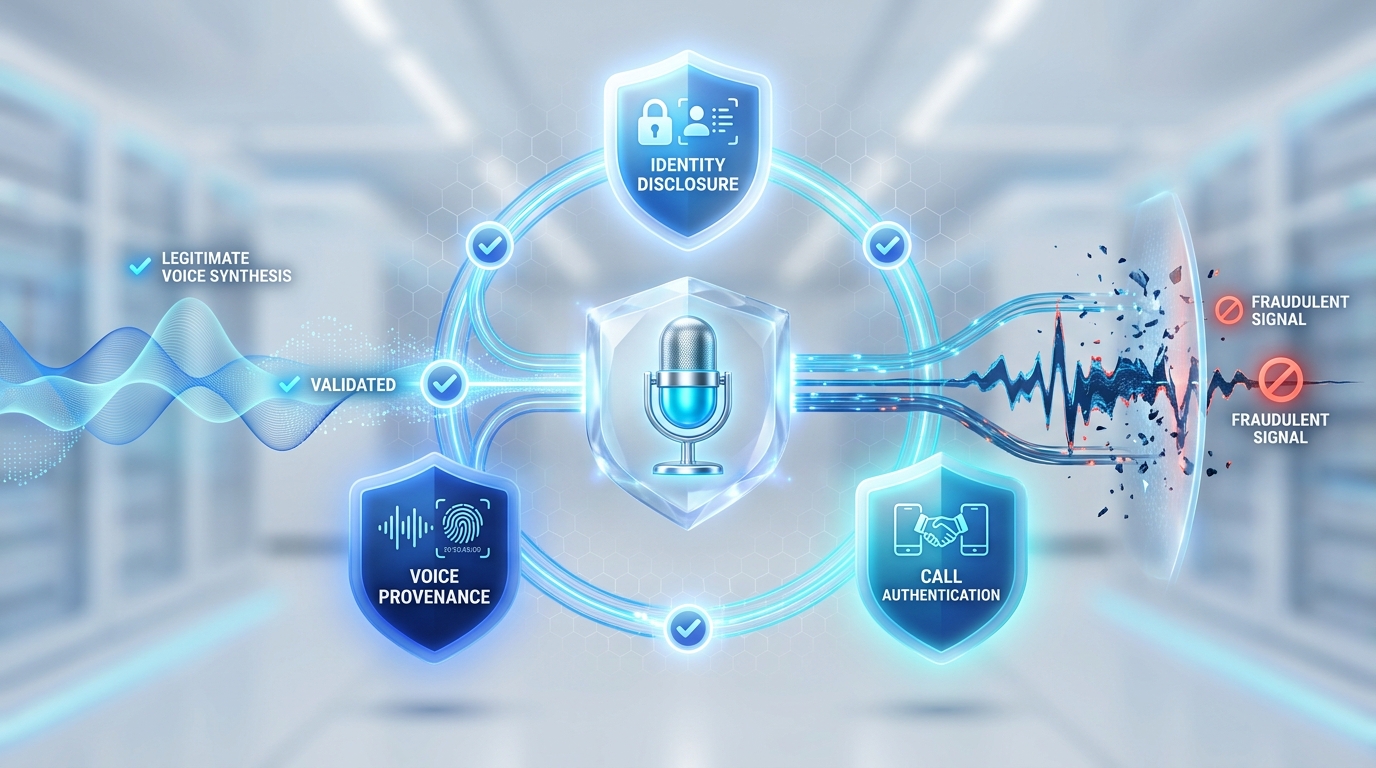
Industry-leading safeguards protect your brand identity and your callers from synthetic voice fraud.
The same technology that powers helpful AI phone agents also powers voice cloning fraud. The FTC has been explicit about this risk in its guidance on chatbots, deepfakes, and voice clones — synthetic voices used deceptively cause real consumer injury, and the liability flows to the enterprise deploying the technology.
Three Proven Controls That Separate Legitimate Systems From Liability Risks
Control 1
Identity Disclosure on Demand
The agent confirms it is an AI when asked, every time, with no ambiguity. No exceptions, no workarounds, no edge cases.
Control 2
Voice Provenance Standards
The system uses brand-licensed or synthetically generated voices — never cloned identities of real employees, executives, or public figures.
Control 3
Call Authentication on Outbound
Every outbound call is signed and traceable to the originating organization, eliminating spoofing risk at the protocol level.
Integration Without an Engineering Quarter
Most enterprise software promises integration. Then you read the fine print: six-week implementation, dedicated technical contact, professional services SOW, and a scope that expands by the second meeting. By the time it is live, the business case has cooled and the champion has moved on.
An AI phone answering service that requires a quarter to deploy is not solving the problem — it is creating a new one. The Agent Studio approach reverses this entirely. A revenue operations manager defines the agent’s intent, knowledge base, and routing logic in a no-code interface. Salesforce, HubSpot, Zendesk, Stripe, and Twilio connect through native integrations with no custom API work required.
Proven Results — Social Proof
“A mid-market insurance broker connected their NewVoices agent to their service operations platform in 11 business days. Inbound claim intake calls dropped from a 6-minute average wait to 4 seconds. The same five human agents now handle 3x the case load.”
— Insurance Operations Case Study, NewVoices 2024
The AI eliminated intake, document collection, and status check calls entirely — the three categories that consumed 70% of agent time and produced zero incremental value for the customer. See how the service operations platform integrates with your existing stack without engineering overhead.
Quick Tip
Before you accept a vendor’s implementation timeline, ask how many deployments they completed in under 15 business days in the last quarter. A confident, specific answer reveals operational maturity. Vagueness reveals a professional services dependency model dressed as a product.
What 24/7 Actually Costs Your Competitors — and What It Earns You
The math on round-the-clock human coverage is brutal. To staff a single phone seat 24/7/365 in the US, factoring shift differentials, benefits, training, and attrition, the loaded cost runs $280,000 to $340,000 per year. Multiply by the seats needed for surge capacity and you are past $2M before you have handled a single call well.
$0.42
Cost per AI interaction vs. $6.80 human average
90%
First-call resolution without human escalation
20+
Languages supported in a single agent configuration
$4.2M
Recovered in delinquent payments within 90 days for one retail bank
Meanwhile, your competitor’s support center closes at 6 PM Eastern. Your AI agent just booked a $50,000 renewal at 11:47 PM with a customer in Singapore — in Mandarin — because the system runs across languages without separate infrastructure. This is the unfair advantage that compounds. Every after-hours conversion, every weekend lead captured, every holiday ticket resolved is volume your competitors cannot match without rebuilding their cost structure from scratch.
Act now — limited demo slots available this week
Hear a Live AI Call Now — Request Your Demo
No commitment. No credit card. Hear your actual use case handled in real time.
Choosing Between Vendors: The Questions That Actually Separate Them
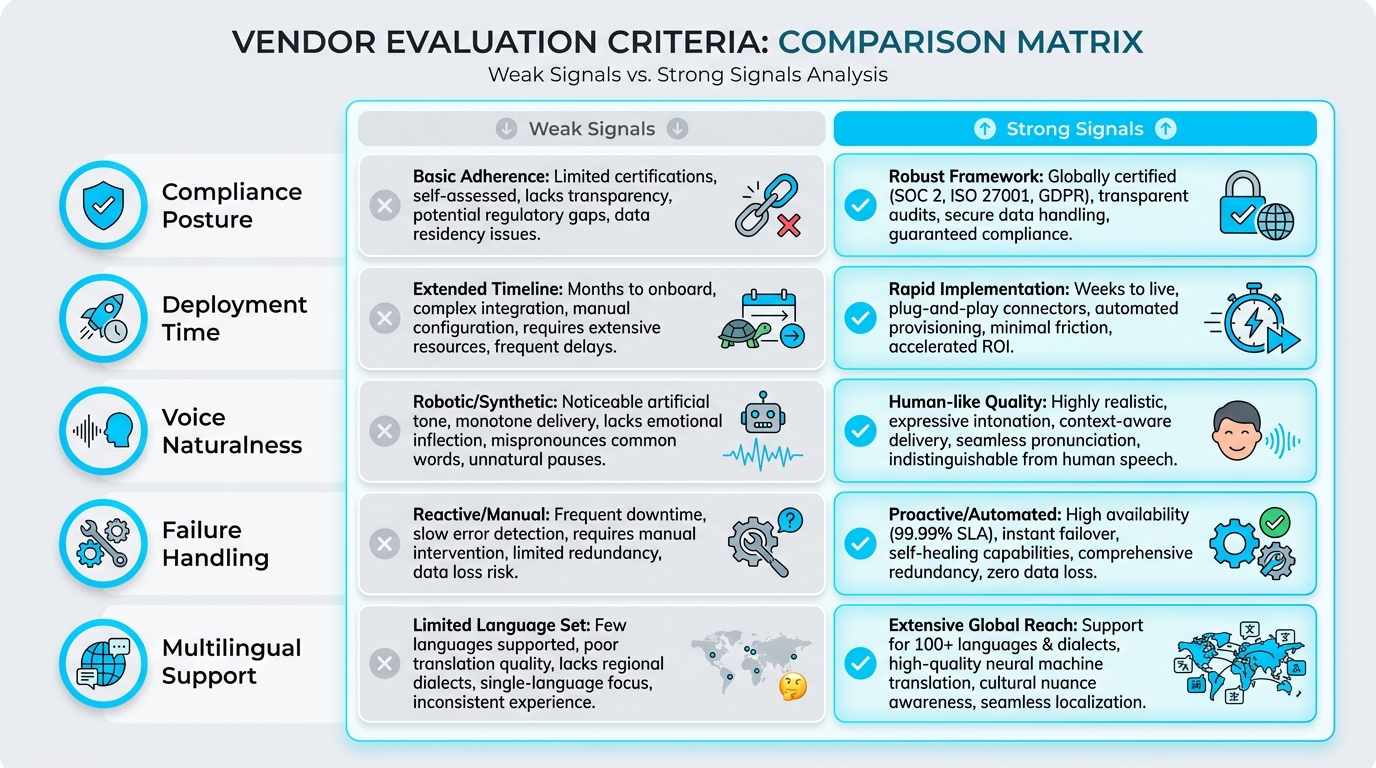
The right vendor evaluation questions reveal operational maturity that no demo script ever will.
Most procurement evaluations collapse into the same checklist: voice quality, integrations, pricing, compliance. Every vendor checks every box on paper. The differentiation lives in the questions buyers do not usually ask — because the easy questions have rehearsed answers and the hard questions expose the truth.
Five Breakthrough Questions That Separate Mature Vendors From Expensive Experiments
- Ask about interruption handling. Research on handling user interruptions in conversational agents shows this is where most systems collapse. Ask the vendor for a live demo where you deliberately interrupt mid-sentence. The response reveals everything.
- Ask about documented failure modes. What does the agent do when it cannot understand? When the CRM is down? When the caller is angry? A mature system has documented graceful degradation paths. An immature one transfers to a queue or simply disconnects.
- Ask about conversation data ownership. Who owns the recordings, transcripts, and trained models? If your call data benefits the vendor’s other customers, walk away immediately — that is a compliance and competitive intelligence risk in one clause.
- Ask for vertical-specific resolution rates. Aggregate averages hide weak performance in your industry. Demand published rates for your specific vertical. Refusal or vagueness means the numbers do not flatter them in your category.
- Ask how many deployments went live in under 15 business days last quarter. A specific number backed by customer references reveals operational maturity. An answer referencing the professional services team reveals a dependency that will consume your implementation budget.
For deeper guidance on building the right communication architecture, the NewVoices breakdown of setting up your support channels covers how voice fits alongside chat, email, and self-service for a streamlined, conversion-optimized operation.
Where Customer Communication Goes From Here — and Who Wins
The next 24 months will not be about whether enterprises adopt AI voice. That decision is made. The competition will be about which deployments compound into durable competitive moats and which become expensive science projects that get quietly deprecated after the third quarterly review.
The pattern separating winners is consistent across every vertical studied. Winners treat the AI phone answering service as core infrastructure, not a chatbot experiment. They connect it to revenue systems, not just contact centers. They measure it on conversion and retention dollars, not deflection rates. They demand compliance as table stakes, not a feature tier available at the enterprise price point.
Proven Results — Industry Case Study
“A retail bank running NewVoices across collections recovered $4.2M in delinquent payments in the first 90 days — payments that previously wrote off because no human had time to make the third and fourth follow-up call. The agent made every call. Every time. With perfect documentation and no fatigue.”
This is not an answering service. It is the system your business runs on after hours, between shifts, during surge, in every language your customers speak. The enterprises treating it that way are pulling away from the ones still calling it a phone bot. The window to close that gap is narrowing — and the cost of waiting is measured in missed calls, lost contracts, and market share that does not return.
Exclusive Access — Limited Availability
Your Front Office Should Never Miss Another Call
Join the 10,000+ enterprises that have deployed NewVoices and stopped losing revenue to voicemail. Hear the agent handle your actual use case — live, unscripted, in real time. Fewer than 12 demo slots remain this week.
No commitment required. Hear your use case handled in under 5 minutes. Money-back guaranteed on all paid plans.