
At 9:47 PM on a Tuesday, a procurement director at a Fortune 500 manufacturer dialed a vendor’s main line with a $340,000 urgent order. The call went to voicemail. By 8:00 AM the next morning, she had already signed with a competitor who answered on the second ring.
That vendor did not lose a deal. They lost a customer — plus every reorder, every referral, every renewal that relationship would have generated over seven years. This is what silence costs after 6 PM. And it is why after-hours answering AI has stopped being a support tool and started being a revenue line item.
min read
What You Will Gain From This Article
Recover $2M+ in lost pipeline
Discover the exact after-hours gap draining your revenue every single night
Cut costs by $240,000+ annually
See the proven math CFOs use to greenlight AI voice deployments in days
Go live in under 3 weeks
No engineering dependency, no 9-month implementation, no disruption
The 14-Hour Revenue Gap Nobody on Your Leadership Team Is Measuring
Your contact center runs eight hours. Your customers live in twenty-four. That is a 14-hour gap every weekday — plus 48 unbroken hours every weekend — where high-intent calls hit voicemail, get routed to dead queues, or simply abandon.
Research on missed appointments and unanswered calls in clinical settings shows that a significant percentage of outreach and inbound attempts go unanswered, with measurable downstream effects on patient outcomes and revenue (PMC Clinical Research). The commercial version of this problem is worse. Enterprise buyers research after hours. Consumers call when the kids are asleep. Emergencies do not check your schedule.
Did You Know?
A midmarket home services company logged 4,200 inbound calls per month. 38% came outside business hours. Of those, 71% never left a voicemail — that is 1,132 missed conversations per month, roughly $2.1M in annualized pipeline, completely unanswered.
This is not a staffing problem. It is a coverage problem — and no amount of overtime solves it.
Why Hiring a Night Shift Is the Wrong Answer in 2025
The instinct is to throw humans at the gap. Add a graveyard team. Outsource to an overseas answering service. Rotate weekend on-call. The math collapses on contact.
A single US-based after-hours agent costs roughly $52,000 fully loaded. To cover 14 weekday hours plus weekends with proper redundancy, you need at least six agents. That is $312,000 per year for a team that handles maybe 40 calls per shift — and quits at a 38% annual attrition rate.
Outsourced answering services solve the cost problem and create a quality problem. Scripts are rigid. Agents juggle multiple clients. They do not know your products, your CRM rules, or your escalation paths. Callers can hear the confusion in three seconds.
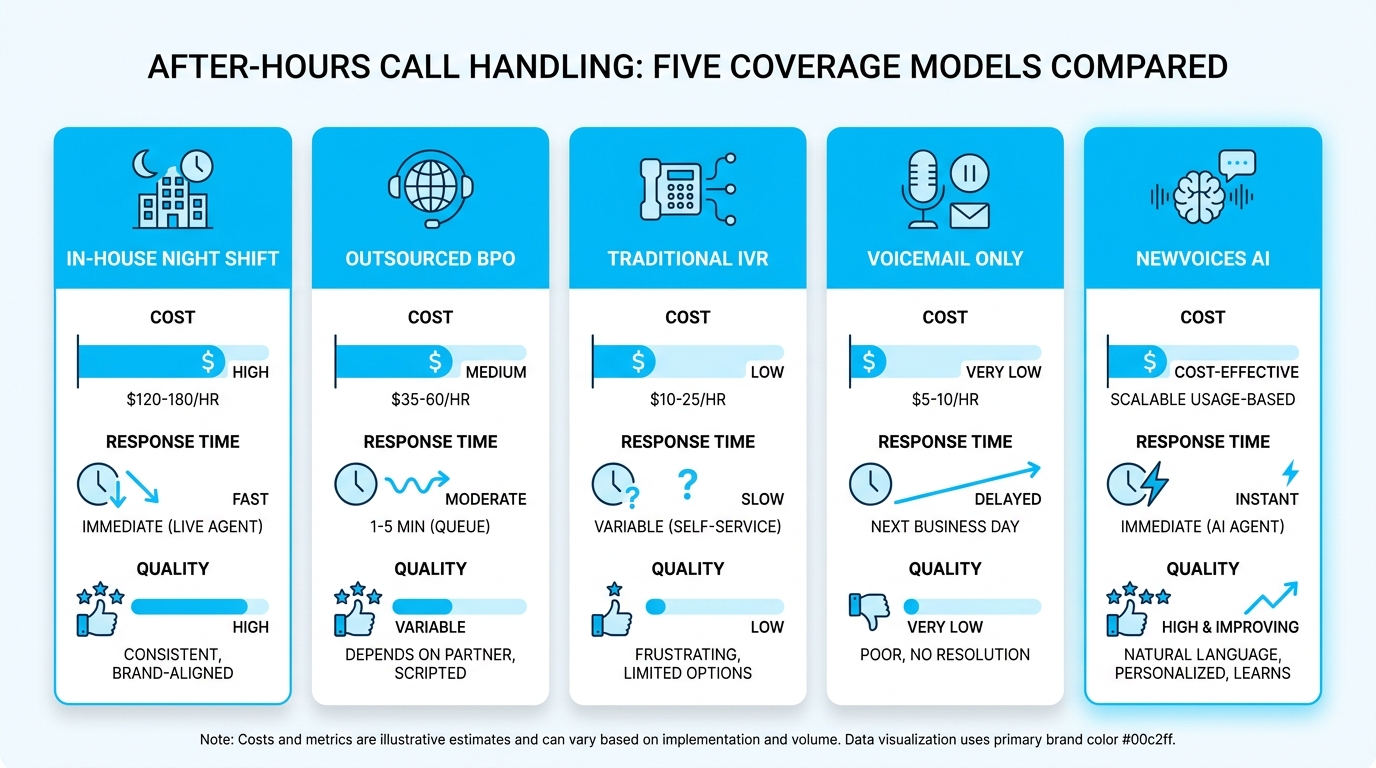
| Coverage Model | Annual Cost (14-hr gap) | Avg. Response Time | CRM-Native | Quality Consistency |
|---|---|---|---|---|
| In-house night shift | $312,000+ | 45 seconds | Yes | Variable (fatigue) |
| Outsourced BPO | $84,000–$140,000 | 90 seconds | Rarely | Low |
| Traditional IVR | $18,000 | Instant menu, 6+ min resolution | Partial | Poor (34% abandonment) |
| Voicemail only | $0 direct | Next business day | No | 71% never return |
| NewVoices AI | $36,000–$72,000 | Under 3 seconds | Native | Identical every call |
Ready to close your 14-hour revenue gap tonight?
Join 10,000+ enterprises already capturing calls their competitors miss every night
Book Your Free Revenue Analysis
No commitment required — bring your call volume data, leave with a revenue model
What a Proven AI Receptionist Actually Does at 2 AM
NewVoices AI answers every call in under 3 seconds — qualifying, booking, and logging the interaction before your competitor even checks their voicemail
A caller dials your main number at 2:14 AM. On the third ring, a voice picks up. Warm. Conversational. Named. “This is Morgan with your company — how can I help tonight?”
The caller explains they need to reschedule a morning delivery. The AI pulls their account from your NewVoices platform integration with Salesforce, confirms the order number, checks your logistics system for available windows, and rebooks the slot. A confirmation text fires before the call ends. The CRM logs the interaction with full transcript, sentiment score, and intent classification.
Quick Tip
Total interaction time on the above scenario: 74 seconds. This is not a chatbot with a script. It is a trained operations agent that runs on silicon — and it handles 90% of the work a Tier-1 human rep would perform, with zero wait time and zero fatigue.
The Counterintuitive Truth About Breakthrough Call Quality at Night
Most executives assume nighttime calls are lower-value. The data says the opposite. After-hours inbound skews toward two segments: high-intent B2B buyers researching on their own time, and urgent consumer needs — medical, emotional, logistical. Both segments convert at 2–4x the rate of daytime cold inbound — if you answer.
Exclusive Case Study: 29% After-Hours Conversion Rate
A commercial insurance broker deployed an AI answering agent for 90 days. Daytime inbound conversion ran at 11%. After-hours inbound — previously a black hole — converted at 29% once every call was answered in under three seconds. The after-hours channel alone added $1.4M in new-business premium in Q3.
Always on. Never tired. Always professional. That consistency compounds, because callers at 11 PM are emotionally primed for either relief or rejection. Answer with a warm, intelligent voice and you win the moment before price ever enters the conversation.
Before and After: The Revenue Anatomy of a Single Deployment
Real-world deployment results: enterprises consistently see 40%+ gains in after-hours booking rates within the first quarter
Before NewVoices
- Calls rolled to voicemail after hours
- Coordinator called back by 11 AM — missed 60% of callers
- Phone-tag cycles averaged 2.3 days
- After-hours booking rate: 19%
- Staff burned out on reconnection attempts
After NewVoices
- Calls answered in 2.1 seconds, 24/7
- Insurance verified in real time on the call
- Direct booking into practice management system
- After-hours booking rate: 64%
- Phone-tag cycles: zero. Net new patients up 41%
Research on phone-based contact interventions confirms that structured, immediate outreach meaningfully reduces no-shows and abandonment (PMC Contact Research). That is not automation. That is a P&L shift.
Quick Tip
The dental group achieved a 41% increase in new patient volume with no added staff. The AI paid for itself in the first six weeks — then continued generating returns every month after.
Privacy and Compliance: The Guaranteed Foundation Most Vendors Skip
Enterprises in healthcare, finance, and legal cannot deploy voice AI that treats compliance as an afterthought. The question is not whether the agent sounds human — it is whether it handles protected information the way regulators require.
NewVoices agents operate under HIPAA’s minimum necessary standard, which requires covered entities to limit PHI use and disclosure to what is strictly needed for the task at hand (HHS HIPAA Guidance). That shapes how call flows are designed: no unnecessary data capture, no open-ended transcription of sensitive fields, no logs retained beyond retention policy.
Security controls map to the NIST SP 800-53 Rev. 5 catalog — access control, audit logging, encryption at rest and in transit (NIST SP 800-53r5). Data minimization follows NIST’s published identity-privacy guidance, which explicitly recommends collecting the least data necessary for authentication and service delivery (NIST 800-63C Privacy).
HIPAA
Compliant by design
SOC 2
Type II certified
GDPR
Built in, not bolted on
NIST
800-53 Rev. 5 aligned
A Lesson From Aviation: Why Proven Consistency Beats Brilliance at Night
Commercial aviation figured out something the call center industry never has: at 3 AM, you do not want your best pilot. You want your most predictable one. Human performance degrades on night shift. Reaction time slows. Judgment narrows. Empathy flattens. This is biology, not training — and no amount of coffee fixes it.
AI agents do not have a circadian rhythm. The caller at 3:17 AM gets the same tone, the same accuracy, the same escalation logic as the caller at 10:15 AM. That is not a feature. That is a structural advantage that a human-only operation literally cannot replicate.
Quick Tip
For enterprises spending millions on CX consistency training, eliminating variance alone — every caller getting the same top-performing interaction every time — is often worth more than the total cost savings of the deployment.
Why Faster Response Time Alone Will Not Save Your Pipeline
Speed is table stakes. The operators who think answering in three seconds is the finish line will be replaced within 18 months. The real differentiator is what happens in the next 90 seconds — whether the AI can qualify, route, schedule, update records, trigger workflows, and escalate correctly when the situation demands a human. A fast answer that ends in “someone will call you back” is just an expensive voicemail.
Native Integrations That Make Every Call Count
NewVoices agents integrate natively with Salesforce, HubSpot, Zendesk, Stripe, and Twilio. An after-hours call can check a customer’s payment status, open a support ticket with correct priority, book a meeting on a named rep’s calendar, and fire a Slack alert — all before the caller hangs up. Explore the full capability set on the platform overview page.
Answer fast. Resolve faster. Anything less is theater.
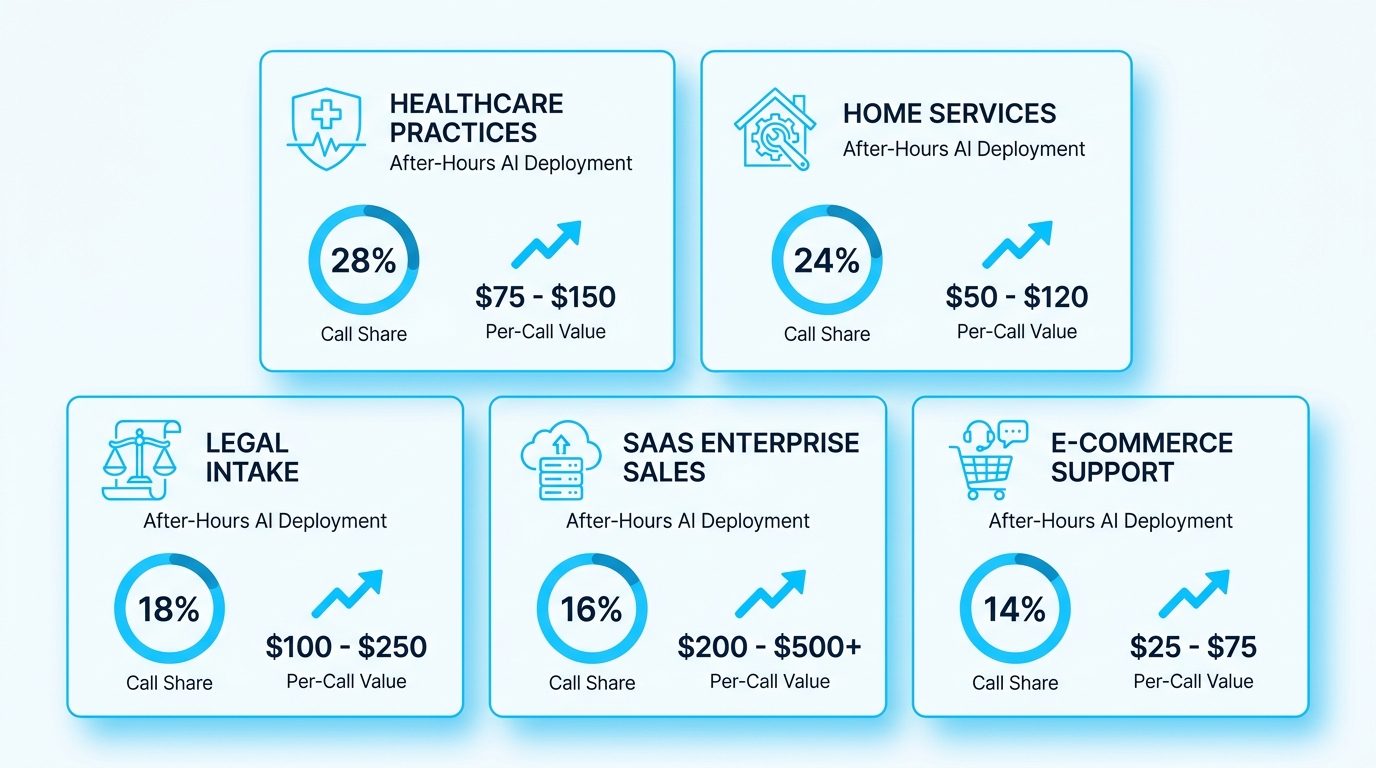
Where After-Hours AI Earns Its Keep First — By Industry
| Industry | After-Hours Call Share | Avg. Per-Call Value | Primary Use Case |
|---|---|---|---|
| Healthcare practices | 29% | $340 avg visit | Appointment booking, triage routing |
| Home services (HVAC, plumbing) | 44% | $1,850 avg job | Emergency dispatch, quote capture |
| Legal intake | 51% | $4,200 avg case value | New matter qualification |
| SaaS enterprise sales | 22% | $68,000 avg ACV | Demo booking, inbound qualification |
| E-commerce support | 38% | $180 order recovery | Order status, returns, cart recovery |
Legal intake is the loudest signal in this dataset. More than half of new-matter inquiries come after business hours — and most firms still route them to voicemail. The firms automating that intake are doubling conversion against firms that do not. Teams focused on sales growth and inbound conversion are usually the first to see ROI within 60 days.
The Spam Problem Hiding Inside Your Coverage Problem
Roughly 30% of inbound calls to US business numbers are spam or robocalls — a figure the FTC has tracked closely through its enforcement hub (FTC Robocall Enforcement). At night, that ratio climbs, because spammers do not sleep either.
Any after-hours answering system has to filter aggressively or it becomes a spam sink. NewVoices agents identify robocall patterns, silent-start calls, and known spoofed numbers in the first 1.5 seconds — and terminate them before any cost or workflow is triggered. Legitimate callers never notice. Your team never sees the noise.
86%
Reduction in Signal Pollution — Overnight
One logistics client cut operational alerts from 340 per night to 47. Night team retention improved immediately — no more waking up for nothing.
How a Deployment Actually Happens — And Why It Takes Days, Not Quarters
Enterprise software implementations have conditioned buyers to expect 9-month rollouts. That is not how voice AI works anymore. A typical NewVoices deployment runs four phases:
Call Flow Mapping
3–5 days
CRM and Telephony Integration
2–4 days
Voice Training and Persona Calibration
3 days
Pilot with Live Traffic
7 days — then production
Most deployments hit production in under three weeks. No engineering dependency — the no-code Agent Studio lets operations teams design and iterate call flows directly. Time-of-day routing is the final piece: calls during business hours route to human reps, calls outside those windows route to the AI. Clear handoff, no number changes, no disruption to the front office.
Experience the voice quality on your own phone before any sales conversation starts
Get a Live AI Call in Seconds — Free
Available now — limited demo slots fill quickly each week
The Honest Cost/Benefit Math Every CFO Needs to See
Finance leaders do not buy narrative. They buy ratios. A midmarket enterprise spending $312,000 on in-house night coverage typically replaces it with an AI deployment costing $54,000–$72,000 fully loaded. That is a $240,000+ annual reduction on the cost side alone.
$240K+
Annual Cost Savings
Versus in-house night shift
$1.4M
Recovered Pipeline
For a $40M revenue company
90 days
Typical Payback Period
Across all deployment types
300%
More Meetings Booked
SaaS company, Q1 result
One SaaS company with 12 SDRs replaced 10 of them with NewVoices agents and booked 300% more meetings in Q1 — while cutting SDR payroll by $1.1M. That is not optimization. That is a new operating model. Teams running service and operations see similar gains on cost-to-serve, particularly on Tier-1 ticket deflection.
What to Ask Before You Sign Anything — Your Exclusive Due Diligence Guide
Every voice AI vendor will tell you they sound human, answer fast, and integrate with your stack. Most are half right on one of those claims. The real diligence questions are narrower:
- Can the agent hold a 4-minute conversation without collapsing into loops?
- Does it handle interruptions — the caller talking over it mid-sentence — without breaking flow?
- What happens when the caller asks something completely off-script?
- How does it escalate, to whom, and with what context handed off?
- Can they play you production recordings — not demo recordings — from your exact industry?
Ask about voice biometric handling and the privacy framing NIST has published around voice as a sensitive modality (NIST Privacy and Biometrics). Ask what the failure mode looks like when the AI does not know the answer. If the vendor cannot play you a live call handling a curveball, they do not have one.
Quick Tip
NewVoices will play you live production recordings from your industry on request — no demo scripts, no cherry-picked calls. Ask your deployment architect on your first call.
What Industry Leaders Are Saying
“We deployed NewVoices on a Thursday. By Sunday night we had already booked six after-hours appointments that previously would have gone to a competitor. The ROI conversation with our CFO lasted about four minutes.”
VP of Operations, Regional Healthcare Group
Deployed Q4 — 41% patient volume increase in 90 days
“Our after-hours calls are now our highest-converting channel. The AI does not get nervous, does not have a bad day, and does not need a script refresh every quarter. It just works — every single call.”
Director of Revenue, Commercial Insurance Broker
$1.4M added in new premium — single quarter
The 14-Hour Gap Is a Choice — Close It Tonight
Every night your phones go quiet, your competitors are closing deals at midnight. The enterprises winning after hours have not hired more people — they have stopped accepting that 6 PM is a reasonable time to stop taking revenue.
After-hours AI pays for itself inside a quarter. Then it becomes invisible infrastructure. Then it becomes your unfair advantage.
Bring your call volume data. Leave with a revenue model. Limited deployment slots available this quarter.