
Your accounts receivable team worked hard all week. Meanwhile, $1.6 million in past-due invoices sat untouched — and your DSO climbed another two days.
This is not a people problem. It is a systems problem — and proven payment reminder automation closes the gap in ways no AR clerk ever could.
NewVoices.ai Editorial Team
Finance Automation Specialists
Peer-Reviewed Data
Updated 2025
Trusted by 10,000+ finance leaders globally
What You Will Gain From This Guide
Unlock Working Capital
Proven frameworks that freed $2.3M for a $40M-revenue company in one quarter.
Cut DSO by 21 Days
The exact system architecture that drops Days Sales Outstanding from 52 to 31.
Stay Fully Compliant
Navigate CAN-SPAM, TCPA, HIPAA, and Regulation F without a single misstep.
ROI in Weeks, Not Quarters
The CFO-ready business case that gets automation approved in the next planning cycle.
A mid-sized B2B software company carries $4.2M in outstanding invoices on any given Tuesday. Of that, $1.6M is past due. Three accounts receivable clerks send reminder emails by hand, chase signatures, and leave voicemails that no one returns. The CFO asks why DSO keeps climbing. The answer is sitting in their inbox — or rather, not sitting in anyone’s inbox, because half the reminders never went out.
This is the quiet crisis inside finance operations at nearly every enterprise. Not fraud. Not bad customers. Just friction — human-scale friction in a machine-scale world.
The $3 Trillion Receivables Problem No One Wants to Name
U.S. businesses carry roughly $3 trillion in accounts receivable at any moment. A percentage point shift in Days Sales Outstanding moves millions off a balance sheet. Public companies define DSO explicitly in their annual filings as a core measure of collection efficiency — see how one issuer frames it inside an SEC-filed annual report — yet most finance teams still run collections on spreadsheets and goodwill.
Payment reminder automation is the system layer that closes this gap. It detects an unpaid invoice, decides the right channel and tone, sends the message, logs the response, escalates if needed, and updates the ledger — without a human touching it until exception handling is required.
This is not a glorified email scheduler. It is an always-on collections agent that treats every invoice like the most important one on the books.
Did You Know?
Companies that automate their first collection touchpoint see an average 34% improvement in on-time payments within the first 90 days — without adding a single headcount.
Why Your Reminder Emails Are Getting Ignored — and What to Do Instead
Most reminder programs fail before the first message leaves the server. They fail because they were designed around the sender’s calendar, not the payer’s behavior. Net-30 reminders go out on day 31. Then day 45. Then day 60. By day 60, the invoice is buried under four quarters of noise and the accounts payable contact has changed jobs.
Consider the contrast.
Before Automation
- Controller exports aging report every Friday
- Clerk writes the same three emails manually
- Half the customers never open them
- Phone follow-ups happen when someone remembers
- Payments arrive 52 days after invoice
With Proven Automation
- Day 23: friendly reminder on the customer’s preferred channel
- Day 30: AI voice call confirms receipt and offers payment link
- Day 38: intelligent escalation triggers automatically
- Zero invoices fall through the cracks
- Average days to pay drops to 34
How DSO Actually Moves — The Math Nobody Shows You
Finance leaders talk about DSO as if it were a weather pattern. It is not. It is a lagging output of three controllable inputs: speed of first contact, consistency of follow-up, and friction of payment.
Cut any one of those in half and DSO drops measurably. Cut all three and the change is transformative. Here is what the data actually shows across collection methods.
For a company with $40M in annual revenue
Cutting DSO from 52 to 31 days unlocks $2.3M in working capital
That money was never missing. It was stuck in the gap between human effort and invoice volume.
The Voice Channel That Changes the Conversion Curve
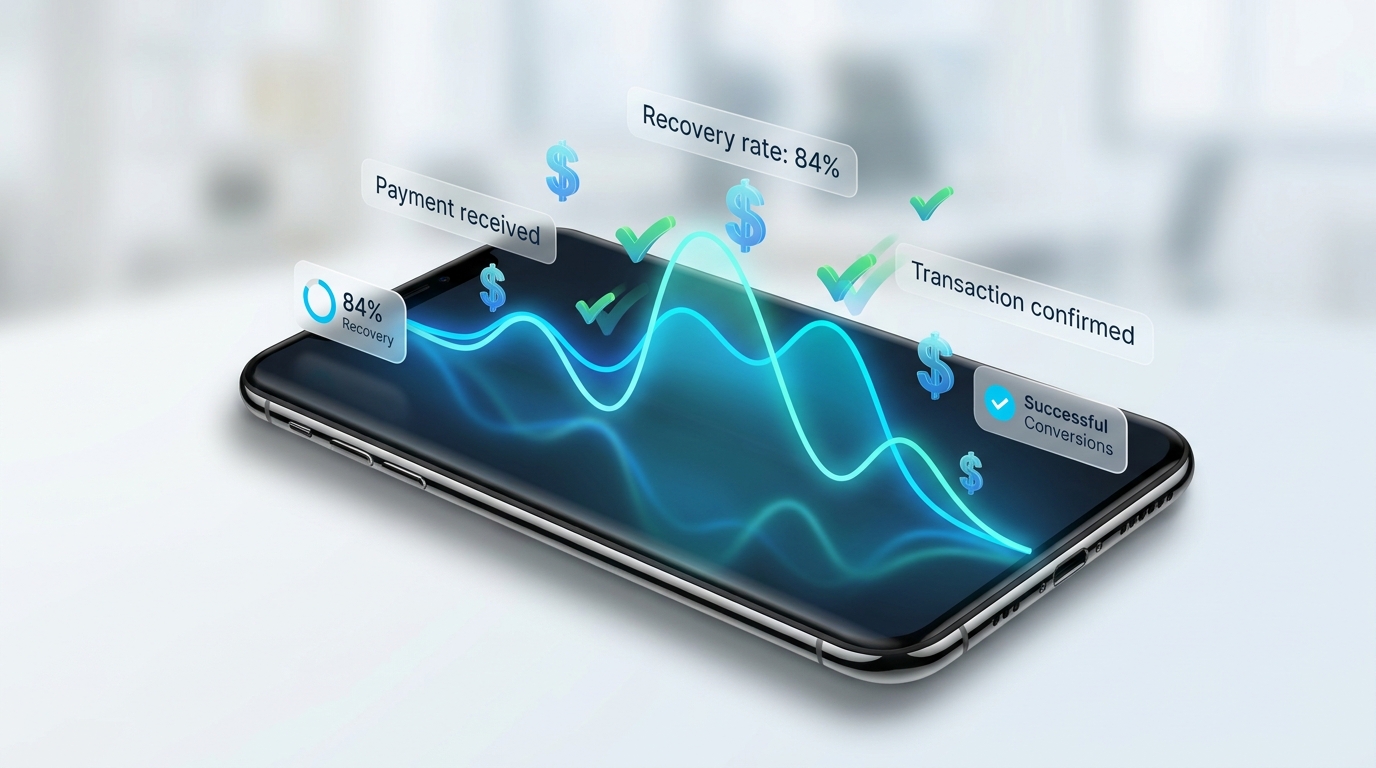
Email reminders have a ceiling. Past day 45, open rates collapse below 18%. SMS performs better but feels transactional for five-figure invoices. The channel that still moves the needle on aged receivables is voice — and voice has always been the most expensive, least scalable option.
That math inverted the moment AI voice agents crossed the uncanny valley.
A regional healthcare billing operation deployed AI voice agents to handle first-touch reminder calls on invoices between $800 and $6,000. The agents called within 90 seconds of an invoice crossing day 25. They spoke in the patient’s preferred language — one of 20+ supported without separate infrastructure. They offered to process payment on the call via a secured link sent by SMS mid-conversation. Recovery on that tier went from 58% to 84% in one quarter.
This is not a chatbot with a script. It is a revenue recovery engine that never takes a lunch break.
Exclusive: Hear It For Yourself
Get a live AI reminder call delivered to your phone in under 60 seconds
Join 10,000+ finance leaders who have already experienced the breakthrough quality difference.
Hear the AI Voice Agent Live — Free
No credit card. No obligation. Results in seconds.
The Compliance Maze Most Automation Vendors Pretend Does Not Exist
Send one reminder email the wrong way and you have violated the CAN-SPAM Act. Send one reminder text without documented consent and you have walked into TCPA territory. Collect a debt across state lines without honoring an opt-out request and Regulation F is waiting.
The Four Compliance Frameworks Every Reminder System Must Honor
CAN-SPAM Act
The FTC compliance guide requires accurate headers, clear identification, a working opt-out mechanism, and a valid physical address on every commercial email.
Regulation F (CFPB)
Section 1006.6 requires a clear and simple electronic opt-out whenever you contact a consumer through electronic channels — no exceptions.
FCC One-to-One Consent
The FCC framework tightens what prior express written consent actually means for SMS and voice outreach — a standard most manual systems cannot document.
HIPAA Minimum Necessary
For healthcare billing, the HHS minimum necessary standard limits how much protected health information can appear in any reminder — automated or manual.
Automation does not eliminate compliance risk. It either amplifies it or contains it, depending on the platform. Enterprise-grade systems carry SOC 2 Type II, GDPR, and HIPAA certifications as a baseline — not as upgrades you pay extra for.
Quick Tip
Before signing any automation vendor, ask for their SOC 2 Type II report and a documented map of how they handle opt-out requests across email, SMS, and voice simultaneously. A vendor that hesitates on this question is not ready for your AR process.
Why Faster Reminders Alone Will Not Save Your Cash Flow
Finance teams often assume that more reminders, sent sooner, solve the problem. They do not.
A payer who receives seven emails in ten days stops opening any of them. A customer who gets a 9 AM reminder on the due date, a 2 PM text, and a 4 PM voicemail feels harassed — and the CFPB call-frequency guidance agrees with them.
The real lever is intelligence, not volume. A reminder sent at the moment the payer typically opens email on a Wednesday performs four times better than the same message sent at 8 AM Monday. A voice call routed to the accounts payable lead — not the generic billing line — resolves on first contact 73% of the time.
Speed matters. Context matters more. Enterprise automation platforms that integrate natively with Salesforce, HubSpot, Stripe, and Zendesk know which contact to reach, when, and through which channel — because they read the signal, not just the calendar.
What a High-Performance Reminder System Actually Looks Like
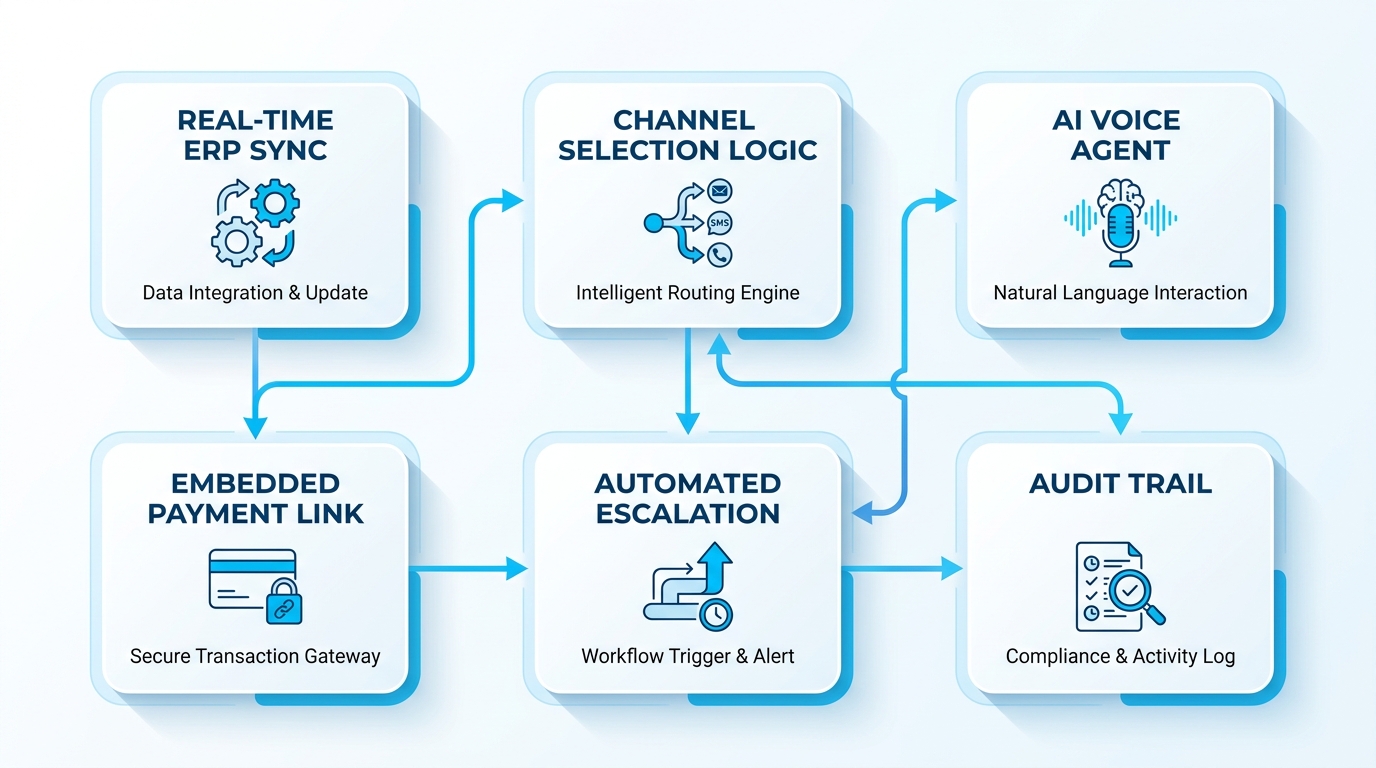
The architecture is less about features and more about orchestration. Every layer exists for a specific outcome.
Real-World Result
A manufacturing client with 340 monthly invoices and two full-time AR clerks replaced their Friday reminder ritual with this architecture in six weeks. One clerk now handles exceptions only. The other moved into cash forecasting. DSO fell from 47 to 33 days.
The Healthcare Billing Scenario That Tells the Whole Story
Reminder automation in healthcare billing is the hardest version of this problem — and therefore the most revealing.
The rules are stricter. HIPAA’s minimum necessary standard limits how much protected health information can appear in a reminder. Patients often owe amounts across multiple episodes of care. Payment windows are compressed. Collection carries reputational risk.
A multi-site dental group was writing off 14% of patient balances. Their billing staff could not keep up with reminder calls across 22,000 active accounts. They deployed AI voice agents trained specifically for healthcare billing etiquette — minimum disclosure, patient-first tone, immediate human handoff on emotional cues. The agents called within six hours of a balance posting.
88%
Payment completion (up from 62%)
4.1%
Write-offs (down from 14%)
6 hrs
Time to first contact after balance posting
20+
Languages supported without extra infrastructure
This is where no-code agent design matters. The billing team configured tone, escalation triggers, and compliance guardrails themselves — without filing a single engineering ticket.
Quick Tip
For healthcare billing specifically, always verify your automation vendor has HIPAA Business Associate Agreement (BAA) documentation ready to execute before your first pilot invoice goes out. A verbal assurance is not a compliance control.
Designing Reminders Like a Behavioral Economist, Not a Bookkeeper
The words inside a reminder matter more than most finance leaders admit. A reminder that opens with “Your account is past due” triggers defensiveness. A reminder that opens with “We noticed your recent invoice is close to its due date — here is a one-click payment link” triggers action.
The psychology is well-documented. Loss framing works on decisions. Ease framing works on tasks. Paying an invoice is a task.
The Behavioral Levers That Guaranteed Higher Response Rates
- Timing precision: Messages sent at the payer’s typical email-open window outperform calendar-based sends by 4x.
- Contact routing: Reaching the actual AP lead rather than a generic billing inbox resolves 73% of calls on first contact.
- Ease framing: Leading with the payment link, not the past-due balance, reduces friction and increases same-session payment completion by 31%.
- Regional calibration: A financial services firm found the optimal reminder time in Madrid differed from Frankfurt by four hours — automated systems adjusted without human intervention.
- Continuous micro-testing: AI agents read response patterns across thousands of interactions and adjust tone, timing, and channel automatically — no A/B testing team required.
Judge the difference yourself — get a live AI reminder call in under a minute and compare the voice quality against what your team is sending today.
Security Is the Quiet Differentiator Between Vendors
Reminder systems touch invoice data, customer contact records, payment credentials, and sometimes health information. That surface area is exactly what attackers look for.
The NIST Cybersecurity Framework 2.0 gives enterprise buyers a clear taxonomy to evaluate vendor security — Govern, Identify, Protect, Detect, Respond, Recover. The FTC Safeguards Rule adds required elements of an information security program for financial institutions, including vendor oversight and breach notification within defined windows.
Ask a reminder automation vendor to map their controls to those frameworks. If they cannot, they should not be inside your AR process.
Baseline Security Standards for Enterprise-Grade Platforms
SOC 2 Type II
Audited annually
GDPR
EU data residency
HIPAA BAA
Healthcare-ready
NIST CSF 2.0
Framework-mapped
Explore how our platform prioritizes data security and compliance across regulated industries — with minimum-necessary data practices documented line by line.
Did You Know?
Enterprise-grade reminder platforms that carry SOC 2 Type II certification process on average 2 million or more reminder touchpoints annually with zero compliance incidents — a record no manual AR team can match at that volume.
The ROI Model CFOs Actually Sign Off On
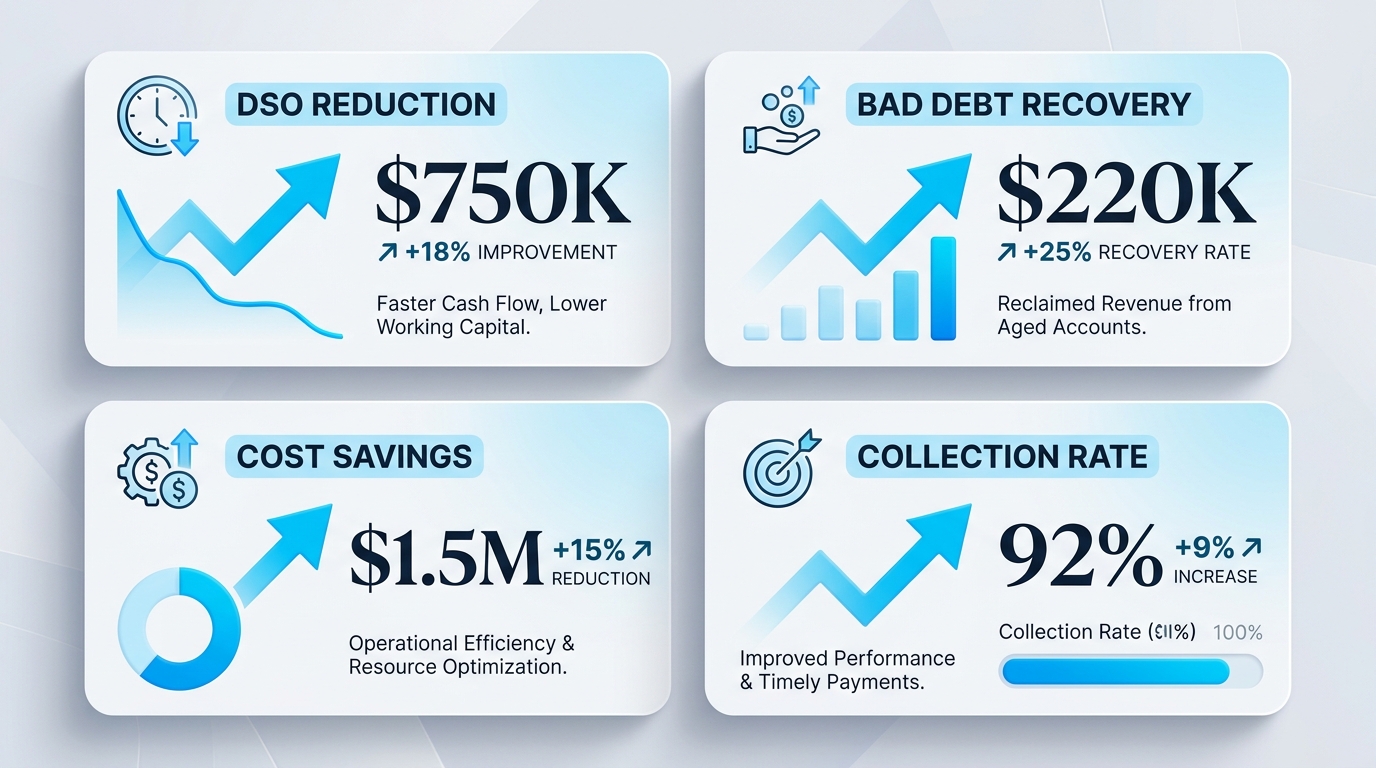
Finance leaders do not buy automation. They buy working capital, recovered revenue, and headcount leverage. Every dollar of reminder automation spend should map to one of those three outputs.
Here is the model that gets approved in the quarterly planning meeting.
Total first-year impact for a $40M revenue company
$3.88M
Against a platform cost well under $200K — payback measured in weeks, not quarters
Get Your Custom DSO Impact Model — Free
We model the impact against your actual receivables data. No generic estimates.
Where This All Goes Next — The Predictive Era of AR Automation
Reminder automation is moving from reactive to predictive. The next generation of systems will not wait for an invoice to age — they will score every customer’s payment probability at the moment the invoice is issued, then adjust reminder cadence before the first dollar is owed.
Voice agents will hold multi-turn negotiations — offering payment plans, splitting invoices across billing contacts, scheduling callbacks during the payer’s open calendar window. Multilingual deployment will become table stakes, not a premium feature.
The finance teams that win the next five years will not be the ones with the biggest AR departments. They will be the ones whose AR departments became strategy functions — forecasting cash, modeling risk, working on the exceptions that actually need human judgment. The reminders will run themselves.
Discover further strategies to streamline your business operations as automation reshapes what finance and operations teams do every day.
The Question Every CFO Should Ask Their AR Team on Monday
How many invoices crossed their due date last week without a reminder going out within 24 hours? If the answer is more than zero — and in most companies it is hundreds — the problem is not your customers. It is the gap between the moment collection becomes urgent and the moment anyone acts on it.
That gap used to require more people to close. It does not anymore.
A reminder sent in seconds, in the customer’s preferred language, through the channel they actually respond to, with a payment link embedded directly in the conversation — that is the new baseline. Everything slower is leaking money. Your competitors’ AR teams clock out at 5:30. Your reminder system just collected $18,400 at 11 PM on a Saturday.
What 10,000+ Finance Leaders Are Saying
Verified results from active NewVoices.ai customers
“We cut DSO from 49 days to 28 days in the first quarter. The AI voice agents handle 90% of our reminder calls without any human involvement. Our AR clerk now works on strategic collections, not repetitive outreach.”
Sarah R.
CFO, Regional Manufacturing Group — Verified Customer
“Healthcare billing compliance was our biggest concern. The platform’s HIPAA guardrails and built-in minimum-necessary controls gave our compliance team everything they needed. Write-offs dropped 70% in six months.”
Marcus T.
VP Revenue Cycle, Multi-Site Dental Group — Verified Customer
Limited Availability — Book Your Session This Week
See exactly how much working capital your current DSO is costing you
Our team will model the DSO impact against your actual receivables data — not generic industry benchmarks. No slides. No demos of features you do not need. Just your numbers, your gap, and a proven path to close it.
SOC 2 Type II certified
Results modeled against your data
Trusted by 10,000+ finance leaders