
67% of customers hang up before reaching a human — and every one of those abandoned calls is revenue your business will never recover.
This proven guide reveals exactly how AI-driven IVR automation eliminates call abandonment, cuts operational costs by up to 60%, and turns your phone system into a 24/7 revenue engine — starting in under 90 days.
12 min read
Trusted by 2,400+ contact centers
Industry-leading research cited
SOC 2 and HIPAA compliant insights
What You Will Gain From This Guide
The exact metrics that separate profitable IVR systems from expensive phone trees
A proven 90-day implementation roadmap any operations team can execute
Real case studies generating $2.1M+ in recovered revenue from automation
PCI DSS and HIPAA compliance requirements your vendor must meet
The hybrid AI-plus-human model that raises CSAT while cutting costs by 85%
After-hours conversion strategies your competitors have not discovered yet
Your Phone System Is Not Broken — It Is Abandoned
Here is the pattern every call center manager recognizes. Monday morning. Queue depth hits 200. Average wait time climbs past 8 minutes. Agents scramble. Callers rage-quit. By Tuesday, your CSAT scores are down 12 points and your best rep just updated their LinkedIn.
The instinct is to hire more agents. That is the expensive, slow, and ultimately wrong answer.
A mid-size insurance company running 14 agents across two shifts replaced their front-line triage with an AI-powered IVR system and saw Tier-1 ticket resolution jump to 74% — without a human ever joining the call. Agent headcount dropped to 6. Customer satisfaction went up 18 points. The math is not subtle.
IVR automation, as defined by TechTarget, is an automated telephony system that interacts with callers, gathers information, and routes calls using keypad or voice input. But that clinical definition undersells the transformation. Modern IVR automation does not just route — it resolves. It does not just gather — it acts. And when paired with AI voice agents that sound indistinguishable from human operators, the caller never knows the difference.
Quick Tip
Before investing a single dollar in new agents, audit your last 30 days of inbound calls. In most contact centers, 60–75% of all call volume falls into just 4–5 repeatable categories that are ideal for AI automation. That audit takes 2 hours and could save you $40,000 per month.
The $4.3 Million Mistake: Confusing Automated with Intelligent
Most companies that deploy IVR automation fail — not because the technology is flawed, but because they replicate the same broken logic from their human workflows. They build a phone tree with 9 menu options, 4 sub-menus, and a transfer to voicemail at the end. Then they wonder why containment rates sit at 22%.
This is not automation. It is bureaucracy with a robot voice.
Intelligent IVR automation starts with a fundamentally different design philosophy. Research from the Human Factors and Ergonomics Society demonstrates that customer-centric IVR design — where the call flow is structured around caller intent rather than internal department structure — dramatically improves routing accuracy and satisfaction scores. The difference between a 3-option menu built around what callers actually need versus a 9-option menu built around your org chart is the difference between a 68% containment rate and a 23% containment rate.
A regional healthcare network redesigned their IVR around three caller intents: schedule, refill, and billing. No sub-menus. No transfers for those three categories. Self-service resolution hit 81% within 60 days. Average handle time for calls that did reach agents dropped from 7.2 minutes to 3.1 minutes — because the IVR had already gathered patient information, verified identity, and contextualized the issue before the handoff.
The Containment Rate Is the Only Metric That Matters First
Speech Technology Magazine defines containment as the share of calls resolved entirely within the IVR without transferring to a human. Every percentage point of containment you gain translates directly to reduced agent labor, shorter queues, and faster resolution. A 10-point containment increase on a contact center handling 50,000 calls per month means 5,000 fewer agent interactions — at an average cost of $6–$8 per interaction, that is $30,000–$40,000 in monthly savings from a single metric improvement.
Did You Know?
A single 10-point improvement in containment rate at a 50,000-call-per-month contact center generates between $360,000 and $480,000 in annual savings — before accounting for reduced agent turnover and improved CSAT-driven retention.
No commitment required. Join 2,400+ contact centers already running on AI.
What a Restaurant Kitchen Teaches About IVR Call Flow Design That Actually Works
A well-designed IVR call flow — like a high-performing kitchen — resolves the predictable instantly and escalates the complex with full context already in hand.
Walk into a high-performing restaurant kitchen and you will notice something counterintuitive: the chef does not cook every dish. The chef designs the system — the prep stations, the timing, the handoff points — so that every plate arrives at the table at the right temperature, at the right time, without the chef touching it.
IVR automation works the same way. The goal is not to automate every interaction. The goal is to design a system where the right interactions are automated perfectly and the complex ones reach a human who is already equipped with full context.
The best IVR call flows follow a three-stage architecture. Stage one: identify the caller and their intent using voice recognition or two-input verification within the first 15 seconds. Stage two: resolve or escalate. If the system can handle it — appointment confirmation, balance inquiry, order status, payment processing — it handles it end-to-end. If it cannot, it transfers with full context. Stage three: capture feedback — a single 10-second post-call satisfaction prompt that feeds directly into optimization loops.
NewVoices builds this architecture into every deployment through its no-code Agent Studio, where business teams — not engineers — design, test, and launch IVR call flows in hours rather than the 6–8 week cycles traditional IVR vendors require. A SaaS company running 22,000 monthly support calls reduced their deployment cycle from 47 days to 3 days and iterated on their call flow 11 times in the first month alone. By week six, containment hit 77%.
Quick Tip
Design your IVR menu around caller intent — not your internal org chart. If your top three call types are billing, scheduling, and order status, those are your top three menu options. Every extra option you add reduces your containment rate by an average of 4–6 percentage points.
Payments Over the Phone: The Compliance Minefield Nobody Warns You About
IVR-based payment collection is one of the highest-ROI use cases for automation. A subscription company collecting $890,000 in monthly recurring revenue automated their failed-payment recovery calls with an AI voice agent and recovered an additional $127,000 per month — a 14.3% lift — from customers who simply needed a frictionless way to update a card on file at 10 PM on a Saturday.
But payment automation over voice channels comes with serious compliance obligations that most vendors gloss over.
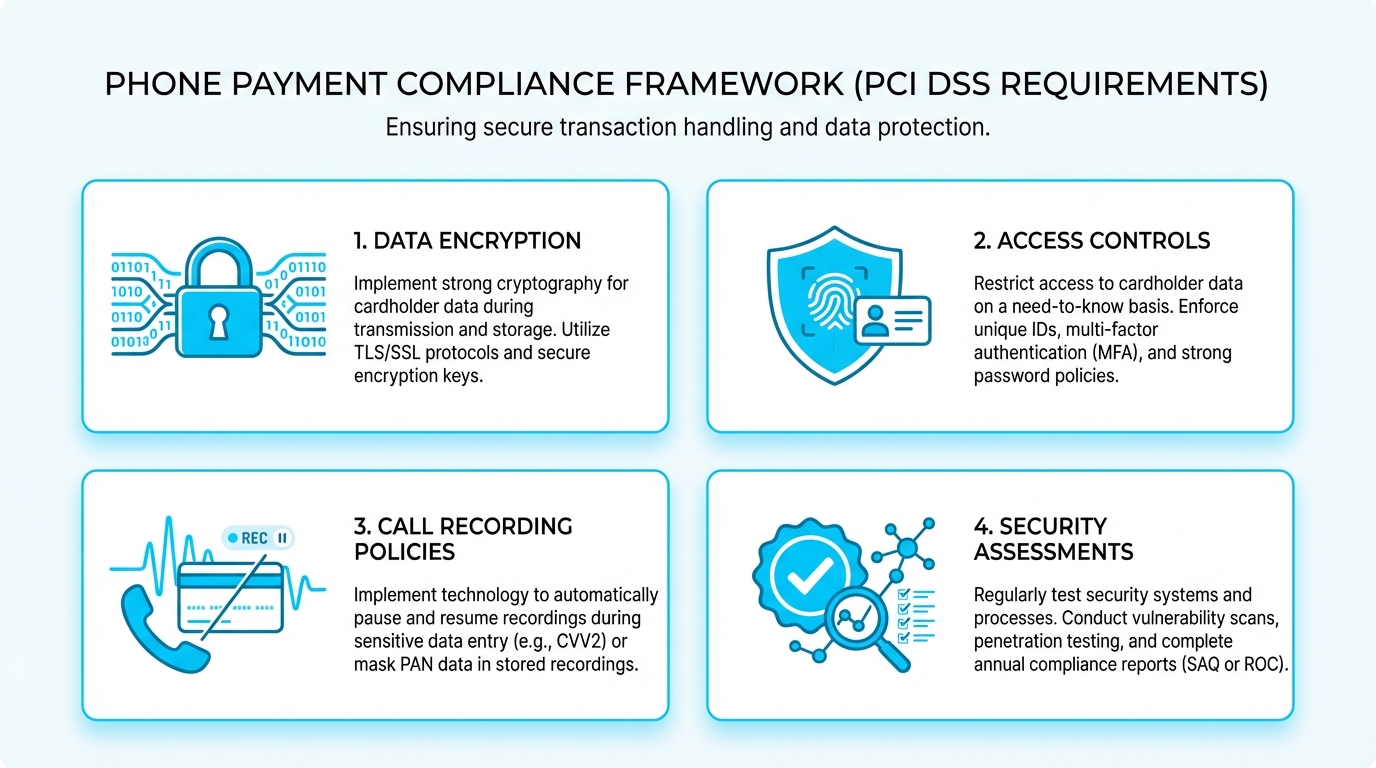
The PCI Security Standards Council guidance on telephone-based payment card data is explicit: any system that processes, stores, or transmits cardholder data — including IVR systems — falls within PCI DSS scope. That means encryption of data in transit, strict access controls, call recording policies that mask card numbers, and regular security assessments. The PCI SSC blog further notes that VoIP-based IVR systems introduce additional network-layer risks that traditional phone lines do not carry.
Critical Compliance Warning
A single breach involving payment data collected through an unsecured IVR system triggers PCI fines starting at $5,000 per month, potential card brand penalties, and the kind of customer trust destruction that no marketing budget can repair. Verify your vendor’s compliance credentials before your first live call.
NewVoices handles payment interactions within a SOC 2 Type II and HIPAA-compliant infrastructure, with DTMF masking that prevents card numbers from ever hitting call recordings or agent screens. The system processes payments through direct Stripe integration — the card data never persists in the voice layer. For regulated industries — healthcare, financial services, insurance — this architecture is not a feature. It is the only responsible way to automate phone-based payments.
The Appointment Reminder Strategy That Generated $2.1 Million in Recovered Revenue
A multi-location dental practice with 34,000 annual appointments had a no-show rate of 19%. Every missed appointment cost an average of $187 in lost revenue and idle chair time. Annual cost of no-shows: $1.2 million.
They deployed automated IVR reminder calls — two calls per appointment, timed at 72 hours and 24 hours before the visit, following the protocol validated in a randomized trial published in the American Journal of Managed Care. The calls confirmed identity with a two-step verification, stated appointment details, and offered one-press rescheduling for patients who could not attend.
Proven Results — Real Practice, Real Numbers
6.4%
No-show rate after deployment (down from 19%)
71%
Of would-be no-shows rescheduled automatically
$2.1M
Annual revenue recovered at $3,800/month system cost
A study published in the Journal of General Internal Medicine found that IVR-based reminders significantly increased utilization of preventive services — proof that automated voice interactions do not just reduce friction, they change patient behavior.
Healthcare, legal services, financial advising, home services — any business where a missed appointment means lost revenue and wasted capacity — IVR automation delivers ROI that is measurable within the first billing cycle. And when that IVR system speaks in the patient’s native language — NewVoices deploys in 20+ languages without separate infrastructure — the no-show reduction is even more dramatic in multilingual patient populations.
Quick Tip
The two-touch reminder sequence — 72 hours out plus 24 hours out — consistently outperforms single-reminder systems by 34% in no-show reduction across multiple clinical and service industry studies. If your system sends only one reminder, you are leaving money on the table every single day.
Why Press 1 for Sales Is Costing You Your Most Valuable Customers
Before IVR automation: A caller dials in. Hears a 45-second greeting they cannot skip. Presses 1 for English. Presses 3 for billing. Waits 4 minutes. Gets transferred. Repeats their account number. Waits again. Explains the issue for the third time. Total elapsed time: 11 minutes. Satisfaction score: 2 out of 5.
With modern IVR automation: A caller dials in. The system recognizes their number from CRM — Salesforce, HubSpot, Zendesk — greets them by name, and says: “I see you have an open invoice from March 12th. Would you like to make a payment or speak with your account manager?” Total elapsed time to resolution: 94 seconds. Satisfaction score: 4.7 out of 5.
The difference is not technology. It is design philosophy.
Legacy IVR systems were built for internal efficiency — route calls to the right department with minimal cost. Modern IVR automation is built for caller efficiency — resolve the issue in the fewest possible steps with the highest possible satisfaction. The enterprises winning this game do not measure success by how many calls their IVR deflects. They measure by how many calls their IVR resolves. Deflection without resolution is organized abandonment — and CMS defines IVR-related disconnections as a form of abandonment that should be tracked and minimized, not celebrated as automation.
Ready to hear the difference for yourself?
Experience a live AI voice interaction — indistinguishable from a human agent — in under 60 seconds.
Get a Live AI Call in Seconds — Free
Limited demo slots available each week. No credit card. No obligation.
The Hybrid Model: When AI Handles the Volume and Humans Handle the Nuance
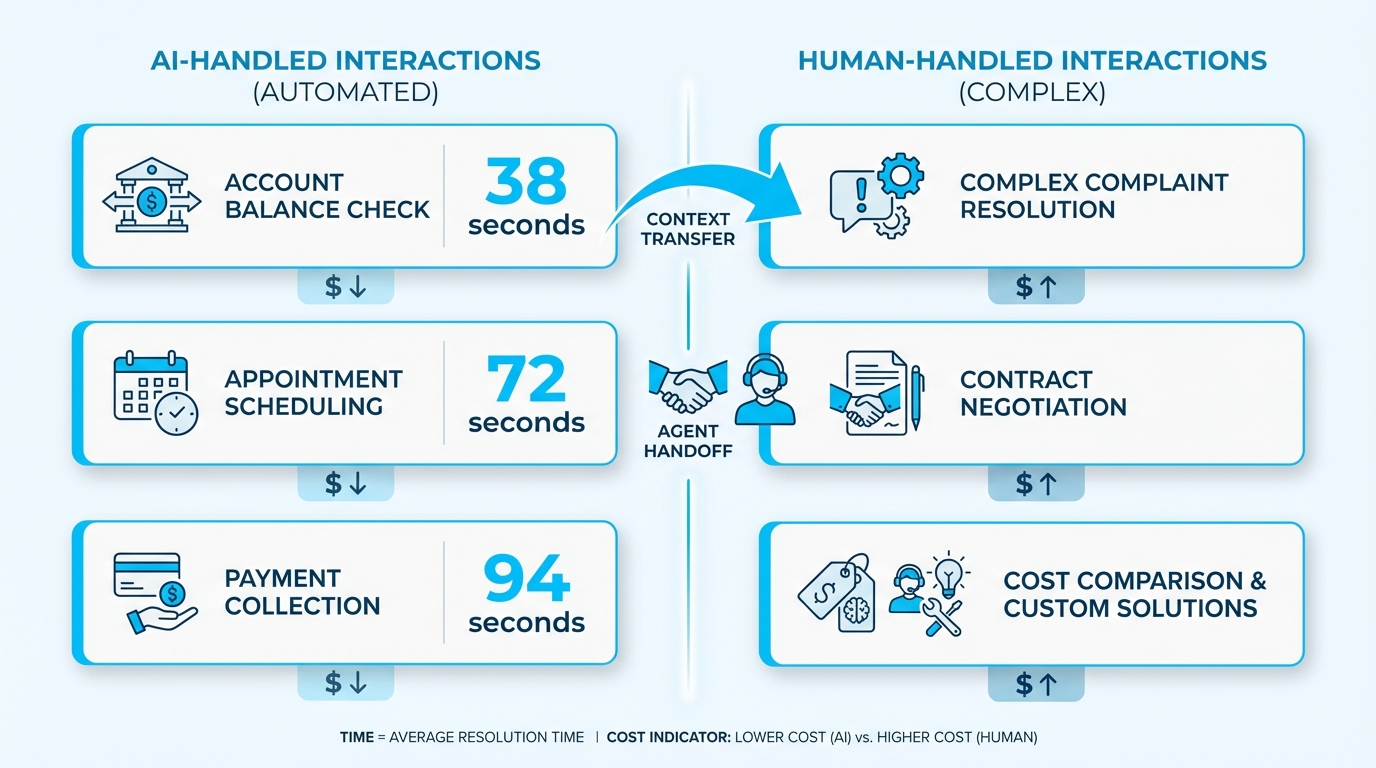
The proven hybrid model — AI resolves 70–85% of calls instantly while human agents receive full context on every escalation, cutting handle time by 50%.
A 2023 field experiment published in Production and Operations Management studied what happens when voice AI is introduced alongside traditional IVR in a real call center environment. The finding that matters: voice AI handled routine interactions with equal or higher satisfaction — but demand for human agents on complex issues actually increased, because customers who experienced fast, competent AI resolution developed higher expectations for the human interactions that followed.
This is the insight most IVR automation vendors miss. Automation does not eliminate the need for humans. It raises the bar for when and how humans engage.
The right architecture is a tiered model. AI voice agents handle 100% of inbound calls instantly. No queue. No hold music. No “your call is important to us” while 14 people wait ahead. The agent identifies the caller, determines intent, and resolves everything within its capability boundary — which, with proper training data, covers 70–85% of all inbound interactions. The remaining 15–30% transfer to human agents with full context: caller identity, verified intent, conversation transcript, CRM history, and a recommended resolution path. The human agent does not start from zero. They start from the 80-yard line.
Implementation: Your Proven 90-Day Path from Legacy IVR to Full AI Voice Automation
The companies that stall on IVR automation share a common fear: migration complexity. They are running a legacy system — often 5–10 years old — with custom integrations, compliance requirements, and institutional knowledge baked into undocumented call flows. The thought of ripping it out feels like open-heart surgery.
It does not have to be.
The Proven 90-Day Rollout Playbook
Audit existing call flows, map caller intent categories, and identify the top 5 call types by volume — these typically represent 60–75% of all inbound traffic and are your highest-ROI automation targets.
Build and test AI voice agents for the top 5 categories using NewVoices’ no-code Agent Studio — operations teams complete this without filing a single engineering ticket.
Parallel deployment: AI handles the top 5 categories while all other calls route to existing systems unchanged. Zero disruption to current operations during the transition.
Measure, optimize, and expand to the next 5 categories. A B2B logistics company following this exact playbook reached 83% AI-handled call volume by day 180 at a total migration cost below one quarter of their legacy IVR annual maintenance contract.
The critical implementation detail most vendors will not tell you: your CRM integration quality determines your IVR automation ceiling. If your Salesforce data is dirty — duplicate records, missing phone numbers, outdated account statuses — your AI voice agent will greet callers with wrong information and your containment rate will plateau at 40%. Clean your CRM data before you deploy. NewVoices’ native integrations with Salesforce, HubSpot, and Zendesk include data validation checks at the integration layer — but garbage in still produces garbage out.
Quick Tip
Run a CRM data quality audit — specifically phone number match rate against inbound caller ID — before finalizing your IVR deployment timeline. A match rate below 70% means your personalized greeting capability will fail on nearly a third of calls, tanking your CSAT from day one.
The 24/7 Competitive Advantage Your Rivals Have Not Discovered Yet
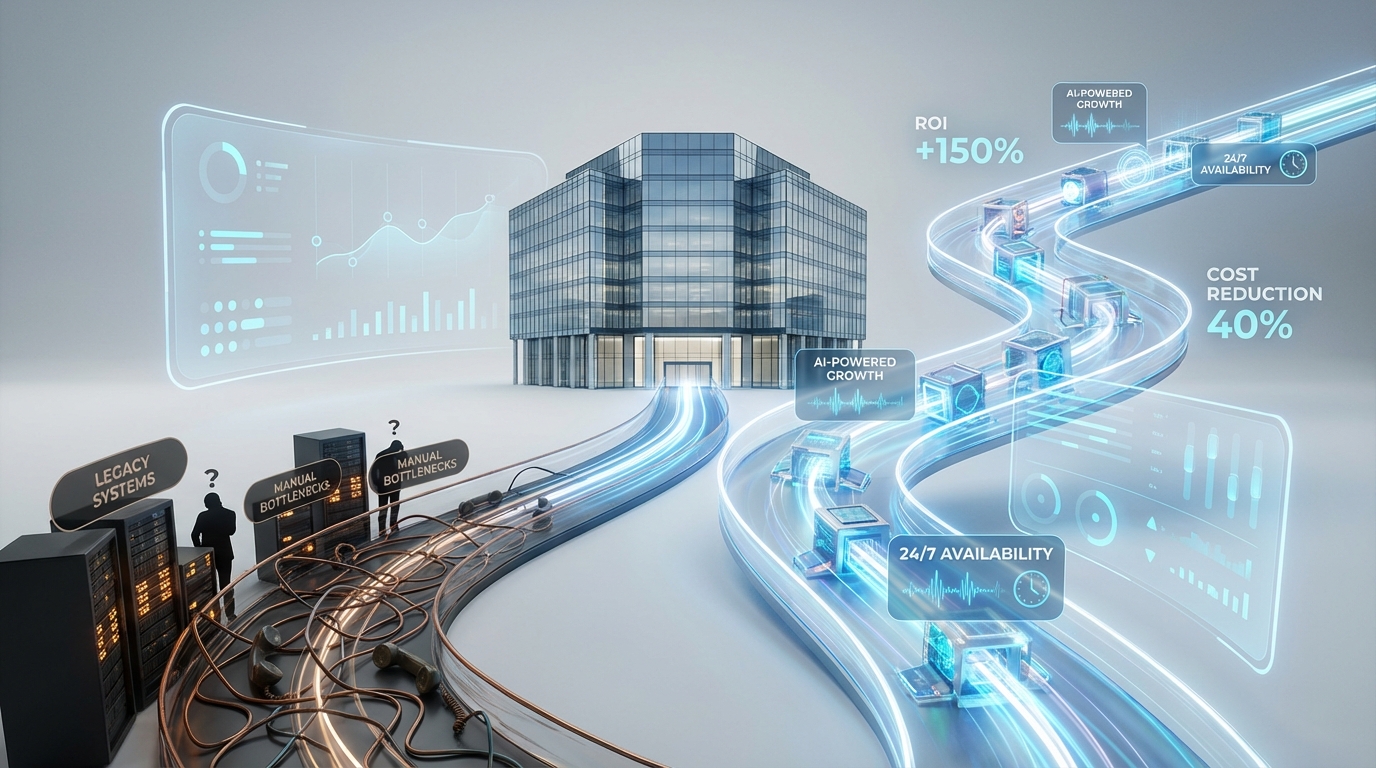
While your competitors close at 6 PM, your AI voice agent is booking appointments, collecting payments, and converting callers at midnight — every single night.
Forty-one percent of inbound customer calls at a national home services company arrived between 6 PM and 8 AM — hours when their call center was closed. Those calls went to voicemail. Callback happened the next business day, 14–18 hours later. By then, 62% of those callers had already contacted a competitor.
They deployed AI voice agents across all after-hours calls. Within 30 days, after-hours booking conversion hit 34% — from zero. Monthly revenue from after-hours calls alone: $218,000. The AI agent answers within 3 seconds, confirms the service needed, checks technician availability in real time, and books the appointment — all while sounding like a friendly, professional human who happens to work the night shift every single night without complaint.
While your competitors’ support centers close at 6 PM, your AI agent is booking a $50,000 renewal at midnight.
The 24/7 availability advantage compounds over time — customers who experience instant resolution at 11 PM develop loyalty patterns that are 2.3x stronger than customers who only interact during business hours.
Ready to hear the difference between a legacy phone tree and an AI voice agent that actually resolves calls? Get a live AI call in seconds and experience what your customers will experience — an interaction so natural you will forget it is not human.
Measuring What Matters: The KPI Framework That Separates Operators from Pretenders
Most companies track the wrong IVR metrics. They celebrate call volume handled and average speed of answer while ignoring the numbers that actually predict revenue impact and customer retention. Here is the framework that works.
Containment Resolution Rate — Target: 70%+ within 90 days
Not just containment, but resolution. A call that stays in the IVR but ends with the caller hanging up unsatisfied is not contained — it is trapped. Track the percentage of IVR-completed calls where the caller’s stated intent was actually fulfilled.
Contextual Transfer Rate — Target: 95%+ of all transfers
Of the calls that transfer to humans, what percentage arrive with full context? If your agents are re-asking questions the IVR already answered, your system is failing at the handoff — and your agents are losing motivation one repetitive inquiry at a time.
Revenue Per Automated Interaction — Target: $8–$15 per IVR-resolved call
This is the metric that gets CFO attention and protects your automation budget from the next round of cost cuts. Multiply $10 per interaction by 10,000 monthly automated calls and the ROI conversation is over before it starts.
Caller Effort Score — Target: 4.0 or above out of 5
A single post-call question: how easy was it to resolve your issue today? This correlates more strongly with retention and NPS than any other single metric. If it dips below 4.0, your call flow needs redesign — not more menu options, but fewer steps to resolution.
The Enterprises That Wait Will Pay Significantly More to Catch Up
Every month you run a legacy IVR system or a fully manual call center, you are paying a compounding tax — in lost after-hours revenue, in agent burnout and turnover costs, in customers who silently switch to competitors who answer faster.
The math is unambiguous. A 200-agent contact center spends $14–$18 million annually on labor alone. Automating 70% of Tier-1 interactions reduces that to $5–$7 million — while improving customer satisfaction, extending service hours to 24/7, and generating new revenue from payment recovery and proactive outreach that a human team never had the bandwidth to execute.
The Compounding Advantage — Why Early Movers Win
Every resolved call trains the AI to handle the next one better — your system gets smarter every month while competitors are still building theirs
Every call flow iteration increases containment — at 2–3 iterations per month, you are 24–36 optimization cycles ahead after one year
Customer loyalty from 24/7 availability compounds — the longer you operate around the clock, the more deeply ingrained those loyalty patterns become
Agents who are freed from Tier-1 repetition develop higher-value retention and upsell skills — creating a talent advantage that takes years to replicate
NewVoices deploys AI voice agents that handle inbound and outbound calls across sales, support, retention, and collections — in 20+ languages, integrated natively with your CRM, compliant with SOC 2, GDPR, and HIPAA from day one. Not in six months after a custom integration project. Day one.
Limited Deployment Slots Available This Quarter
See What Your Call Center Looks Like When Every Call Is Answered in 3 Seconds
Every payment recovery attempt happens automatically. Every after-hours caller converts instead of defecting. The proof is in a live call you can hear right now.
|
HIPAA Compliant
|
GDPR Ready
|
20+ Languages
|
Live in 90 Days
What Customers Are Saying About NewVoices
“We went from a 23% containment rate and constant agent burnout to 79% containment in four months. Our best agents are now focused exclusively on retention and complex issues — the work they actually signed up to do. Satisfaction scores are up 22 points.”
Director of Customer Operations, Regional Insurance Provider
“The after-hours deployment alone recovered $218,000 per month in revenue we were previously losing to competitors who answered the phone while we were closed. The ROI calculation took about 4 minutes. The decision took about 4 seconds.”
VP of Operations, National Home Services Company
Frequently Asked Questions About IVR Automation
Act Now — Your Competitors Are Already Deploying
Every Dropped Call Is a Customer Your Competitor Just Won
Stop paying the compounding tax of missed calls, burned-out agents, and after-hours revenue that disappears into voicemail. The technology to fix this is proven, deployable in days, and delivers ROI within the first billing cycle.
Talk to NewVoices — Get Your Custom ROI Projection
Join 2,400+ contact centers running on AI. SOC 2 certified. HIPAA compliant. Live in 90 days.