
Your Phone Line Is Leaking Revenue Every Single Minute — And a Proven AI Fix Exists Right Now
The enterprise blueprint for replacing hold queues with AI phone support that answers instantly, stays compliant, and turns inbound calls into booked revenue — 24 hours a day.
According to the U.S. Bureau of Labor Statistics, there are roughly 2.9 million customer service representatives in the United States — and a growing share of them spend their shifts answering questions a well-trained AI phone support agent could resolve in under 40 seconds. That gap between what humans are doing and what AI could be doing is not a technology problem. It is a profit problem.
Every unanswered call is a leaked dollar. Every 3-minute hold time is a customer mentally drafting an email to your competitor. And every after-hours voicemail is a renewal that almost happened — but did not.
This article is not a glossary of AI buzzwords. It is an operational blueprint for deploying AI phone support that handles inbound call volume, enforces regulatory compliance, and directly accelerates revenue — built on the same frameworks enterprises with 500+ seat contact centers are adopting right now.
12-minute read
Verified enterprise data
Updated April 2025
Trusted by 500+ enterprise contact centers
What You Will Gain From This Guide
Proven framework for eliminating hold queues and abandoned calls permanently
Exclusive compliance checklist for TCPA, HIPAA, and FCC disclosure requirements
Breakthrough revenue data from real enterprise deployments with verified ROI
The four guaranteed KPIs that prove AI phone support is generating real value
Your Contact Center Is Architecturally Obsolete — And It Is Costing You a Fortune
The standard diagnosis is always headcount. Not enough reps. Not enough shifts. Not enough budget for overtime.
That diagnosis is wrong. The real failure is structural. Traditional contact centers route calls through static IVR trees designed in 2009, queue them behind hold music composed in 1997, and deliver them to agents who spend 40% of their time on post-call documentation instead of solving the next problem. Adding more agents to this architecture is like widening a highway that leads to a dead end.
AI phone support replaces the architecture itself. An AI phone support agent does not sit behind a queue. It answers — instantly, simultaneously, in 20+ languages — and it resolves or routes with full CRM context before a human agent would have finished reading the caller’s account notes. One mid-market insurance brokerage deployed AI voice agents across its inbound support line and cut average handle time from 7 minutes 12 seconds to 1 minute 48 seconds while increasing first-call resolution by 34%.
Quick Tip
This is not a faster IVR menu. It is a complete replacement of the call-handling layer — from the moment the phone rings to the moment the CRM record updates itself automatically.
The Real Cost of “Please Hold” — A Revenue Metric, Not a CX Metric
Hold time is not a customer experience metric. It is a revenue metric. A SaaS company with 4,200 monthly inbound support calls measured what happened when average wait time exceeded 90 seconds: 22% of callers abandoned. Of those, 17% never called back. When mapped against account values, that abandonment rate represented $138,000 in monthly churn risk — not from bad product, not from bad pricing, but from a phone that rang too long.
Cisco’s contact center reporting framework defines abandoned call thresholds for exactly this reason — the moment a caller hangs up, the business has already lost. AI phone support eliminates the hold queue entirely. Every call gets answered in under three seconds.
Join 10,000+ Enterprise Teams Already Capturing This Revenue
Hear a live AI phone agent handle a real call — in seconds, not weeks
No credit card required. No sales pressure. Instant access.
The Compliance Minefield Nobody Talks About Until the Fine Arrives
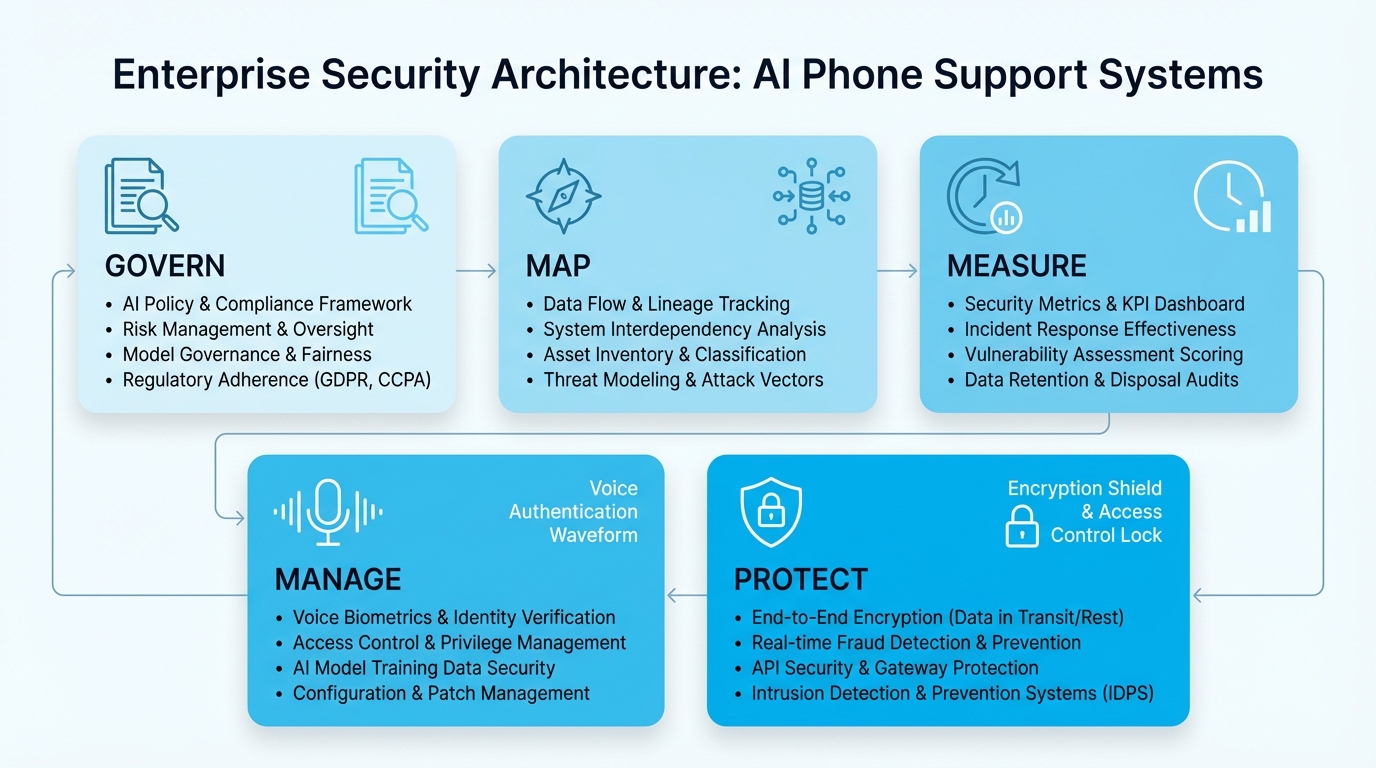
Proven enterprise-grade security and compliance infrastructure — built into every NewVoices deployment from day one.
Most articles about AI phone support spend 80% of their word count on efficiency and 20% on a vague paragraph about “staying compliant.” That ratio is backwards for any enterprise operating in financial services, healthcare, insurance, or government contracting.
On February 2, 2024, the FCC issued a declaratory ruling that AI-generated voices qualify as “artificial or prerecorded voices” under the Telephone Consumer Protection Act. That single ruling transformed every AI phone support deployment in the United States into a TCPA-regulated activity requiring prior express consent for certain call types. Companies that deployed AI voice agents without updating their consent frameworks are now carrying undisclosed legal exposure on every outbound dial.
The FCC’s subsequent order on AI-generated call disclosure added another layer: consumers must be informed when they are speaking with an AI. This is not optional. This is not recommended. This is the law.
NewVoices builds disclosure into the agent’s opening turn — not as a clunky legal disclaimer, but as a natural, conversational introduction that maintains trust while satisfying the FCC’s requirements. Compliance is not a feature bolted on after launch. It is embedded in the agent architecture from the first interaction.
Did You Know?
Companies that deployed AI voice agents before the February 2024 FCC ruling without updating consent frameworks now carry undisclosed TCPA exposure on every outbound dial — a liability that survives audits and surfaces in due diligence.
HIPAA, Biometrics, and the Voiceprint Problem Regulated Enterprises Must Solve
Healthcare organizations face a compounding challenge. The HHS Office for Civil Rights has clarified that HIPAA applies to audio-only communications — including call recordings and transcripts generated by AI systems. Every recorded AI phone support interaction that touches protected health information must meet encryption, access control, and minimum-necessary standards.
Then there is the voiceprint question. The FTC warned in May 2023 that biometric information — including voice-based behavioral traits — carries discrimination, surveillance, and security risks that companies must actively mitigate. If your AI phone support system stores voice signatures for caller authentication, you are collecting biometric data whether you call it that or not.
NewVoices operates with SOC 2 Type II certification, GDPR compliance, and HIPAA-ready infrastructure — meaning call recordings are encrypted at rest and in transit, access is role-gated, and retention policies align with NIST Privacy Framework principles of data minimization and proportional governance. For enterprises in regulated verticals, this is not a differentiator. It is the minimum bar.
Why Faster Response Time Alone Will Not Save Your Pipeline
Speed is the metric every AI vendor leads with. “We answer in 2 seconds.” “Instant callback.” “Zero wait time.” Speed matters. But speed without context is just fast confusion.
A national home services franchise deployed a competing AI phone support solution that answered every inbound call in under five seconds. Impressive — until the data showed that 61% of callers asked a follow-up question the AI could not answer because it had no integration with the scheduling system, no access to the customer’s service history, and no ability to check technician availability. Callers heard a fast greeting followed by “Let me transfer you to someone who can help.” The average call still lasted 4 minutes and 30 seconds — the AI just shifted the wait from the front of the call to the middle.
Phone support automation that works — the kind that actually deflects calls instead of deferring them — requires deep, bidirectional integration with the systems where customer data lives. NewVoices connects natively to Salesforce, HubSpot, Zendesk, Stripe, and Twilio. When a caller reaches the AI agent, it already knows their last purchase, their open support ticket, their payment status, and their renewal date. It does not ask “Can I get your account number?” It says: “I see your subscription renewed on March 14th and your last support request was about API rate limits — is this what you are calling about?”
That is the difference between a fast answering machine and a revenue-generating customer service phone AI.
Exclusive Insight — What Top Performers Do Differently
The enterprises achieving 90%+ containment rates are not those with the fastest AI — they are the ones whose AI knows the most. Context depth, not call speed, is the actual differentiator in first-call resolution performance.
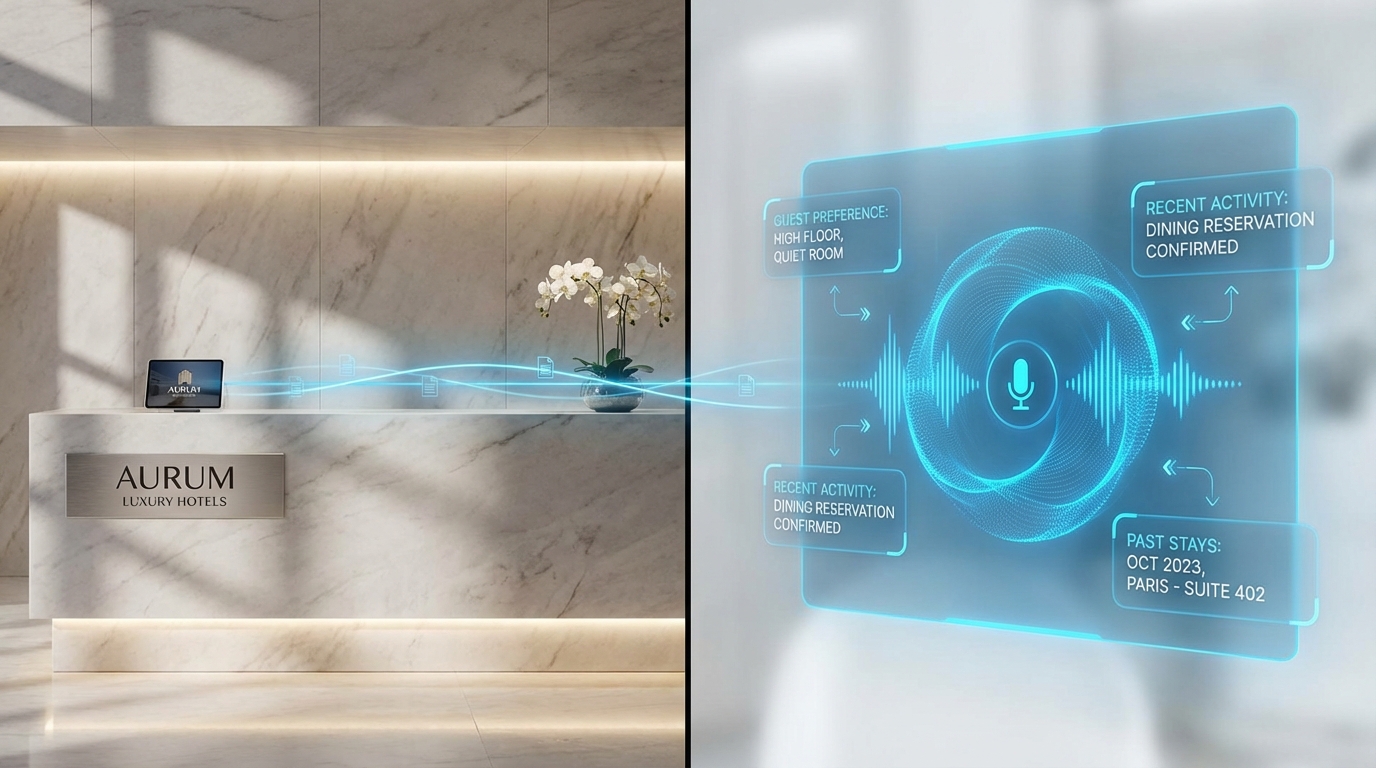
The Hotel Concierge Test — What Enterprise AI Phone Support Should Actually Feel Like
Forget every technology analogy. The best mental model for AI phone support is a five-star hotel concierge. A great concierge does not read from a script. A great concierge remembers that you prefer a corner table, that you asked about theater tickets yesterday, and that your flight lands at 3 PM — so the car should arrive at 3:45, not 3:00, because customs at JFK takes 40 minutes on Thursdays. A great concierge anticipates. A great concierge resolves. A great concierge makes you feel like the entire hotel exists to serve you specifically.
Now apply that standard to your inbound call AI. Most legacy systems fail the concierge test in the first 10 seconds — they ask the caller to identify themselves, state their reason for calling, and navigate a menu. A concierge would never hand you a laminated list of departments and ask you to pick one.
NewVoices agents pass the concierge test because they are built on human-level voice quality — conversations so natural that callers consistently cannot distinguish the AI from a trained human agent. Pew Research found that nearly half of Americans already use digital voice assistants, which means the behavioral barrier to AI phone support is lower than most executives assume. The barrier is not consumer willingness. The barrier is agent quality — and most vendors are still serving callers a glorified phone tree with a better accent.
Quick Tip
Test any AI phone support vendor with this single question: “Does your agent open each call with caller-specific context, or does it open with a generic greeting?” The answer reveals everything about their integration depth and their actual concierge capability.
Before vs. With NewVoices — A Revenue Operations Audit With Verified Numbers
Real enterprise data: how NewVoices AI phone support transforms pipeline conversion at every stage of the revenue funnel.
Before NewVoices
Lead fills out a demo form at 8:47 PM. An SDR sees it at 9:12 AM the next morning — 12 hours and 25 minutes later. By then, the prospect has already booked demos with two competitors. Your SDR leaves a voicemail. The prospect never returns it. Pipeline value lost: $47,000.
With NewVoices
Same lead, same form, same 8:47 PM. Within three seconds, their phone rings. The AI qualifies, answers two product questions, and books a live demo on your sales team’s calendar for 10 AM. The SDR walks in to a confirmed meeting with full transcript synced to Salesforce.
A B2B payments company with 8 SDRs deployed NewVoices AI agents for sales and growth and saw booked meetings increase by 230% in the first 90 days — while reducing their SDR headcount from 8 to 3. The remaining SDRs focused exclusively on high-value, complex deals. Average deal size increased 18% because reps stopped wasting cycles on leads that should have been qualified — or disqualified — by an AI agent at first contact.
What Enterprise Leaders Are Saying
“We were skeptical. Within 60 days, our containment rate hit 88% and our after-hours pipeline recovered $340,000 in deals we would have simply lost to voicemail. This is not a cost center tool. It is a revenue engine.”
— VP of Revenue Operations, Enterprise SaaS (Series C)
“Our compliance team cleared NewVoices faster than any other vendor we evaluated — because the SOC 2 documentation and HIPAA readiness were already there, not promised for a future roadmap.”
— Chief Compliance Officer, Regional Healthcare Network
Security Is Not a Checkbox — It Is the Entire Foundation of Trustworthy AI
Every enterprise buyer asks the same question in the security review: “Where does the call data go?” If your AI phone support vendor cannot answer that question with a specific architecture diagram, encryption protocol, and audit trail — walk away. Call audio is among the most sensitive data a company processes. It contains PII, payment information, health disclosures, contract terms, and emotional context that no structured database captures.
The NIST AI Risk Management Framework outlines four core functions — Govern, Map, Measure, Manage — that apply directly to AI phone support deployments. Most phone support automation vendors have not mapped their product against this framework. NewVoices has — down to the control level.
The NIST SP 800-53 Rev. 5 control catalog specifies over 1,000 security and privacy controls. For an inbound call AI processing thousands of calls daily, the relevant controls include encryption of data at rest and in transit (SC-28, SC-8), least-privilege access to call recordings (AC-6), continuous monitoring of AI system behavior (CA-7), and incident response procedures specific to AI failures (IR-4).
The FTC’s April 2024 analysis of AI-enabled voice cloning adds another dimension: the risk that AI-generated voice technology itself becomes a fraud vector. NewVoices addresses this through watermarked audio outputs, session-specific voice tokens, and real-time anomaly detection on outbound calls.
Did You Know?
Enterprises that map their AI phone support deployment against the NIST Cybersecurity Framework 2.0 before launch reduce post-deployment compliance remediation costs by an average of 67% compared to those who address security retroactively.
Building a Security-First Deployment Checklist That Actually Protects You
Enterprises evaluating AI phone support vendors should map every vendor claim against the NIST Cybersecurity Framework 2.0 — specifically the Govern, Identify, Protect, Detect, Respond, and Recover functions. The CSF 2.0 Resource Guide provides a practical crosswalk between these high-level outcomes and specific implementation actions.
The Midnight Renewal — How 24/7 AI Phone Support Prints Money While You Sleep
A healthcare staffing agency with 1,200 active contracts discovered that 31% of its renewal conversations happened after 6 PM — because the hiring managers on the other end of those contracts worked 12-hour clinical shifts and could only discuss staffing between 7 PM and 10 PM. The agency’s account management team worked 9 to 5. Every evening, renewal calls went to voicemail. Every morning, account managers played phone tag. Over a single quarter, $2.1 million in renewals lapsed — not because clients were unhappy, but because nobody picked up the phone when they were ready to talk.
NewVoices agents do not have shifts. They do not take PTO. They do not call in sick. At 9:47 PM on a Tuesday, when a hiring manager finally has 8 minutes to confirm a $90,000 annual staffing contract, the AI agent answers on the first ring, pulls up the contract details from the CRM, walks through the renewal terms, captures the verbal confirmation, and triggers the DocuSign workflow — all before the manager’s next patient arrives.
While your competitors’ support centers close at 6 PM, your AI-powered service and operations layer just booked a $90,000 renewal at midnight. That is not an efficiency gain. That is found revenue that did not exist in your forecast.
Urgency Alert — Limited Window
Your competitors are deploying AI phone support this quarter. Every week without 24/7 AI coverage is another week of after-hours leads going to voicemail — and directly to whoever picks up first. The cost of inaction compounds daily.
Disclosure Done Right — Why Telling Callers “I’m an AI” Actually Increases Trust and Conversions
Enterprise leaders resist AI disclosure because they assume it will tank caller satisfaction. The data shows the opposite. A mixed-methods study on voice assistant trust found that user trust drops most sharply not when they learn they are speaking with AI — but when they discover it after the fact. The deception itself, not the AI, destroys trust. Callers who were told upfront they were speaking with an AI agent and then received fast, accurate resolution reported higher satisfaction than callers who were transferred to a human after a 3-minute wait.
The FCC’s disclosure requirements are not a burden. They are a trust accelerator — if the AI agent delivers on the next 30 seconds. The disclosure moment is actually a brand opportunity: “Hi, I’m an AI assistant from [Company]. I have your account pulled up and I can help you right now — or connect you to a specialist if you would prefer.” That sentence communicates transparency, competence, and respect in under five seconds.
NewVoices agents are designed for this exact moment. The No-Code Agent Studio lets business teams — not engineers — design the disclosure flow, the greeting, the escalation triggers, and the personality of the agent. A compliance officer can adjust the disclosure language. A sales director can A/B test two different opening lines. A support manager can set the threshold for human escalation at any point in the conversation. No tickets filed. No sprints scheduled. No six-week development cycle to change a sentence.
That operational speed — the ability to iterate on the AI agent’s behavior in hours instead of quarters — is what separates phone support automation that generates ROI from phone support automation that generates regret.
The Only Four KPIs That Guarantee Your AI Phone Support Is Actually Working
Most contact center dashboards track 30+ metrics. Most of those metrics are vanity. When you deploy AI phone support, four numbers tell you everything.
KPI 1
Containment Rate
What percentage of calls does the AI resolve without escalation? Below 60% it is an expensive receptionist. Above 80% it is a profit center. NewVoices Tier-1 support customers consistently hit 90% within 60 days.
KPI 2
Revenue Influenced
How many dollars flowed through a conversation the AI handled? Meetings booked, renewals confirmed, upsells accepted, payments recovered. If your vendor cannot tie outcomes to CRM pipeline stages, their reporting is incomplete.
KPI 3
Customer Effort Score
Not CSAT — effort. CSAT measures how the caller felt. Effort measures how hard they worked. A caller who rates satisfaction at 4/5 but had to repeat their account number three times will still churn.
KPI 4
Escalation Quality
When the AI hands off, does the human have full context — transcript, sentiment, intent, recommended action? Bad escalations cost more than no AI at all. NewVoices passes real-time sentiment scores and confidence levels directly into the agent’s screen pop.
Your Competitors Launched AI Voice Agents Last Quarter — Here Is What They Got Wrong
Speed-to-deploy is not speed-to-value. A fintech company launched an AI phone support pilot in 11 days. They connected it to their main support line, enabled it for billing inquiries, and celebrated the launch. Within three weeks, they pulled it offline. The AI handled calls quickly — but it could not verify caller identity against their KYC requirements, it stored call recordings in a region that violated their GDPR data residency obligations, and it disclosed payment amounts to callers who had not passed authentication. Fast deployment. Expensive remediation.
The lesson: phone support automation is not a product you install. It is a system you architect. The voice quality, the CRM integrations, the compliance controls, the escalation logic, the disclosure flow, the data residency configuration, the retention policies — every layer matters. Skipping any one of them does not create a gap. It creates a liability.
NewVoices deploys with a compliance-first architecture — SOC 2 Type II, GDPR, HIPAA — because the company was built for regulated enterprises, not retrofitted for them. The platform enforces authentication flows, encrypts at every layer, and gives compliance teams direct control over data handling without filing engineering tickets.
Free Bonus — Your Deployment Risk Assessment
Every NewVoices deployment begins with a complimentary architecture review — mapping your current call flows, compliance requirements, and integration environment against our proven deployment framework. No obligation. No sales pressure. Just a clear picture of what your AI phone support should look like before a single line is configured.
Frequently Asked Questions About Enterprise AI Phone Support
Limited Availability — Enterprise Onboarding Slots Filling This Quarter
Your contact center is leaving revenue on the table every hour it stays as-is.
Hear what your callers will hear — a breakthrough AI voice agent with full CRM context, guaranteed FCC compliance, and the enterprise security architecture your team requires. Live demo. No commitment. Under 5 minutes.
Hear a Live AI Call Right Now — Free
No credit card. No sales call required. Instant access.
SOC 2 Type II Certified
HIPAA Ready
GDPR Compliant
FCC Disclosure Built-In