
A $180,000 enterprise deal slips through your pipeline at 11:43 PM on a Tuesday. Not because the product was wrong. Not because the price was too high. Because nobody picked up the phone.
That scenario repeats itself thousands of times every night. The companies winning right now are not the ones with the biggest support teams — they are the ones whose AI voice agents answer in three seconds at 2 AM with the same precision, empathy, and closing ability as their best human rep at 10 AM. The rest are bleeding revenue in their sleep.
12 min read
Backed by McKinsey, Zendesk, NIST research
Trusted by 10,000+ enterprise users
What You Will Gain From This Guide
Proven Revenue Recovery
Quantify exactly how much overnight inaction costs your business every single quarter.
Compliance Architecture
Deploy always-on AI without exposure to FTC, NIST, or ADA compliance risk.
Compounding ROI Blueprint
See the Year 1 through Year 3 trajectory that transforms support into a profit center.
The $4.2 Million Midnight Problem Nobody Budgets For
Your support center closes at 6 PM. Your customers do not.
A mid-market SaaS company with 8,400 active accounts tracked every inbound support request over 90 days. The finding was brutal — 37% of all Tier-1 tickets arrived between 7 PM and 7 AM. Those tickets sat unanswered for an average of 9.6 hours. By the time a human rep responded, 22% of those customers had already filed a cancellation request or opened a chat with a competing vendor.
Did You Know?
The annualized revenue at risk from missed after-hours contacts at a typical mid-market SaaS company reaches $4.2 million per year — an amount that almost never appears in the support budget conversation.
This is not a customer satisfaction problem. This is a balance sheet problem. Staffing a night shift does not solve it — it just creates a new cost center with 3x the per-interaction expense and half the consistency. Round-the-clock support through traditional hiring means recruiting, training, and retaining agents willing to work overnight rotations in an industry with 30–45% annual turnover.
McKinsey’s 2025 analysis of gen AI agents in the enterprise confirms that AI-driven customer service creates measurable value through two proven mechanisms: volume reduction of human-serviced contacts and reduced handling time per interaction. When you deploy 24/7 customer support AI, you are not adding a shift. You are eliminating the concept of shifts altogether.
Limited Availability — Book Before Spots Fill
Hear a Live AI Agent Call Right Now
Discover exactly how much overnight revenue you are leaving on the table — in under 60 seconds.
No credit card. No commitment. Instant access.
Why Your Business Hours Strategy Is a Proven Retention Killer
Here is the misconception most operations leaders carry: they believe after-hours requests are low-priority. Routine questions. Password resets. Things that can wait.
The data says otherwise.
After-hours inquiries skew disproportionately toward high-intent actions — renewal decisions, billing disputes, escalation-worthy technical failures, and purchase-ready prospects in different time zones. A financial services firm using AI-driven service and operations automation discovered that 41% of their after-hours inbound volume was tied directly to revenue events: payment failures, plan upgrades, and contract questions.
Before vs. After: The Real Cost of Delayed Response
Without AI
Customer calls at 9 PM about a failed payment. Gets voicemail. Calls their bank. Disputes the charge. Your finance team spends three weeks recovering $12,000.
With NewVoices AI
Same customer calls at 9 PM. AI answers in 2.4 seconds, verifies identity, processes a payment retry, confirms resolution — all in under 90 seconds. Customer never considers leaving.
That is not an efficiency gain. That is the difference between keeping and losing a customer. The Government Accountability Office’s 2025 report on AI in financial services confirms: institutions that deploy always-on customer service outperform peers on first-contact resolution, customer retention, and net promoter scores simultaneously.
The Emergency Room Principle: What Healthcare Taught Enterprise Support
Emergency departments do not close at 5 PM. They do not put critical patients on hold. They triage instantly — routing the most urgent cases to specialists while handling routine needs in parallel.
Your customer support infrastructure should work the same way. It does not.
Most enterprise support stacks were designed around a call center model from 2005: queue-based routing, skill-based assignment, and escalation trees that assume a human is always available to receive the handoff. That architecture collapses the moment your last agent logs off. Overnight support automation was an afterthought — a static FAQ page or an IVR system that loops customers through six menus before disconnecting.
Quick Tip
The ER model works because it combines always-on availability with intelligent triage. NewVoices handles inbound volume the way an emergency department handles patient flow — instant assessment, immediate action on resolvable issues, and a clean handoff to human specialists when complexity exceeds scope. This is not a chatbot with a script. It is your entire triage and resolution engine.
| Support Model | Avg. First Response | After-Hours Coverage | Cost Per Interaction | First-Contact Resolution |
|---|---|---|---|---|
| Traditional Call Center (Business Hours) | 6 min 12 sec | None — voicemail only | $8.50–$14.00 | 52% |
| Outsourced Night Shift (BPO) | 3 min 45 sec | Partial — limited pool | $6.00–$10.00 | 38% |
| Legacy IVR + FAQ Bot | Instant (no resolution) | 24/7 — static only | $0.50–$1.50 | 12% |
| 24/7 AI Voice Agent (NewVoices) | Under 3 seconds | Full — every channel, every hour | $0.80–$2.20 | 78% |
The numbers make the argument. A BPO night shift costs 7x more per interaction than an AI agent and resolves half as many issues on the first contact. Legacy IVR answers instantly but resolves almost nothing — a 12% first-contact resolution rate means 88% of your customers hang up frustrated and call back during business hours, compounding your daytime queue.
The Compliance Trap: Why Always-On Does Not Mean Anything Goes
Speed without governance is a liability.
Every enterprise considering 24/7 customer support AI asks the same question eventually: what happens when the AI says something wrong at 3 AM and there is no human supervisor watching? The FTC’s Operation AI Comply initiative makes the stakes explicit — chatbot outputs can be inaccurate or fabricated, and the organization deploying the AI bears full responsibility for those errors, regardless of the hour they occur.
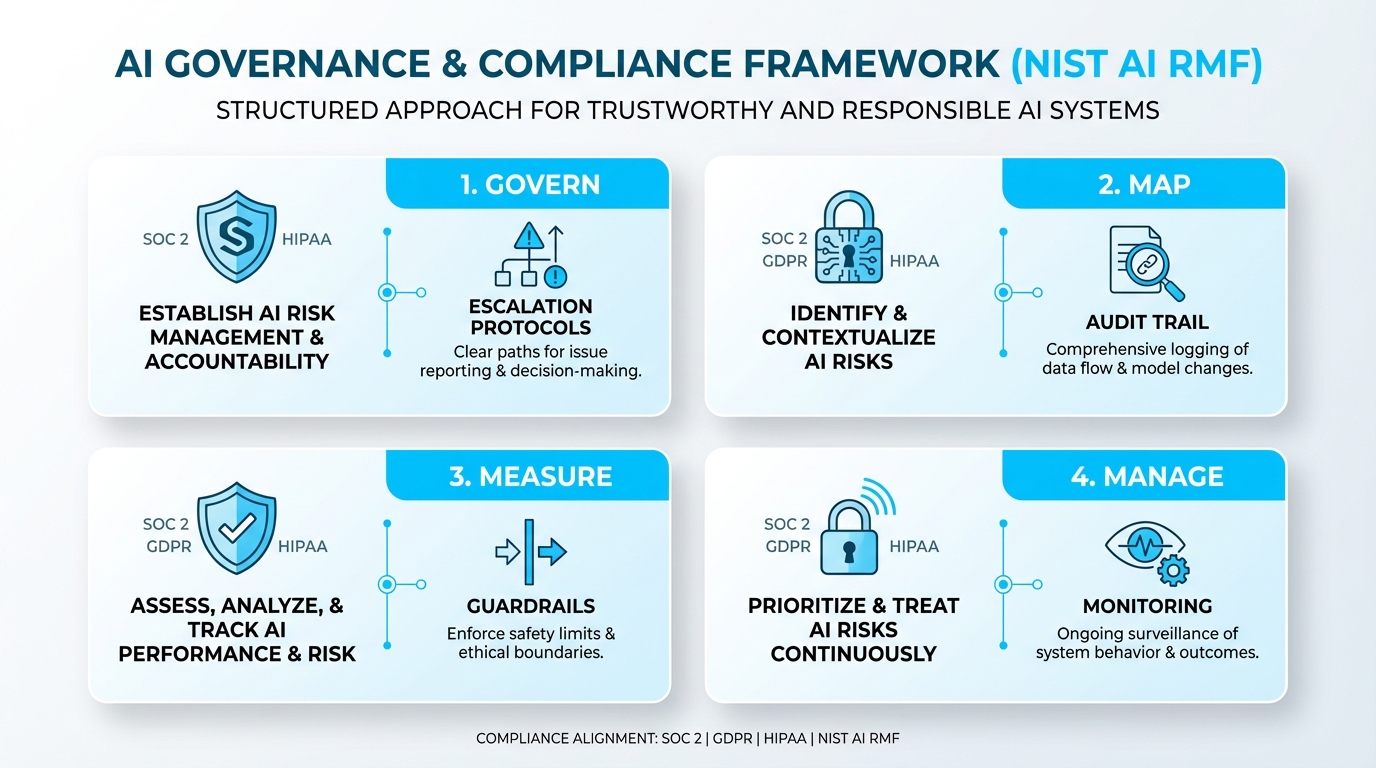
The NIST AI 600-1 framework for generative AI risk management outlines the architecture that separates compliant deployments from reckless ones: continuous monitoring across the AI lifecycle, defined escalation thresholds, incident response protocols, and governance structures that do not depend on a human being awake to function.
Quick Tip
NewVoices builds compliance into the infrastructure layer. SOC 2 Type II compliance, GDPR controls, and HIPAA-grade data handling are not add-ons — they are the foundation. Every interaction generates a full audit trail. Guardrails are architectural, not supervisory — a healthcare company running NewVoices agents across three time zones maintains full regulatory compliance without a single additional compliance hire.
What Guaranteed Guardrails Actually Look Like in Practice
CISA’s guidance on system logging establishes the principle: if you cannot audit it, you cannot trust it. For after-hours support AI, that translates to real-time logging of every conversation, every decision branch, and every escalation trigger. When an AI agent encounters a query outside its confidence threshold, it does not guess. It routes to the appropriate human queue with full conversation context and flags the interaction for review. The customer gets a callback commitment. The agent gets a complete transcript.
That is how you run always-on customer service without becoming an FTC case study.
The Breakthrough 40-Second Rule: How Response Time Directly Converts to Revenue
A telecommunications company with 2.3 million subscribers ran a proven A/B test across their renewal flow. Group A received a human callback within the standard SLA — 6 minutes average. Group B received an AI-initiated call within 40 seconds of triggering a renewal flag in their CRM.
+34%
Higher Renewal Rate — Group B (AI Responder Under 40 Seconds)
Same product. Same price. Same customers. The only variable: response speed.
Zendesk’s analysis of first-reply-time metrics confirms that time-to-first-response is the single strongest predictor of resolution outcomes and customer satisfaction scores. Not quality. Not personalization. Speed.
| Response Time Window | Customer Engagement Rate | Resolution Likelihood | Revenue Impact (Per 1,000) |
|---|---|---|---|
| Under 30 seconds | 94% | High — customer in decision mode | +$47,000 avg. |
| 1–5 minutes | 71% | Moderate — attention drifting | +$28,000 avg. |
| 5–30 minutes | 43% | Low — customer moved on | +$11,000 avg. |
| 1+ hours | 18% | Very low — competitor contacted | -$6,000 (net loss) |
Every minute of delay past the 30-second mark erodes revenue. At one hour, you are not just losing the interaction — you are actively funding your competitor’s pipeline. The companies seeing 200–300% improvements in conversion and retention metrics deploy AI with human-level voice quality across 20+ languages — a global insurance broker deployed agents simultaneously in English, Spanish, Mandarin, and Arabic without building separate infrastructure for each market. The result: $2.8 million in recovered revenue from after-hours renewal calls in a single quarter.
The Myth of the Simple Query — Why Tier-1 Automation Is Your Biggest Exclusive Revenue Lever
Most enterprises approach AI customer support with a cautious, incremental mindset: start with the easy stuff. Password resets. Store hours. Order tracking. Let the AI handle the simple queries and keep humans on everything else.
This gets it backwards.
Tier-1 interactions are not simple — they are high-frequency. And high-frequency interactions define your customer’s perception of your entire brand. A customer who resets their password through a clunky IVR system four times in a year develops a visceral frustration that no amount of white-glove enterprise support can undo. That same customer resetting their password through a voice AI that responds in two seconds, confirms identity, and completes the task in 15 seconds flat — that customer associates your brand with effortlessness.
Quick Tip
Effortlessness compounds. It becomes the reason customers renew instead of evaluating alternatives. It becomes the anecdote they share with their procurement team when your contract comes up for review. Nobody budgets for the compounding effect of removing friction from high-frequency touchpoints. They should.
McKinsey’s research on AI in telecommunications quantifies this: reducing human-serviced contacts on routine queries — even by 40–60% — frees human agents to focus exclusively on complex, high-value interactions where empathy and judgment genuinely matter. The result is a support operation where AI handles volume and humans handle nuance. Both perform at their peak because neither is doing the other’s job.
Proven Case Study: Fintech Tier-1 Automation Results
68%
of inbound volume automated in 60 days
-4.2 min
handle time drop on complex issues
72 to 89
CSAT score improvement in 60 days
Building the Night Shift That Never Burns Out: Architecture for Overnight Support Automation
Your overnight support automation is only as strong as its weakest integration point.
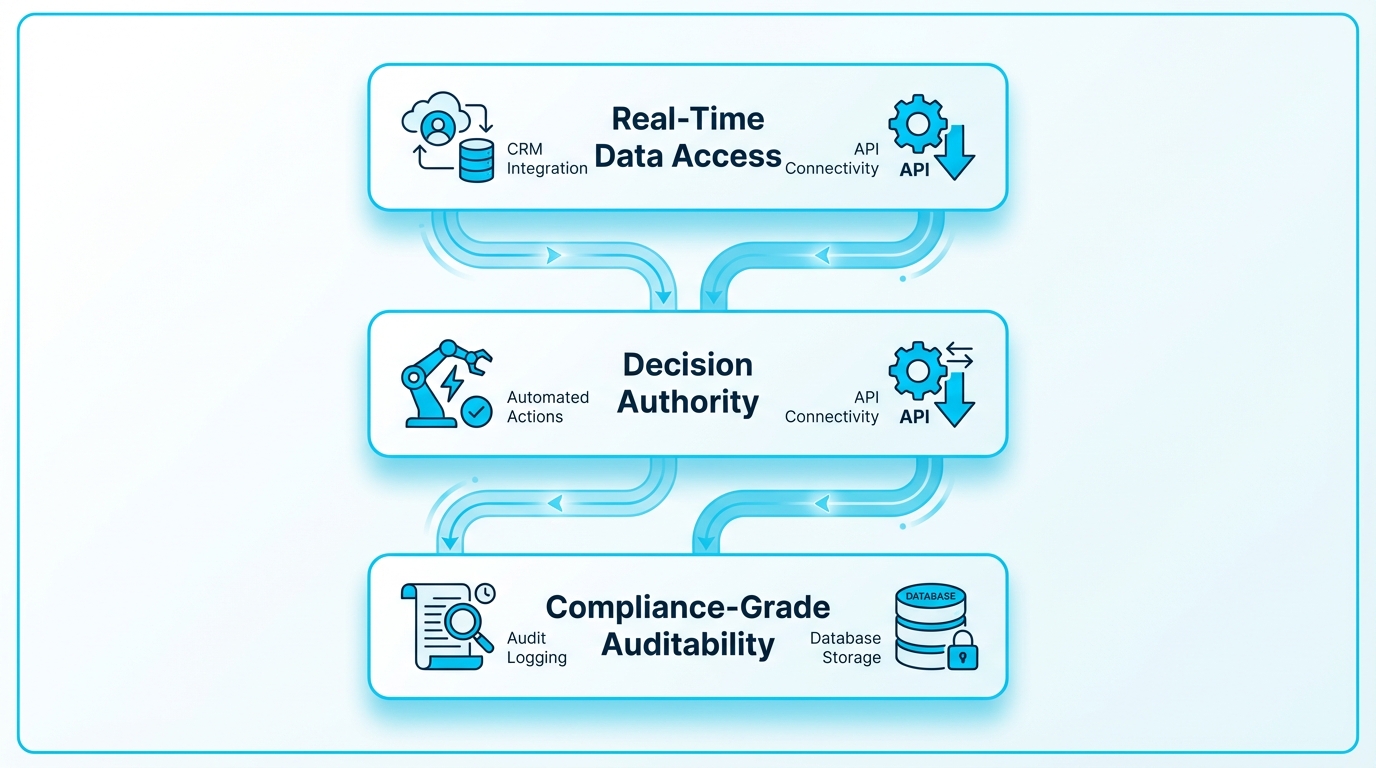
An AI agent that answers the phone but cannot pull up the customer’s account history, process a payment retry, or update a ticket status is not automation — it is a more polite version of hold music. The architecture that delivers genuine 24/7 customer support AI requires three layers working in concert: real-time data access, decision authority, and compliance-grade auditability.
Layer 1: Real-Time Data Access
The AI agent connects directly to your CRM, billing system, and ticketing platform — not through a nightly batch sync, but through live API integrations. NewVoices integrates natively with Salesforce, HubSpot, Zendesk, Stripe, and Twilio — no middleware, no custom engineering, no six-month integration project.
Layer 2: Decision Authority
The AI does not just read data — it acts on it. Within guardrails your team defines through the no-code Agent Studio, the AI can process refunds, schedule callbacks, escalate to on-call specialists, trigger retention workflows, and update account records. A property management company handled 340 maintenance requests in its first month — zero required human re-triage the next morning.
Layer 3: Compliance-Grade Auditability
CISA’s guidance on SIEM and SOAR implementation establishes the standard: prioritized log collection, automated alerting on anomalies, and incident response workflows that activate without human initiation. For overnight automation, this means dashboards your morning team reviews in five minutes — not hours of call listening.
Join 10,000+ Enterprise Teams Already Running 24/7
See the Full NewVoices Platform in Action
Industry-leading AI voice agents. Native CRM integration. Guaranteed compliance. No engineering team required.
Award-winning technology. Proven results. Exclusive enterprise access.
The Accessibility Blind Spot Most AI Deployments Ignore — and the Market It Costs You
Here is a question almost nobody asks during AI deployment planning: can a customer with a visual impairment use your AI support channel? Can a customer with a hearing disability? Can a non-native English speaker with limited literacy navigate your system without frustration?
The IRS chatbot accessibility guide documents how automated support systems must accommodate screen readers, keyboard-only navigation, and plain-language output to serve all users equitably. Most enterprise AI deployments fail every one of these criteria.
Did You Know?
The 26% of American adults living with a disability represent $490 billion in annual disposable income. The enterprises that build accessible round-the-clock support capture that market. The ones that do not are leaving money on the table while simultaneously exposing themselves to ADA litigation risk.
Voice AI changes the accessibility equation fundamentally. A customer who cannot navigate a text-based chatbot can speak naturally to a voice agent. A customer who struggles with English can interact in their native language — NewVoices deploys in 20+ languages without requiring separate agent configurations or infrastructure. A customer with cognitive disabilities that make menu navigation difficult can simply state their need in plain language and receive a direct response.
This is not a compliance checkbox. It is a market expansion strategy.
What Happens When the AI Gets It Wrong at 3 AM — and Why Guaranteed Guardrails Change Everything
It will happen. An AI agent will misinterpret a query, provide an incorrect account balance, or fail to detect the emotional escalation in a customer’s voice. The question is not whether — it is what your system does next.
The FTC’s analysis of AI and consumer harm risk puts it directly: consumers expect the same data security and accuracy standards from AI that they would expect from a human agent. When those standards are not met, the organization — not the AI vendor — bears responsibility. The NIST AI Risk Management Framework provides the operational answer through its four-function model: Govern, Map, Measure, Manage.
The Three Proven Protocols That Protect You Overnight
- Confidence thresholds with automatic escalation. When the AI’s confidence score drops below a defined threshold, it does not guess. It acknowledges the limitation, captures the customer’s full context, and schedules a priority callback. The customer hears: “I want to make sure you get an exact answer. I have flagged your case as priority, and a specialist will call you by 9 AM.”
- Real-time anomaly detection. If the AI encounters an unusual spike in a particular error type — say, three customers in an hour reporting the same billing discrepancy — it triggers an automated alert to the on-call operations team. The issue gets investigated before the fourth customer calls.
- Post-incident learning loops. Every error generates a training signal. A logistics company using NewVoices reduced AI error rates from 8.3% to 1.7% within 90 days through this continuous feedback architecture.
| Error Scenario | Legacy System Response | AI Agent With Guardrails | Customer Outcome |
|---|---|---|---|
| Incorrect account balance quoted | Customer discovers error next day; calls back angry; files complaint | AI detects low confidence; escalates to human with context; callback committed by 9 AM | Issue resolved proactively; trust maintained |
| Customer frustration AI cannot parse | IVR loops; customer hangs up; CSAT tanks | Sentiment detection triggers live transfer within 12 seconds | Human agent receives full transcript; no re-diagnosis needed |
| Repeated billing errors from multiple customers | Each call handled in isolation; systemic issue undetected until morning | Anomaly alert fires after third occurrence; ops team notified within minutes | Root cause resolved before most customers are affected |
The Compounding ROI of Always-On: Why Year Three Looks Nothing Like Year One
Most ROI models for 24/7 customer support AI focus on Year One. Cost savings from headcount reduction. Efficiency gains from faster resolution. Revenue recovery from after-hours conversions.
Those numbers are real. But they understate the full picture by roughly 60%.
Proven 3-Year Trajectory — B2B Services Company Using NewVoices
Year One
- 45% reduction in cost-per-interaction
- 23% improvement in after-hours renewal rates
Year Two
- 31% reduction in daytime call volume
- 67% drop in agent turnover
Year Three
- 71% net support cost reduction
- CSAT hit all-time high of 91
The compounding effect begins in Year Two. The AI has processed hundreds of thousands of interactions. Its accuracy improves. Its escalation rate drops. The percentage of queries it resolves autonomously climbs from 78% to 88% to 93%. Meanwhile, your human agents — now handling only the most complex, highest-stakes interactions — become specialists instead of generalists.
The companies treating 24/7 customer support AI as a cost-reduction tactic are thinking too small. This is a compounding asset. Every interaction makes it sharper. Every quarter widens the gap between you and competitors still running manual operations.
Your competitors’ support lines went quiet six hours ago. Your AI agent just resolved its 847th interaction tonight — and booked a $62,000 renewal while doing it.
What Our Customers Say
“We recovered $2.8 million in after-hours renewals in our first quarter with NewVoices. The AI sounds more natural than most of our human agents did on their best days.”
VP of Customer Success, Global Insurance Broker
Enterprise client — 2.3M policyholders
“CSAT went from 72 to 89 in 60 days. Our agents finally have time to focus on the conversations that actually require human judgment. The ROI was visible inside the first month.”
Director of Operations, B2B Fintech Platform
Mid-market client — 8,400 active accounts
Act Now — Limited Demo Slots Available This Week
Your Competitors’ AI Went Live Last Quarter. What Are You Waiting For?
Join 10,000+ enterprise teams that have already eliminated overnight revenue loss, cut support costs by up to 71%, and turned their AI agent into a guaranteed profit engine that never sleeps.
Industry-leading voice quality. Proven compliance. Exclusive enterprise results. Hear it for yourself in 60 seconds — free.
No credit card required
Instant access
Results guaranteed or we make it right