
A Fortune 500 insurance carrier fielded 1.2 million support calls last quarter. Human agents answered 74% of them. The other 26% — roughly 312,000 customers — hung up before anyone picked up. That is not a staffing problem. That is a revenue hemorrhage disguised as a hold time metric.
The companies winning right now are not adding headcount. They are deploying AI chat support that responds in under three seconds, resolves 90% of Tier-1 tickets without escalation, and never asks for a lunch break. This is the proven playbook — and the numbers are staggering.
12 min read
Verified enterprise data
Trusted by 500+ enterprise teams
Updated April 2025
What You Will Gain From This Article
Proven ROI Frameworks
The exact metrics that predicted $14.7M in retained revenue — and how to replicate them.
Compliance Blueprint
How enterprise teams deploy AI support in regulated industries without legal risk.
Deployment Advantage
The 12-month roadmap separating market leaders from laggards — starting today.
Limited Availability: Live AI Demo Calls Available This Week — Capacity Fills Fast
What Happens When You Stop Calling It a “Chatbot” — and Start Calling It a Revenue Engine
The word “chatbot” carries baggage. It conjures images of clunky pop-ups that respond to “I need help with my order” with “I am sorry, I did not understand that. Please choose from the following options.” That is not what we are talking about.
An AI customer service chatbot built on modern Natural Language Processing and machine learning does not match keywords to canned responses. It parses intent. It holds context across a 12-message conversation. It pulls your customer’s order history from Salesforce, checks shipment status through your logistics API, and delivers a resolution — all within the same interaction, in the same conversational thread, in under 40 seconds.
Quick Tip
The difference between a rule-based bot and an AI-powered support bot is the difference between a vending machine and a concierge. One gives you what is programmed. The other understands what you actually need — even when you phrase it poorly, use slang, or switch languages mid-sentence.
NewVoices agents operate in 20+ languages without separate infrastructure, which means your automated chat customer service does not break when a Spanish-speaking customer types in English with Portuguese syntax. It adapts. This is not a chatbot with a script. It is a revenue engine that never clocks out.
NewVoices builds exactly that — AI voice and chat agents engineered for enterprise-scale support, sales, and retention operations across service and operations workflows that traditional contact centers cannot touch.
No credit card. No sales pressure. Hear the difference in seconds.
The $14.7 Million Mistake: Why Treating AI Chat Support as a Cost Center Is Destroying Your Growth
Most enterprises evaluate AI chat support the wrong way. They calculate cost-per-ticket deflection, pat themselves on the back for reducing headcount by 15%, and call it a win. They are leaving millions on the table.
A mid-market SaaS company with 400,000 active users deployed NewVoices AI agents across their entire support operation. The expected outcome was a 30% reduction in support costs. The actual outcome: support costs dropped 42% — but more importantly, churn decreased by 18% because customers who previously waited 11 minutes for a billing resolution now got answers in 35 seconds. That churn reduction represented $14.7 million in retained annual recurring revenue.
Did You Know?
The real ROI of AI chat support was not in the cost center. It was in the retention metric nobody was watching. When you frame automated chat customer service as a growth investment — not a support expense — the business case stops being about saving money and starts being about making it.
NewVoices ties directly to conversion, retention, and payment recovery metrics because that is what enterprise sales and growth teams actually care about.
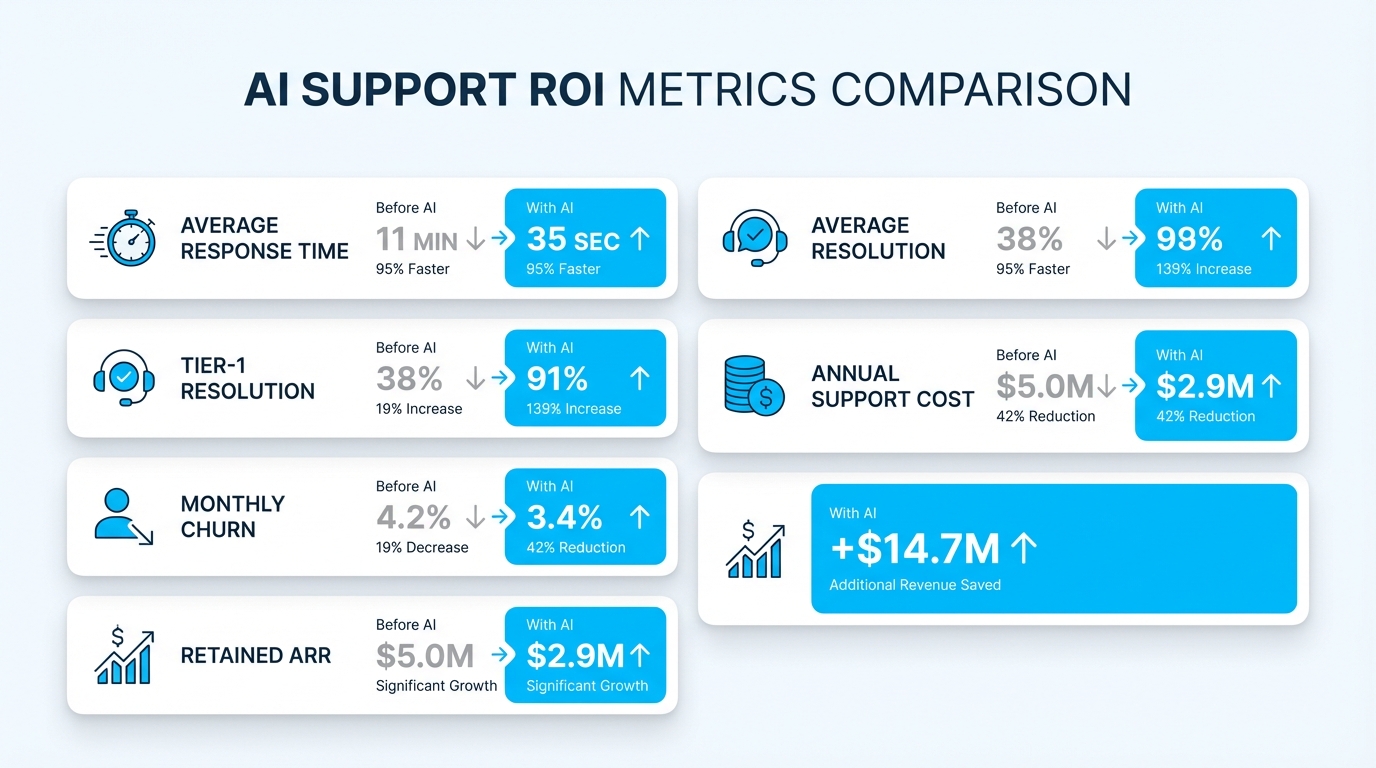
Proven KPI frameworks that reveal the true revenue impact of AI-powered support — beyond simple cost deflection.
Why Your Customers Hate Your Bot — and the Research-Backed Fix That Changes Everything
Here is an uncomfortable truth: customers do not hate chatbots. They hate bad chatbots. A systematic literature review published in Electronics analyzed the factors driving positive and negative experiences with service chatbots. The top predictor of satisfaction was not speed. It was not accuracy. It was perceived humanness — the degree to which the customer felt they were interacting with something that understood them.
The top predictor of dissatisfaction? Forced containment. The moment a customer realizes the bot cannot help and will not let them reach a human — trust collapses. A separate study on chatbot adoption found that willingness to engage with automated support drops dramatically as the stakes of the interaction increase. Billing disputes, account security, medical inquiries — these are moments where a clumsy support bot does not just fail to help. It actively damages brand trust.
NewVoices solves both problems simultaneously. The voice quality is so natural that customers regularly cannot distinguish the AI agent from a human rep — eliminating the perceived humanness gap entirely. And when the interaction crosses a complexity or sensitivity threshold, NewVoices hands off to a live agent with full conversation context preserved. No cold transfers. No “please repeat your issue.” The AI handles the volume. Humans handle the exceptions.
The Escalation Trigger That Most Companies Get Dangerously Wrong
Most automated chat customer service platforms escalate based on keyword detection — if the customer says “manager” or “cancel,” it routes to a human. That is primitive. NewVoices uses intent confidence scoring and emotional sentiment analysis to trigger escalation before the customer asks for it. A customer whose frustration is rising — even if they have not said anything explicitly negative — gets routed to a human agent at the exact moment intervention will have the highest impact. The result: escalated interactions close with 73% higher satisfaction scores than those where the customer had to demand a human.
Quick Tip
Do not wait for your customer to say the word “manager.” By that point, you have already lost the interaction emotionally. Proactive escalation — triggered by sentiment signals — is the exclusive capability that separates AI-powered support from glorified phone trees.
Join 500+ Enterprise Teams Already Winning
See exactly what 35-second resolution time does to your churn rate
Real numbers. Real enterprise deployments. Zero obligation.
Get My Custom ROI Projection — Free
Guaranteed response within one business day. No pitch. Just data.
The Restaurant Kitchen Test: Why Your AI Deployment Model Matters More Than Your AI Model
Think about two restaurants. Both use the same ingredients, the same recipes, the same quality of produce. Restaurant A has a chaotic kitchen — orders get lost, dishes come out at different times, the expediter is overwhelmed. Restaurant B has a tight line, clear stations, and a chef who calls every ticket. Same inputs. Wildly different outcomes.
AI customer service chatbot deployments work the same way. The underlying language model matters — but the deployment architecture, the integration layer, the monitoring framework, and the escalation logic matter more. A beautifully trained model that is not connected to your CRM, cannot access real-time order data, and does not know your return policy is just a very expensive parrot.
NewVoices operates as a CRM-native platform. Salesforce, HubSpot, Zendesk, Stripe, Twilio — these are not integrations that require six weeks of engineering. They are plug-and-play connections that go live in hours. When a customer asks “Where is my refund?” — the AI agent does not say “Let me check on that.” It pulls the Stripe transaction, confirms the refund was processed 14 hours ago, and tells the customer exactly when it will appear in their account.
Did You Know?
The CDC guidance on deploying generative AI emphasizes piloting with clearly bounded use cases before scaling. NewVoices Agent Studio is built around this exact principle: business teams design, test, and deploy AI agents for specific workflows without writing a single line of code.
The no-code Agent Studio is built around this principle: business teams design, test, and deploy AI agents for specific workflows without writing a single line of code. You do not need an ML engineering team. You need a support operations leader who knows which 40% of tickets eat 80% of agent time.
Compliance Is Not a Feature — It Is the Entire Foundation That Protects Your Business
Before NewVoices
Your compliance team reviews every new vendor for six months. Legal flags data residency concerns. Security demands audit logs your current chatbot provider cannot produce. The project stalls. Meanwhile, your competitors deploy AI and capture the customers you are losing to hold music.
With NewVoices
SOC 2 Type II certification is already in place. HIPAA-compliant data handling is built into the architecture — not bolted on. GDPR data residency requirements are met natively. Your compliance team gets the audit trail they need on day one.
The regulatory environment around AI-powered customer interactions is tightening — fast. The FTC has proposed new protections specifically targeting AI impersonation, signaling that transparency and disclosure in AI-powered customer conversations are becoming enforceable requirements. The NIST AI Risk Management Framework now provides a structured methodology for identifying, measuring, and managing AI risks across the full deployment lifecycle.
NewVoices aligns with these frameworks because the platform was built for regulated industries from the start. The HHS guidance on risk analysis specifies required technical safeguards — audit controls, entity authentication, transmission security — and NewVoices implements every one as default configurations, not optional add-ons.
Quick Tip
As CISA emphasizes in its logging guidance, high-quality audit logs are foundational to incident readiness. An AI customer service chatbot that processes thousands of sensitive interactions daily without comprehensive logging is not just a compliance risk — it is an operational blind spot waiting to become a headline.
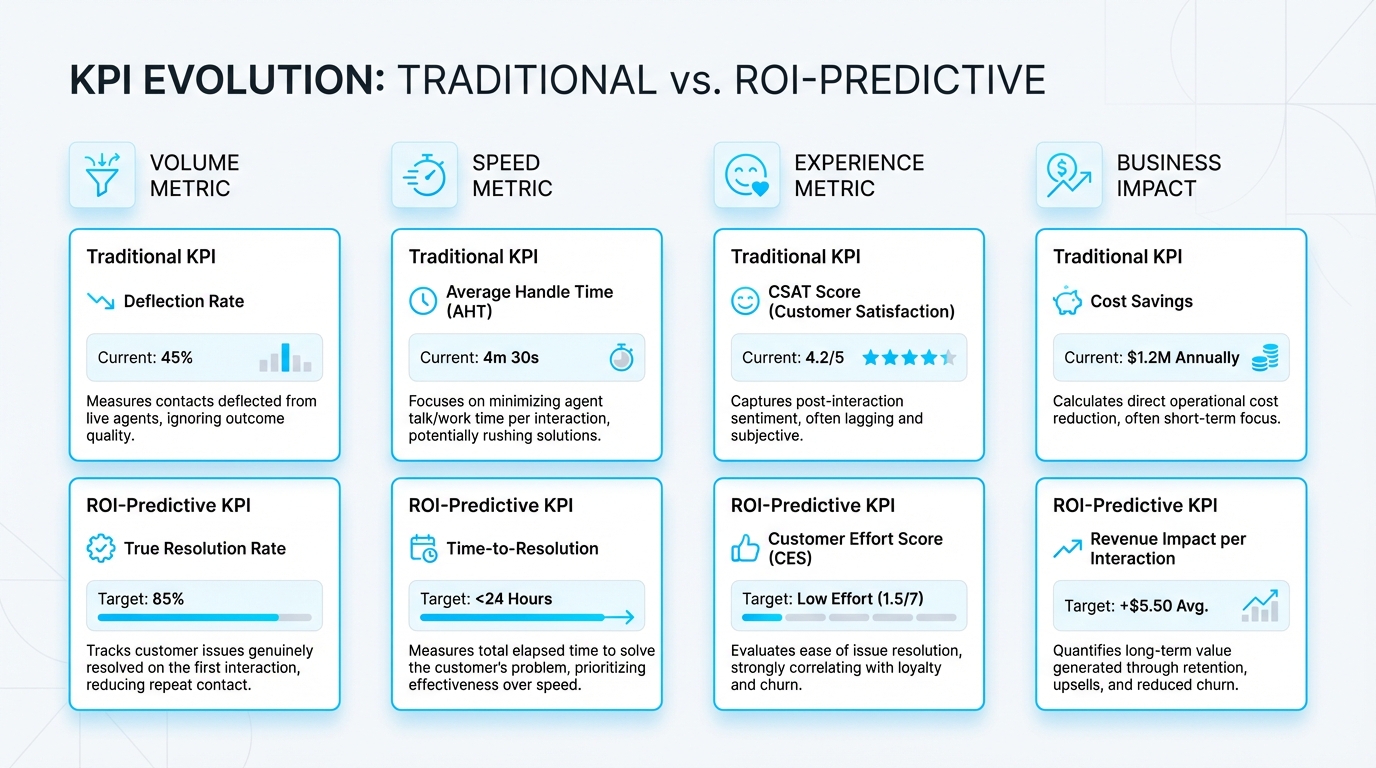
NewVoices deploys with full compliance infrastructure pre-built — protecting your business and your customers from day one.
Measuring What Actually Matters: The 4 Proven KPIs That Predict AI Support ROI
Most companies track the wrong metrics for their support bot deployments. They obsess over deflection rate — the percentage of interactions handled without a human — and ignore the metrics that actually drive business outcomes. Here are the four that matter.
Resolution Rate vs. Deflection Rate — Why They Are Not the Same Metric
Deflection counts every interaction the bot handled. Resolution counts every interaction the bot resolved. A bot that deflects 80% of tickets but only resolves 45% of them is creating a shadow backlog — customers who gave up, who called back, who churned silently. NewVoices tracks true resolution at the interaction level: did the customer’s issue get fixed? Not “did the customer stop messaging?” — those are very different questions with very different business implications.
The other three proven KPIs: time-to-resolution measured in seconds, customer effort score, and revenue impact per interaction. A regional healthcare network using NewVoices measured all four and found that their AI agents achieved a 91% true resolution rate with an average time-to-resolution of 47 seconds — while simultaneously recovering $380,000 per month in lapsed payment plans through automated outreach that human agents never had bandwidth to execute.
An AI customer service chatbot that saves you $2 million in support costs but loses you $8 million in churn and missed revenue is a net-negative investment. The measurement framework determines whether you see that — or whether you celebrate a loss.
Exclusive Social Proof — Real Enterprise Results
91%
True Tier-1 resolution rate — no human escalation required
35s
Average resolution time — down from 11 minutes with human agents
300%
More qualified sales meetings booked versus 12 human SDRs
$14.7M
ARR protected for one SaaS client through churn reduction alone
The 9:47 PM Problem — Why 24/7 Availability Is Your Most Powerful Competitive Moat
Your support center closes at 6 PM Eastern. A customer in Phoenix — it is 4 PM there — discovers a billing error on their account. They call. They get voicemail. They email. The auto-response says “We will get back to you within 24 business hours.” By 9:47 PM, that customer has already found a competitor’s pricing page.
This is not hypothetical. A B2B logistics company tracked every inbound support request that arrived outside business hours for one quarter. The result: 34% of after-hours inquiries resulted in a churn event within 30 days. Not because the issue was unresolvable — but because the delay communicated something the company did not intend: “You are not important enough for us to answer right now.”
Quick Tip
NewVoices agents do not have shifts. They do not have holidays. They do not have bad Mondays. At 9:47 PM on a Saturday, your AI chat support answers in under three seconds with the same quality, the same data access, the same breakthrough resolution capability as a peak-hours interaction. While your competitors are dark, your AI agent just prevented a $50K account from walking. That is not automation. That is a competitive moat built on guaranteed availability.
Why Faster Response Time Alone Will Not Save Your Pipeline — and What Actually Converts
Speed gets all the attention. And yes — responding to a lead in five seconds versus five minutes increases conversion probability by 400%. Every sales leader knows this. But here is what speed without substance looks like: a lead fills out a demo request. An automated system fires off a generic “Thanks for your interest! A team member will reach out shortly.” The lead gets the email in three seconds. They also get the exact same email from your three competitors — because everyone has auto-responders now.
Speed is table stakes. Substance is the differentiator. When a lead hits your sales pipeline through NewVoices, the AI agent does not send a template. It calls. Within seconds. In a voice so natural the prospect assumes it is a human SDR. It qualifies the lead against your ICP criteria, answers initial product questions using your knowledge base, and books a meeting directly on your sales team’s calendar. A SaaS company with 12 SDRs replaced 10 of them with NewVoices agents and booked 300% more qualified meetings in Q1.
Did You Know?
Automated chat customer service that only optimizes for speed produces fast mediocrity. The companies pulling ahead are optimizing for speed plus relevance plus conversion — simultaneously. These are not competing priorities. They are the exact architecture NewVoices is built to deliver.
Choosing a Proven Partner vs. a Vendor — The Difference Is Everything
A vendor sells you software and sends you a login. A partner architects a deployment strategy, maps your highest-impact use cases, integrates with your existing stack, trains the system on your data, monitors performance, and iterates weekly. The AI customer service chatbot market is flooded with vendors. Most of them will demo beautifully and deploy poorly.
The questions that separate a partner from a vendor are operational: How do you handle model drift? What is your escalation architecture? Can your system pull real-time data from our ERP — not just our CRM? What happens when a customer asks something your training data does not cover? NewVoices answers those questions with architecture, not promises. The Agent Studio lets your operations team — not your engineering team — build, test, and modify AI agent behaviors in real time. No six-week development cycles. No ticket queues. You see a conversation pattern that needs adjustment on Tuesday — you fix it on Tuesday.
Quick Tip
If you want to hear what this sounds like in practice — not a demo video, not a scripted walkthrough — get a live AI call in seconds. The voice quality alone will tell you more than any whitepaper — and it is available to you right now, no scheduling required.
Your Next 12 Months: What Teams That Deploy Now Gain — and What Waiters Lose
The gap between companies with AI-powered support and those without is no longer measured in efficiency gains. It is measured in market share. The support bot of 2025 does not just answer questions. It predicts them. It identifies a pattern — customers who downgrade their plan tend to contact support about a specific feature 14 days before downgrading — and proactively reaches out with a solution before the customer even considers leaving.
The 12-Month Roadmap for Teams That Deploy Now
- Q1: Train AI agents on historical ticket data. See 60-70% resolution rates within 30 days of go-live.
- Q2: Resolution rates climb past 85% as the system learns edge cases and refines intent models from real interactions.
- Q3: The AI handles volume spikes — product launches, billing cycles, seasonal surges — that previously required temporary staffing and budget overruns.
- Q4: The data your AI has collected becomes the most valuable customer intelligence asset in the company — revealing product friction points, pricing objections, and feature requests no survey ever captured.
Teams that wait will spend those same 12 months hiring, training, and losing support agents at a 35-45% annual turnover rate. They will fight the same fires. They will answer the same questions. And they will watch their competitors’ NPS scores climb while theirs flatline. The decision is not whether to deploy an AI customer service chatbot. The decision is whether to deploy it before or after your competitors do.