
A single AI robocall campaign just triggered a $6 million FCC fine. Your outbound AI calling operation could be next.
Most enterprises running AI voice agents have zero dedicated compliance architecture. They bolt an AI onto a dialer, point it at a list, and hope for the best. The fines are not theoretical anymore — they are arriving.
|
Updated for 2024 FCC Rulings
|
Trusted by 10,000+ Enterprise Teams
What You Will Gain From This Playbook:
Proven framework to eliminate seven-figure TCPA fine exposure overnight
Exclusive consent validation techniques that protect every single call
Breakthrough automation strategies that turn compliance into a competitive weapon
Guaranteed methods to boost answer rates by 40% while staying fully compliant
Here is the tension every enterprise faces: AI calling works. It books more meetings, recovers more revenue, and handles more support volume than any human team at scale. But the regulatory environment around artificial voices has shifted dramatically — and the companies treating compliance as a checkbox instead of an operating system are the ones writing seven-figure checks to the FCC.
This is not a guide to avoiding AI calling. This is the definitive playbook for doing it so cleanly that compliance becomes your unfair advantage.
The FCC Already Answered the AI Voices Question — Most Companies Missed It
In February 2024, the FCC issued a declaratory ruling that removed all ambiguity: AI-generated voices qualify as artificial under the Telephone Consumer Protection Act. AP News reported the ruling as a direct response to the surge in AI-powered robocalls flooding consumer phone lines — and Axios confirmed the practical implication: every restriction that applies to prerecorded voice messages now applies to AI-generated speech, full stop.
Did You Know?
The entire TCPA enforcement apparatus — consent requirements, calling hour restrictions, Do Not Call obligations, opt-out mandates — now applies to your AI voice agent exactly the same way it applies to a recorded human message.
The statute itself, 47 U.S.C. Section 227, grants the FCC broad authority to regulate calls made with automated equipment and artificial or prerecorded voices. The implementing regulation, 47 CFR Section 64.1200, translates that authority into operational rules.
Every enterprise deploying AI calling needs to treat these two documents the way a pilot treats a pre-flight checklist — not optional, not aspirational, mandatory before every engagement.
NewVoices builds its entire outbound calling engine against this regulatory framework. Every call routed through the platform inherits compliance controls that map directly to 47 CFR Section 64.1200 — not as an add-on module, but as foundational architecture. The result: enterprises using NewVoices for sales and growth campaigns do not choose between velocity and compliance. They get both.
Consent Is Not a Form Field — It Is a Legal Contract Most Companies Get Wrong
The single most expensive mistake in AI calling is treating consent as a UX problem instead of a legal one.
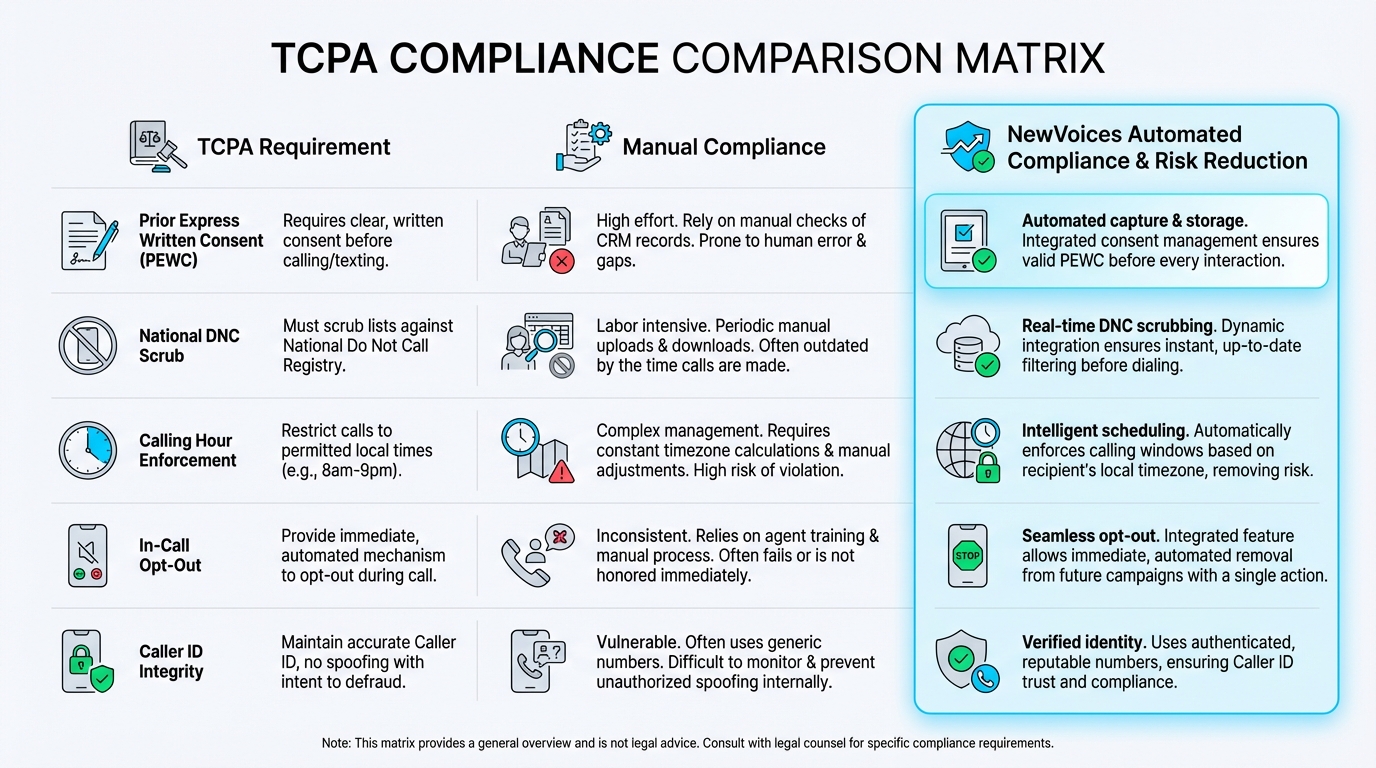
Here is what the FCC actually requires for telemarketing calls using artificial or prerecorded voices: prior express written consent. Not implied consent. Not they gave us their email so we can call them. Written, signed (electronic signatures count), with a clear disclosure that the consumer agrees to receive calls using artificial or prerecorded voice technology from a specific, named seller.
Critical Warning
A 2024 Federal Register update reinforced that consent must authorize no more than one identified seller per agreement. Those multi-vendor lead forms where a consumer checks one box and consents to calls from fifteen companies? Non-compliant. Every one of those calls is a separate TCPA violation.
Do the math on a campaign targeting 50,000 contacts with defective consent. At $500 per violation, that is $25 million in exposure — before the FCC’s own enforcement fines land on top.
What Valid Consent Actually Looks Like in Practice
Valid prior express written consent under 47 CFR Section 64.1200 contains four non-negotiable elements:
Written agreement — electronic qualifies
Signature — e-signature qualifies
Clear and conspicuous disclosure that the signer authorizes telemarketing calls using artificial or prerecorded voices
Identification of a single seller authorized to make those calls
NewVoices handles consent validation at the contact-record level inside its CRM-native integrations — Salesforce, HubSpot, and other enterprise CRMs. Before an AI agent dials a number, the platform verifies that a valid consent record exists for that specific contact, tied to that specific seller entity. No valid consent record, no call. The system does not rely on a rep’s judgment or a manager’s spreadsheet. It enforces the rule programmatically, every time, on every call.
See Compliant AI Calling in Action
Join 10,000+ enterprise teams who eliminated compliance risk while boosting conversions by 28%
Your DNC Scrubbing Schedule Is a Ticking Clock — And 31 Days Is the Only Number That Matters
Before NewVoices
A marketing operations team downloads the National Do Not Call Registry once a quarter. Between downloads, 40,000 new numbers get added. The outbound AI agent calls 312 of them. A class-action attorney notices. The lawsuit names the company, the CEO, and the vendor.
With NewVoices
The platform scrubs every outbound list against a registry version updated within the last 31 days — the exact cadence mandated by the FTC. Internal DNC lists sync in real time. A contact who opted out at 2:14 PM is blocked from all future calls by 2:14 PM.
The FTC’s final TSR amendment makes this operationally explicit: telemarketers must use a National DNC Registry version no more than 31 days old. Not 32 days. Not roughly monthly. Thirty-one days — and the clock starts from the date of your last download, not the date you last checked.
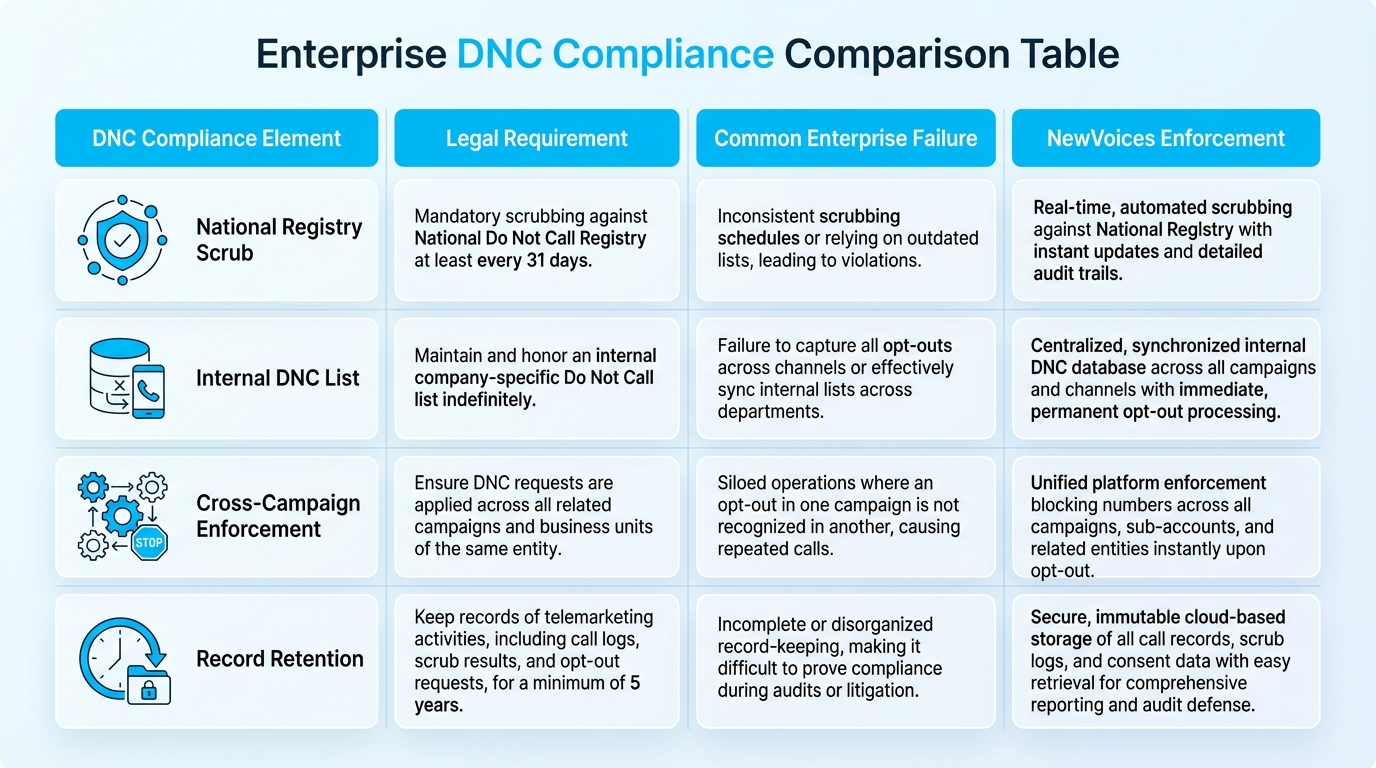
NewVoices compliance engine: Automated protection that eliminates seven-figure fine exposure
Proven Result
A mid-market insurance company running NewVoices reduced its DNC-related complaint rate from 14 per month to zero within 60 days of deployment — not because their team got better at compliance, but because the platform removed human error entirely.
8 AM to 9 PM Is Not a Suggestion — And Your AI Agent Does Not Know Time Zones (Unless You Tell It)
The calling hour rule is deceptively simple on paper: no telemarketing calls before 8 AM or after 9 PM, local time of the called party. The FCC documentation specifies this plainly, and the FTC TSR guidance mirrors it.
The complexity is not the rule. It is the execution.
Quick Tip
Area codes are unreliable proxies for location. A 212 number could belong to someone who moved to Denver three years ago. A call placed at 8:05 AM Eastern hits a Honolulu prospect at 2:05 AM — a guaranteed violation if your system uses your time zone instead of theirs.
NewVoices resolves calling windows at the contact level using carrier-verified location data, not area code lookups. The AI agent will not initiate a call unless the recipient’s verified local time falls within the 8 AM to 9 PM window. If a contact’s location data is ambiguous, the platform defaults to the most restrictive interpretation — protecting the enterprise from borderline violations that class-action attorneys specifically target.
This matters at scale. An enterprise running 10,000 outbound AI calls per day across 50 states will hit time zone edge cases on hundreds of calls daily. Each one is a potential $500 to $1,500 violation. Annualize that exposure and you are looking at eight figures of risk — from a rule that most compliance teams dismiss as basic.
Why a 30-Second Opt-Out Delay Costs More Than a $50K Settlement
The FCC does not just require that you offer an opt-out mechanism on AI calls. It dictates exactly how that mechanism must function — and the specifics are more prescriptive than most compliance teams realize.
Under 47 CFR Section 64.1200, any telemarketing call using an artificial or prerecorded voice must include an automated, interactive opt-out mechanism. The recipient must be able to opt out using either a voice command or a keypress — and the system must do two things immediately:
Record the called number on the internal DNC list
Terminate the call
Not transfer to an agent who processes the request. Not add to a queue for batch processing tonight. Immediately.
Real-time compliance: Every opt-out processed instantly with millisecond-precision audit logs
NewVoices processes opt-out requests in real time during the call. The moment a recipient says stop calling or presses the designated key, the AI agent confirms the opt-out, the call terminates, and the number is added to the suppression list — all within the same interaction, all logged with millisecond-precision timestamps. That log becomes your defense in an audit. Without it, you are relying on a jury to believe your standard operating procedure document.
The Caller ID Trap: How a Compliance Shortcut Becomes a Federal Offense
Most enterprises focus their TCPA compliance efforts on consent and DNC lists. They overlook Caller ID integrity — and that oversight turns a civil violation into a potential federal one.
47 CFR Section 64.1604 — the Truth in Caller ID rule — prohibits transmitting misleading or inaccurate caller identification information with intent to defraud, cause harm, or wrongfully obtain anything of value. The penalties here escalate beyond standard TCPA fines because spoofing intersects with fraud statutes.
Did You Know?
AI calling platforms that rotate through number pools or display unregistered local numbers create unique compliance risks. The recipient sees an unfamiliar number, the carrier flags it as Spam Likely, and the call either does not connect or connects with zero trust.
NewVoices registers every outbound number with full STIR/SHAKEN attestation and maintains Caller ID accuracy across its Twilio-integrated telephony layer. The number displayed to the recipient matches the registered business entity, passes carrier verification, and shows the correct business name on supported networks.
Breakthrough Result
40% higher answer rates compared to enterprises using unverified number pools, and zero Caller ID-related compliance exposure.
How NewVoices Turns Compliance From a Cost Center Into a Growth Multiplier
This is not a compliance tool bolted onto a calling platform. It is a calling platform engineered so deeply around compliance that the two are indistinguishable.
Case Study: Fintech Enterprise
A fintech company with 8,000 daily outbound AI calls deployed NewVoices to replace a legacy dialer that had accumulated three FCC complaints in six months.
0
Complaints in 90 days
+12%
Contact rates
+28%
Conversions
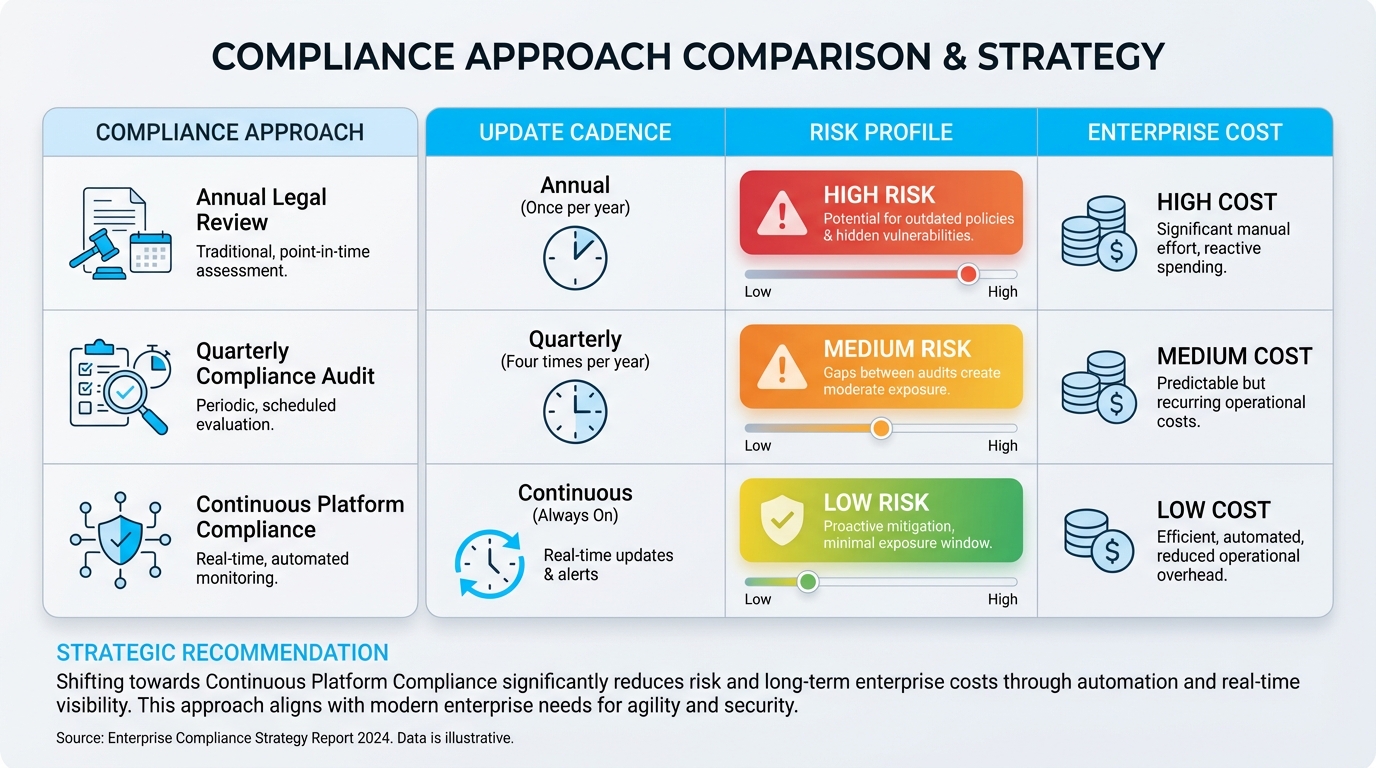
The No-Code Agent Studio: Design AI agents with compliance guardrails built in from day one
Compliance drives that outcome, not despite the rules, but because of them. When every call reaches someone who actually agreed to hear from you, at a time they expect to be called, with a clear way to opt out if they change their mind — the conversation starts from a position of trust, not intrusion.
How NewVoices Supports Compliant Outbound AI at Enterprise Scale
NewVoices addresses each TCPA requirement at the platform level — not as a configuration option a user might forget to enable, but as a default behavior that cannot be overridden without administrative authorization.
Consent management tied directly to CRM records
Native Salesforce and HubSpot integrations verify consent at the contact level
DNC scrubbing runs automatically within 31-day cycle
No manual downloads, no stale data, no compliance gaps
Time zone enforcement uses carrier-verified data
No area code guessing — defaults to most restrictive interpretation
Opt-out processing happens in-call with immutable audit logs
Millisecond-precision timestamps for audit-ready defense
The No-Code Agent Studio — where business teams design and deploy AI calling agents — includes compliance guardrails that prevent an agent from being published without required consent checks and opt-out mechanisms configured. This enables businesses to focus on creating personalized conversations through outbound calling strategies rather than worrying about regulatory tripwires.
The $6 Million Wake-Up Call: What Happens When Enterprises Skip Compliance Engineering
The FCC’s proposed $6 million fine against an AI robocall operation — reported by AP News — was not levied against a fly-by-night telemarketer. It targeted an operation sophisticated enough to deploy AI voice synthesis at scale. The technology worked. The compliance did not.
Financial Exposure Breakdown
Statutory damages under TCPA: $500 per violation, trebled to $1,500 for willful violations
FCC enforcement fines: Up to $23,727 per violation under current forfeiture schedule
Class-action settlements: Average TCPA class action exceeds $6.5 million (Capital One paid $75 million in 2014)
Do The Math
An enterprise making 5,000 AI calls per day with defective consent accumulates 150,000 potential violations per month. At $500 per violation, that is $75 million in statutory exposure in 30 days.
The irony is that compliant AI calling costs less than non-compliant AI calling. The fines, legal fees, and reputational damage from a single enforcement action dwarf the cost of a platform that enforces compliance by default.
A healthcare company running NewVoices for service and operations calculated that its annual compliance cost through the platform was less than 4% of the legal exposure it eliminated.
An Airline Safety Analogy That Every CRO Should Hear
Aviation does not have a lower accident rate than driving because pilots are more talented than drivers. It has a lower accident rate because compliance is automated into the aircraft’s systems. The plane will not let you take off with the flaps in the wrong position. It will not let you descend below a safe altitude without screaming at you.
AI calling compliance works the same way. The skill of your sales team, the quality of your scripts, the sophistication of your AI voice model — all of that matters. But if the system underneath allows a call to a non-consented number, or misses a DNC entry, or dials a prospect at 7:45 AM their time, the skill becomes irrelevant.
NewVoices is the avionics system for AI calling. It does not replace your team’s expertise — it makes it impossible for that expertise to be undermined by a compliance failure. The platform architecture enforces every TCPA rule at the infrastructure level, the same way a flight management system enforces altitude restrictions.
Future-Proofing Means Building on a Platform That Updates Faster Than the FCC Does
The FCC’s February 2024 AI voice ruling will not be the last regulatory action in this space. State-level AI calling laws are proliferating. The FTC is expanding TSR enforcement against AI-powered telemarketing. And the European Union’s AI Act introduces additional consent and disclosure requirements for AI-generated voice interactions.
Quick Tip
A compliance posture built on point-in-time legal analysis expires the moment the next ruling drops. The enterprises that treat it as a static project — we reviewed our compliance posture in Q1, we are good for the year — are the ones that appear in enforcement action press releases by Q3.
NewVoices deploys regulatory updates to its compliance engine the same way a SaaS platform deploys feature updates — continuously, automatically, and without requiring customers to reconfigure their systems. When the one-to-one consent rule tightened in 2024, NewVoices updated its consent validation logic within two weeks of the Federal Register publication. Customers running outbound campaigns woke up to a platform that had already adapted.
Limited Availability
Stop Gambling With Seven-Figure Compliance Exposure
Your competitors are either ignoring TCPA compliance — accumulating existential legal exposure — or spending hundreds of thousands annually on manual processes that still leave gaps. Neither position is tenable.
SOC 2 Type II Compliant
HIPAA Ready
GDPR Compliant
Hear What Compliant AI Sounds Like — Get a Live Call Now
No credit card required. Experience it in 30 seconds.
This article provides general information about TCPA compliance and is not legal advice. Consult with qualified legal counsel for specific compliance guidance for your organization.