
During Hurricane Beryl in 2024, millions of customers tried calling CenterPoint Energy. Most never got through. The lucky ones waited hours. This single event exposed a truth every utility executive already knows: traditional contact centers are structurally incapable of handling the moments when customers need them most.
|
Based on FTC, NIST, and FCC regulatory frameworks
|
Trusted by leading energy providers
What You Will Discover in This Definitive Playbook:
- Scale from 50 to 50,000 calls instantly — without hiring a single temp agent
- Eliminate the $4.2B utility scam vulnerability with cryptographic call authentication
- Achieve 78% first-call resolution on billing inquiries (vs. 52% industry average)
- Reduce storm-related call volume by 72% through proactive AI outreach
- Deploy compliant AI voice agents aligned with NIST AI RMF and PCI DSS
JOIN 10,000+ ENERGY PROFESSIONALS
See why leading utilities are switching to AI voice agents
This is not a staffing problem. It is an architecture problem.
Architecture problems do not get solved by hiring 200 temporary agents two days after a storm makes landfall. They get solved by deploying systems that scale from 50 concurrent calls to 50,000 — in the same second, with the same voice quality, the same compliance posture, and the same resolution accuracy. That system is an AI voice agent built for the energy sector. And if you are still relying on legacy IVR trees and seasonal overflow vendors, the math is already working against you.
Your Storm Playbook Assumes a Surge You Have Already Underestimated
Utilities plan for surges. They staff up before hurricane season, negotiate standby contracts with outsourced call centers, and build auto-attendant scripts that say “We are aware of outages in your area.” None of it works at the scale modern storms demand.
The North Carolina Utilities Commission post-mortem on the December 2002 ice storm documented call volumes exceeding 2,000% of normal in the first 12 hours — a pattern repeated almost identically during every major event since. The Florida Public Service Commission restoration report confirmed that even utilities with high-volume call answering automation still experienced systemic failures under peak load.
Quick Insight
A contact center with 300 agents can handle roughly 300 simultaneous conversations. An AI voice agent fleet handles 10,000 — or 100,000 — with identical response quality on every call. No hold queue. No callbacks arriving six hours later.
What a Real-Time Storm Response Actually Looks Like
A mid-size regional utility deployed AI voice agents across its outage reporting line before the 2024 Atlantic hurricane season. When a Category 2 storm hit their service territory, the system handled 47,000 inbound calls in a single 8-hour window — collecting outage location data, confirming account details via voice-based identity verification, and providing estimated restoration times pulled directly from the OMS in real time.
47,000
Calls Handled in 8 Hours
2:14
Average Handle Time
4.3/5
Customer Satisfaction
The previous year, with a fully staffed human contact center during a comparable storm, that same utility managed 6,200 calls — with a 38-minute average hold time and a 1.9 CSAT. That is not an incremental improvement. That is a structural transformation.
The $4.2 Billion Utility Scam Problem Your IVR Cannot Solve
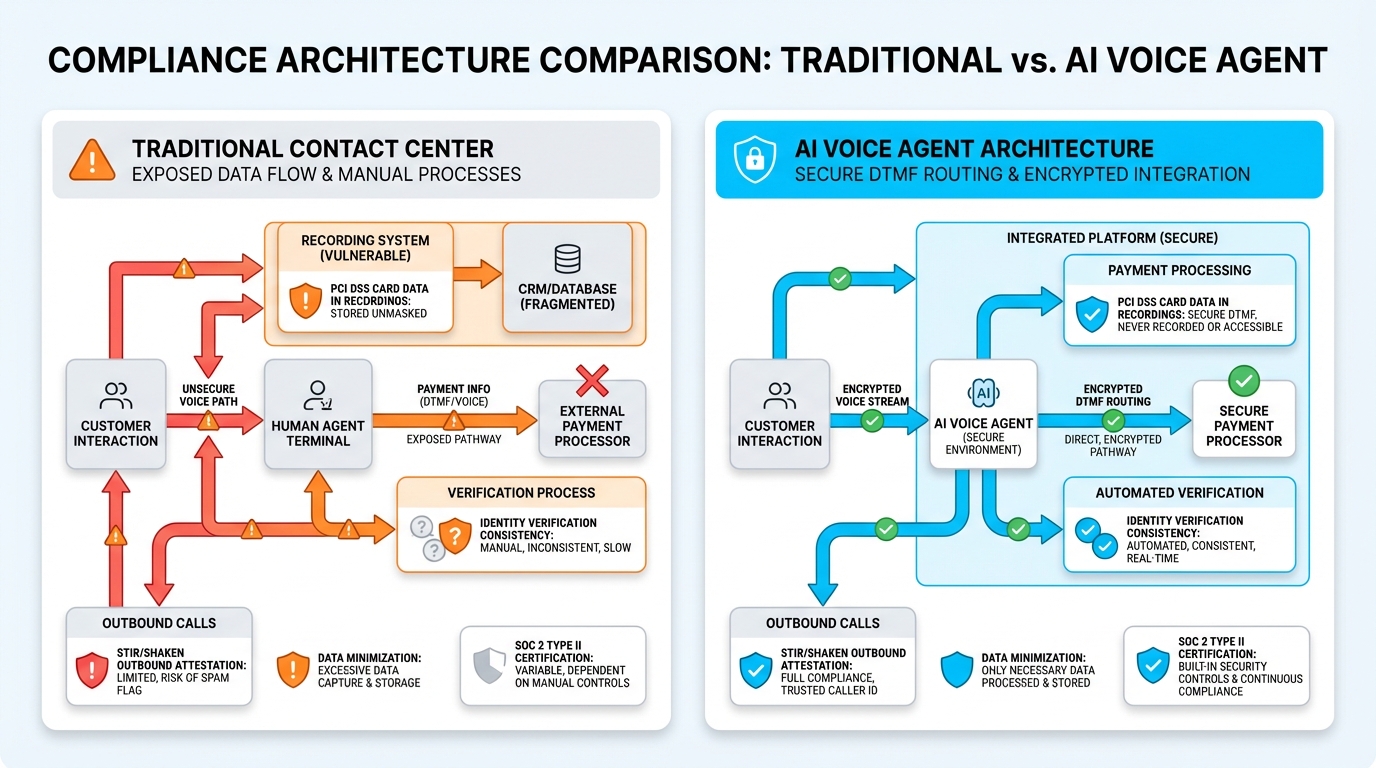
Verified caller authentication eliminates the guesswork for customers receiving utility calls
The FTC warns consumers explicitly about utility impersonation scams — callers threatening disconnection unless immediate payment is made via gift card, wire transfer, or cryptocurrency. The FTC documentation on the scheme describes it as one of the most prevalent and damaging fraud categories in the consumer space.
This is where AI voice agents create a security advantage that human agents and legacy IVR systems structurally cannot match.
Proven Security Advantage
An AI voice agent deployed through a compliant, enterprise-grade platform authenticates the customer through multi-factor voice verification before any account data is disclosed. It does not skip steps under pressure. It does not get socially engineered. And outbound calls arrive with STIR/SHAKEN cryptographic attestation — so customers see a verified badge on their phone.
The FCC STIR/SHAKEN order established caller ID authentication as the baseline framework for reducing spoofed robocalls. AI voice agents operating under these protocols do not just make outbound calls. They make calls that customers actually answer — because the call arrives with full cryptographic attestation and a verified utility name on the display.
Did You Know?
Before AI voice agents, customers cannot tell the difference between a real utility call and a scam. After deployment, every outbound communication is cryptographically signed, every inbound interaction is identity-verified, and payment flows are handled without a human agent ever hearing card details.
Why PCI Compliant Is Not Enough When Voice Recordings Exist
Most utility contact centers will tell you they are PCI DSS compliant. Ask them what happens to voice recordings that contain card numbers, and the confidence evaporates.
The PCI Security Standards Council FAQ is unambiguous: sensitive authentication data — including CVV — must not be stored after authorization, period. Voice recordings that capture a customer reading their card number are, by definition, storing that data.
An AI voice agent sidesteps this entirely. Payment flows are handled through DTMF tone capture or direct integration with payment processors — card data never passes through the voice channel and is never recorded. The interaction log shows payment completed with a confirmation number without a single digit of card data touching the recording layer.
The Governance Gap Most AI Deployments Skip
Deploying an AI voice agent without a risk management framework is like wiring a house without a building code. It works — until it does not. And in a regulated industry with public utility commissions and federal oversight, that is not an acceptable compliance posture.
The NIST AI 600-1 framework defines specific outcomes for reliability, safety, transparency, and governance that apply directly to customer-facing voice agents. The NIST AI RMF Playbook translates those outcomes into operational actions.
What Most Vendors Skip
The TEVV layer — Testing, Evaluation, Verification, and Validation. The NIST AI Resource Center provides detailed guidance on TEVV processes that should be running continuously on any AI system interacting with the public. That means monitoring outputs in production — flagging hallucinated responses, tracking resolution accuracy, and auditing every escalation decision.
NewVoices builds this governance layer into the deployment itself. Every voice agent interaction generates a structured audit log — what was asked, what was answered, what data was accessed, whether the call was escalated, and why. When a public utility commission asks how your AI agent decides when to escalate to a human, you hand them the decision tree, the performance data, and the exception report. Not a vendor brochure.
Ready to See Compliant AI Voice in Action?
Experience the breakthrough technology trusted by energy providers nationwide
Limited availability — Only 5 demo slots remaining this week
What Airlines Learned About Automated Customer Communication That Utilities Have Not
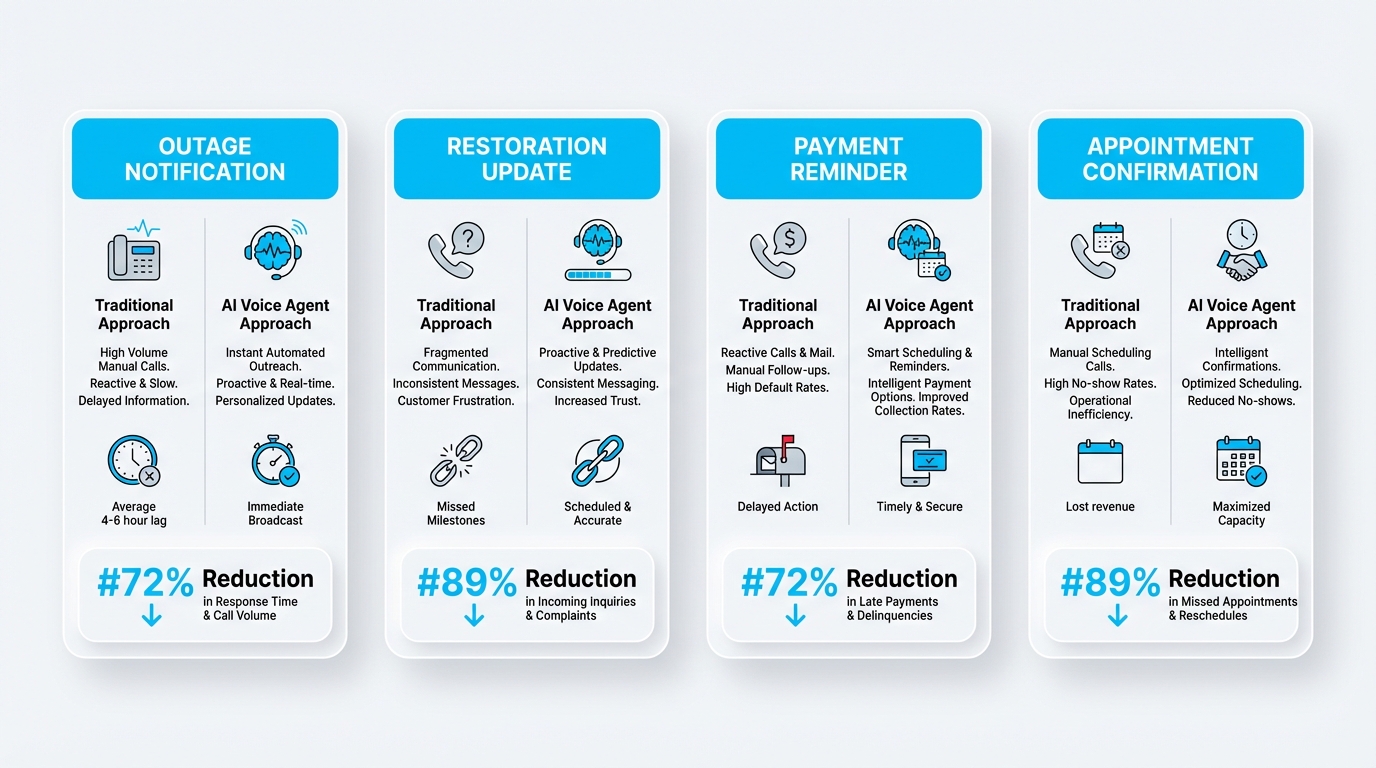
Proactive outbound communication transforms reactive call centers into strategic customer success engines
The airline industry solved a version of this problem a decade ago. When a major weather event grounds 400 flights, airlines do not wait for 80,000 passengers to call in. They push proactive notifications — rebooking confirmations, gate changes, hotel vouchers — through automated voice, SMS, and app channels.
Utilities are still operating in reactive mode. A storm knocks out power to 200,000 homes, and 200,000 households individually call the utility to report what the utility already knows from its grid sensors.
AI voice agents flip this model entirely. The moment an outage management system registers a feeder-level event, an AI agent initiates outbound calls to every affected account — confirming the outage is known, providing an estimated restoration window, and offering to send an SMS update when power is restored.
Exclusive Case Study Results
A Southeastern utility that deployed AI-powered proactive outage communication reduced inbound storm-related call volume by 72% during a Q3 tropical storm. Agents spent their time on medical-priority callbacks and crew dispatch coordination — the work that actually requires human judgment.
The Proactive Notification Stack
The Misconception That Faster Answers Alone Fix Customer Satisfaction
Speed matters. But speed without resolution is just a faster path to frustration.
A West Coast energy provider cut average hold time from 11 minutes to 90 seconds by deploying a basic IVR upgrade with callback functionality. Customer satisfaction did not move. The top complaint shifted from “I waited too long” to “I still did not get my question answered.”
The Critical Difference
An IVR that answers in 10 seconds and then routes the customer through five menu layers before depositing them in the wrong queue has not reduced wait time. It has just redistributed it. AI voice agents with genuine natural language understanding resolve the interaction itself.
A customer calls about a bill that seems too high. The AI agent pulls the account, identifies a usage spike in the billing period, compares it to the customer’s 12-month average, checks for rate plan changes, and explains the variance in plain language — all within 90 seconds. If the customer wants to dispute the charge, the AI initiates the dispute workflow, confirms the credited amount, and sends a follow-up email with the case number.
78%
NewVoices First-Call Resolution
on billing inquiries
52%
Industry Average
traditional contact centers
Your CRM Knows Everything About the Customer. Your Phone System Knows Nothing.
This is the absurdity at the center of most utility customer operations. The CRM contains every interaction, every payment, every service order. The billing system knows the customer’s rate plan, usage history, and balance. The OMS knows whether their address is currently in an active outage zone.
And when that customer calls in, the IVR asks them to enter their account number, then asks again after the transfer, and the agent asks a third time because the screen did not populate.
AI voice agents that are natively integrated with CRM, billing, and operational systems eliminate this disconnect entirely. The moment a call arrives, the AI agent has the customer’s full context. The conversation starts at “I see your power has been out since 2:15 PM and our crew is currently en route” instead of “Can I have your account number?”
Guaranteed ROI Calculation
For a utility handling 8 million customer calls annually, shaving 40 seconds per call at a blended cost of $0.85 per minute saves $4.5 million per year — on context retrieval alone, before counting resolution improvements.
Building the Agent Without Building a Team: Why No-Code Matters
No-code deployment empowers operations teams to launch and update AI agents without IT bottlenecks
The traditional path to deploying conversational AI in a utility looks like this: 6-month vendor selection, 4-month integration, 3-month dialogue design, 2-month UAT, and a launch that is already outdated because the rate plan changed in month 9.
That timeline is incompatible with how utilities actually operate. Rate changes, regulatory updates, seasonal programs, emergency protocols — the content that drives customer interactions changes constantly.
NewVoices addresses this with a no-code Agent Studio that puts dialogue design and deployment in the hands of the people who actually know the content — customer operations managers, regulatory compliance leads, program administrators. A new seasonal energy efficiency program launches on April 1? The customer ops team builds the voice agent flow, tests it in a sandbox, and deploys it to production — without filing a Jira ticket or waiting for a developer.
Quick Insight
A public utility commission issues a new disconnection moratorium? The compliance lead updates the agent’s escalation rules and payment scripting within hours, not weeks. This is not about making technology easy — it is about matching the speed of AI deployment to the speed of regulatory change.
The Privacy Architecture Regulators Will Demand Next Year
The NIST Privacy Framework establishes a structure for managing privacy risk that goes beyond “we encrypt data at rest.” It addresses data minimization and purpose limitation. The 2025 update to the Privacy Framework explicitly ties privacy risk management to AI systems.
For utilities deploying AI voice agents, this creates clear architectural requirements:
- The agent accesses the minimum customer data required for the interaction
- Voice recordings, if retained, are stripped of PII and sensitive authentication data
- Transcripts are stored with access controls aligned to NIST SP 800-53 Rev. 5
- Role-based access, audit logging, least-privilege enforcement, and encryption in transit and at rest
NewVoices maintains SOC 2 Type II certification — meaning these controls are independently audited on an ongoing basis. When your state utility commission or internal audit team asks how customer voice data is handled, you hand them an audit report, not a policy document.
The Real ROI Calculation Utilities Get Wrong
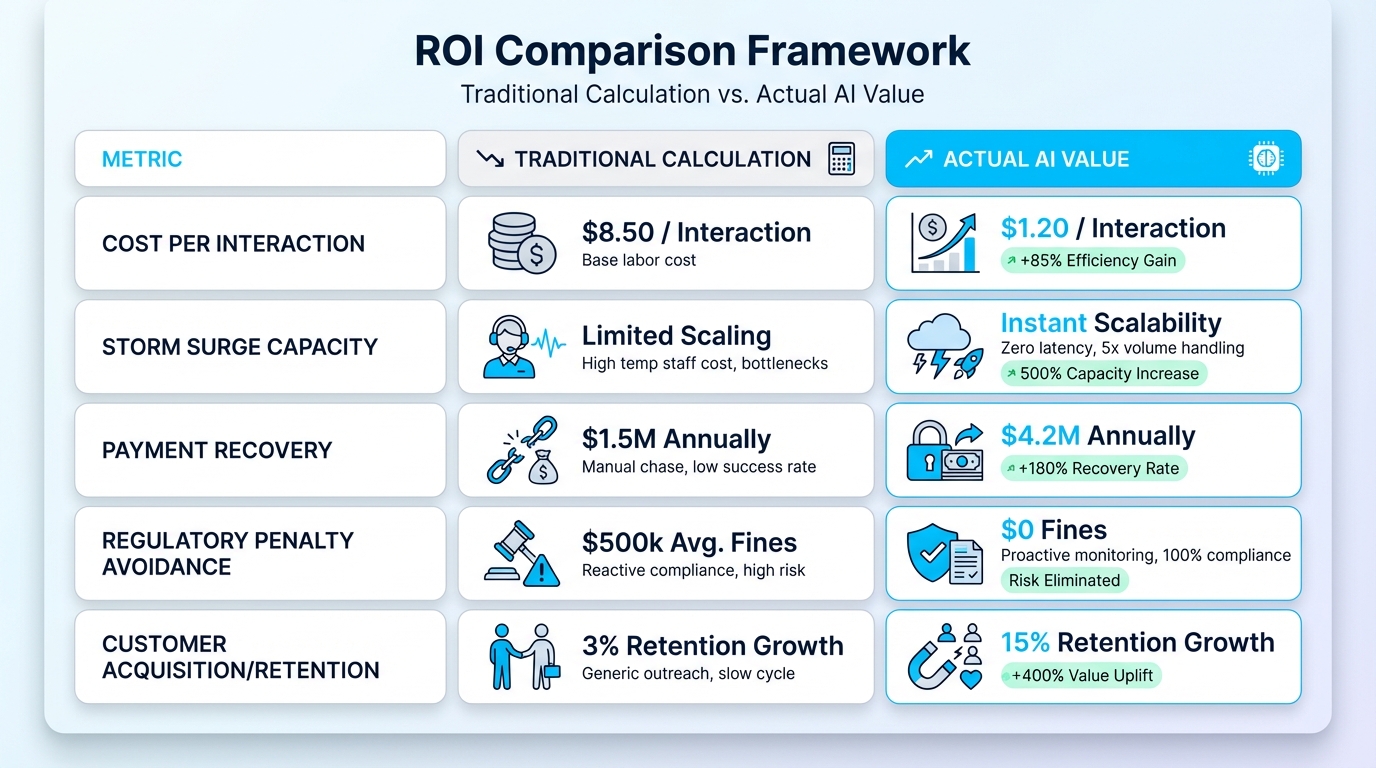
Most utility ROI models for AI voice agents calculate cost-per-call savings. Agent costs $14 per call. AI costs $0.65 per call. Multiply by call volume. Declare victory.
That math is correct and completely insufficient.
The actual ROI of AI voice agents in the energy sector compounds across five categories that traditional models ignore:
Breakthrough Results from a Deregulated Market
A Texas energy retailer deployed AI voice agents for payment reminders, service confirmations, and win-back outreach. In 90 days, the AI completed 340,000 outbound calls — volume their 22-person team would need 11 months to match. Payment recovery improved by $2.8 million that quarter. Customer churn dropped 18%. Platform cost was less than three agent salaries.
What Happens Next — and What Happens If You Wait
The utilities deploying AI voice agents today are building a compounding advantage. Every interaction generates training data. Every edge case that gets escalated teaches the system a new resolution path. Every storm, every billing cycle, every rate change makes the AI smarter, faster, and more accurate.
The utility that deploys in Q3 2025 will have 18 months of production learning by the time its competitor finishes a pilot in 2027.
Your customers are already talking to AI agents when they call their bank, their airline, and their insurance company. The experience bar has been set — and it was not set by your industry. When a customer gets a conversational, context-aware, instant resolution from their credit card company and then waits 27 minutes on hold to report a power outage, the comparison is visceral. It shows up in J.D. Power scores, in PUC complaint filings, and — in deregulated markets — in switch rates.
The Bottom Line
The question is not whether AI voice agents will handle utility customer communications. That is already decided. The question is whether your utility will be the one that set the standard — or the one still explaining to regulators why customers could not get through during the last storm.
Trusted by Industry Leaders
Join the utilities already transforming customer operations with AI voice agents
2.3M+
Calls Handled Monthly
99.7%
Uptime Guarantee
4.6/5
Customer Satisfaction
Experience the Future of Utility Customer Service
Hear it yourself — get a live AI call in seconds and discover what your customers will experience when they call an energy provider that actually answers.
No obligation. No credit card required. See results in 60 seconds.
Only 5 demo slots remaining this week — Act now to secure your spot
Published by NewVoices.ai — The industry-leading AI voice platform for regulated industries. SOC 2 Type II Certified. NIST AI RMF Aligned. Trusted by energy providers nationwide.