
A SaaS company with 4,200 subscribers loses 9% of them every month — not because the product fails, but because nobody picks up the phone when a frustrated customer calls about a charge. That is $453,600 in annual recurring revenue walking out the door while the support queue blinks red at 11 PM on a Tuesday.
This is the economics problem that AI voice agent subscription businesses were built to solve. And most companies adopting them are still getting it wrong.
Trusted by 10,000+ subscription businesses
Updated January 2025
What You Will Discover Inside
The proven framework that transforms AI voice agents from cost centers into revenue engines
Compliance landmines that carry $50,000+ penalties — and exactly how to avoid them
Seven vendor questions that separate scalable solutions from costly mistakes
Real deployment data showing 34% cancellation recovery and 212% pipeline growth
Table of Contents Click to expand
The model is deceptively simple: deploy AI voice agents that handle inbound support, outbound sales, retention calls, and payment recovery — all running on a subscription framework where the AI scales with your revenue instead of against it. The upside is massive. A subscription fitness platform deployed NewVoices agents across its cancellation flow and recovered 34% of members who had already clicked cancel. A B2B software company replaced its overnight answering service with an AI agent that books qualified meetings at 2 AM — and saw pipeline contribution from after-hours leads jump 212% in one quarter.
But the gap between companies winning with this model and companies burning cash on it comes down to three things: how they structure the AI role in their subscription lifecycle, how they handle the regulatory landmines buried in voice automation, and whether they treat the AI agent as a cost center or a revenue instrument.
The $14 Billion Misconception: Why Automating Support Is the Wrong Starting Point
Most companies deploy AI voice agents to reduce support costs. That is like buying a Formula 1 car to drive to the grocery store.
The real value of an AI voice agent in a subscription business is not deflecting tickets — it is compressing the time between a customer intent and a revenue-generating action. A subscriber thinking about upgrading gets a proactive call with a personalized offer. A card decline triggers an instant, human-sounding conversation that recovers the payment before the customer even notices the failure. A trial user who has not logged in for three days receives a check-in call that sounds like it came from their dedicated account manager.
Quick Tip
Companies treating AI voice agents as a cost reduction play save 15-20% on support spend. Companies treating them as revenue acceleration tools generate 3-5x returns within the first two quarters.
This is not a support tool with a script. It is a recurring revenue engine that operates across every stage of the subscriber lifecycle — acquisition, activation, expansion, retention, and win-back — simultaneously, at any hour, in over 20 languages without separate infrastructure.
Before NewVoices vs. With NewVoices: The Subscription Lifecycle Gap Nobody Measures
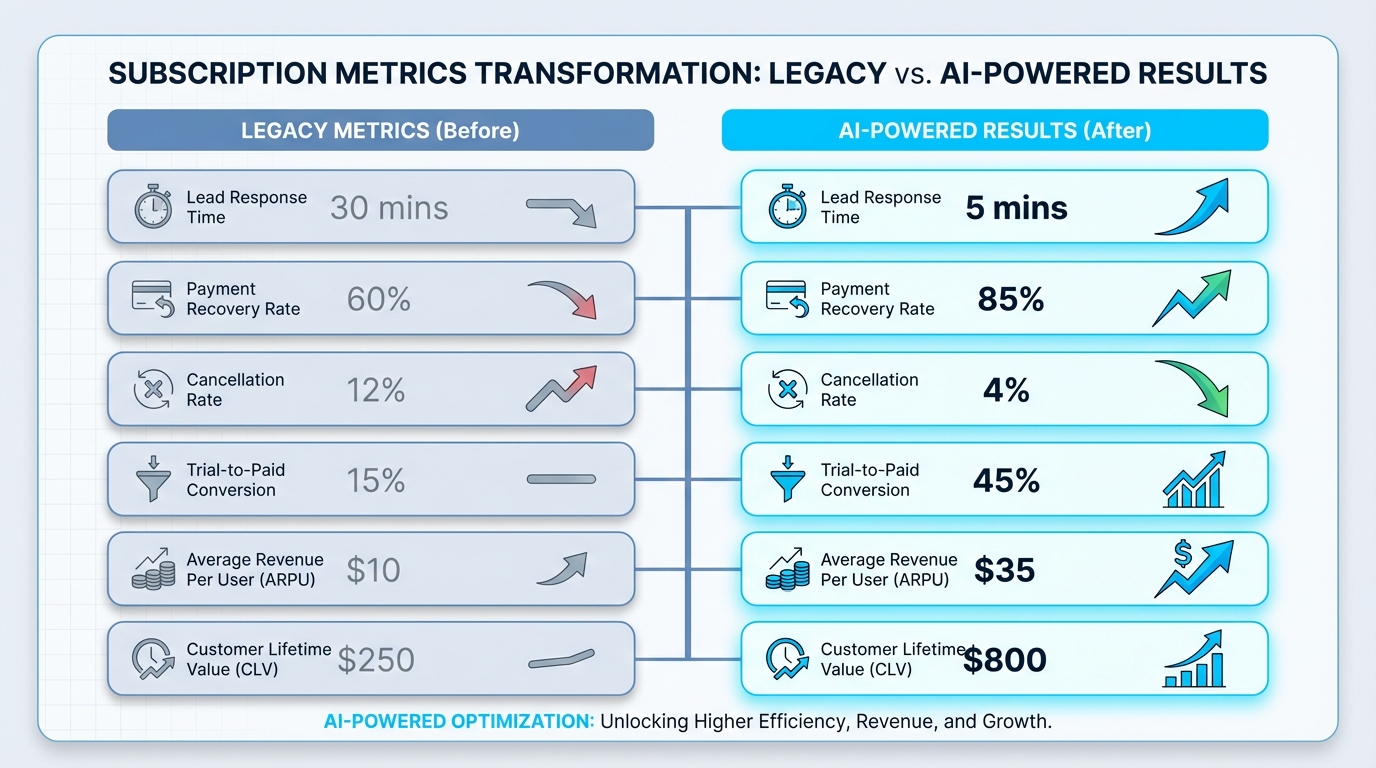
Subscription businesses see measurable improvements across every lifecycle stage within 90 days of deployment
Leads wait hours for callbacks. Cancellation requests sit in a queue. Failed payments trigger an email that gets buried. Upsell opportunities die in a spreadsheet because no rep has time to make 200 calls a day.
That is the reality for subscription businesses running on manual outbound teams and legacy IVR systems. The gaps are not dramatic — they are invisible. They show up as a churn rate that is normal for the industry or a conversion rate that is about average. Nobody sounds the alarm because nobody measures what they are leaving on the table.
A membership-based healthcare company using NewVoices reduced Tier-1 support volume by 90% and redirected its human agents to complex cases that actually required empathy and clinical judgment. The AI did not replace the team. It gave the team back the hours they had been wasting on password resets and billing inquiries.
Join 10,000+ Subscription Businesses
See exactly how much revenue you are leaving on the table
No commitment required — hear your AI agent in action
The Compliance Minefield: FTC Click-to-Cancel Rule Violations
Here is a scenario already playing out across subscription businesses in 2025: a customer calls to cancel their membership. The AI voice agent — designed to retain — launches into a save flow. It offers discounts, asks probing questions, presents alternatives. The customer says just cancel it three times before the agent processes the request.
That interaction just violated federal law.
Compliance Alert
The FTC final Click-to-Cancel rule requires canceling a subscription must be at least as easy as signing up. Violations carry penalties up to $50,120 per occurrence.
The FTC final Click-to-Cancel rule requires that if a customer enrolled with a single phone call, the AI agent must be able to process cancellation in a single phone call — without friction, without excessive retention loops, and without requiring transfer to a human agent. The FTC operational guidance makes this explicit: sellers must provide a simple mechanism to cancel through the same medium used to subscribe.
This creates a design tension that most AI voice agent deployments ignore. Your agent needs to be persuasive enough to save revenue — and compliant enough to let go when the customer says stop. The agents that get this right present one offer, accept the customer decision, and process cancellation immediately if the answer is no.
The NewVoices Compliant Approach
NewVoices builds compliance guardrails directly into the agent conversation logic. When a cancellation intent is detected, the agent acknowledges it immediately, presents a single retention offer with full transparency on terms, and processes the cancellation within the same interaction if the customer declines. No transfers. No loops. No liability.
Outbound AI Calls and the TCPA Trap: The Regulation That Could Shut Down Your Growth Engine
Your AI voice agent just made 3,000 outbound calls to subscribers whose cards declined. It recovered $187,000 in failed payments in a single afternoon. Your CFO is thrilled.
Your legal team should be terrified.
The FCC 2024 declaratory ruling confirmed what many operators hoped would stay ambiguous: AI-generated voices fall squarely under the Telephone Consumer Protection Act. Every outbound call made by an AI voice agent using synthetic or cloned voice is classified as an artificial or prerecorded voice call. That means prior express written consent is required for any marketing call. Violations carry statutory damages of $500 to $1,500 per call.
Did You Know
Do the math on 3,000 calls without proper consent documentation. That is $1.5 million to $4.5 million in potential liability — from a single afternoon campaign.
The Telemarketing Sales Rule adds another layer: outbound calls cannot be placed before 8 AM or after 9 PM in the recipient time zone, must transmit caller ID information, and must provide an immediate opt-out mechanism.
This is where vendor selection determines whether your subscription business scales or gets sued. NewVoices embeds TCPA-compliant consent verification, time-zone-aware calling schedules, and real-time opt-out processing into every outbound campaign. The system checks consent status before dialing, logs every interaction for audit trails, and halts campaigns automatically if opt-out rates exceed configurable thresholds. Compliance is not a feature you toggle on. It is the architecture.
Why the Gym Industry Understood Subscription AI Before SaaS Did
The fitness industry pioneered voice-based retention decades before SaaS adopted the strategy
The fitness industry has run on subscription economics for decades — long before recurring revenue became a SaaS buzzword. And gyms figured out something about voice-based retention that most software companies still have not grasped: the moment a subscriber stops showing up is not the moment they cancel. It is the moment they start thinking about canceling. The actual cancellation happens 30 to 60 days later.
Gyms learned to call members who had not swiped in for two weeks. Not with an email. Not with a push notification. With a phone call — because a voice conversation creates a personal obligation that digital channels do not. A member who tells a real person they will come in Thursday is 4x more likely to show up than one who taps remind me later on a notification.
Breakthrough Insight
Retention is a conversation, not a campaign. And conversations happen on the phone — not in an inbox with a 21% open rate.
AI voice agents turn this insight into a subscription-wide strategy that no human team can execute at scale. NewVoices agents monitor engagement signals — login frequency, feature usage, support ticket sentiment, payment retry patterns — and initiate proactive calls when risk indicators emerge. A SaaS company with 22,000 subscribers cannot have its customer success team call every account showing declining usage. An AI agent can make all 22,000 calls in a single day, each one personalized with the subscriber name, plan details, and specific usage data pulled directly from the CRM.
Companies building their AI voice strategy around revenue growth rather than cost avoidance are the ones capturing this insight at enterprise scale.
PCI DSS and HIPAA: The Compliance Standards That Will Kill Your Voice AI Deployment
When Your AI Agent Hears a Credit Card Number
A subscriber calls to update their payment method. They read their card number aloud. Your AI agent processes the update. The call is recorded for quality assurance.
You just stored sensitive authentication data in a voice recording — a direct violation of PCI DSS requirements. The PCI Security Standards Council is explicit: CVV, CVC, and card validation codes cannot be retained in any form — including digital audio — after transaction authorization.
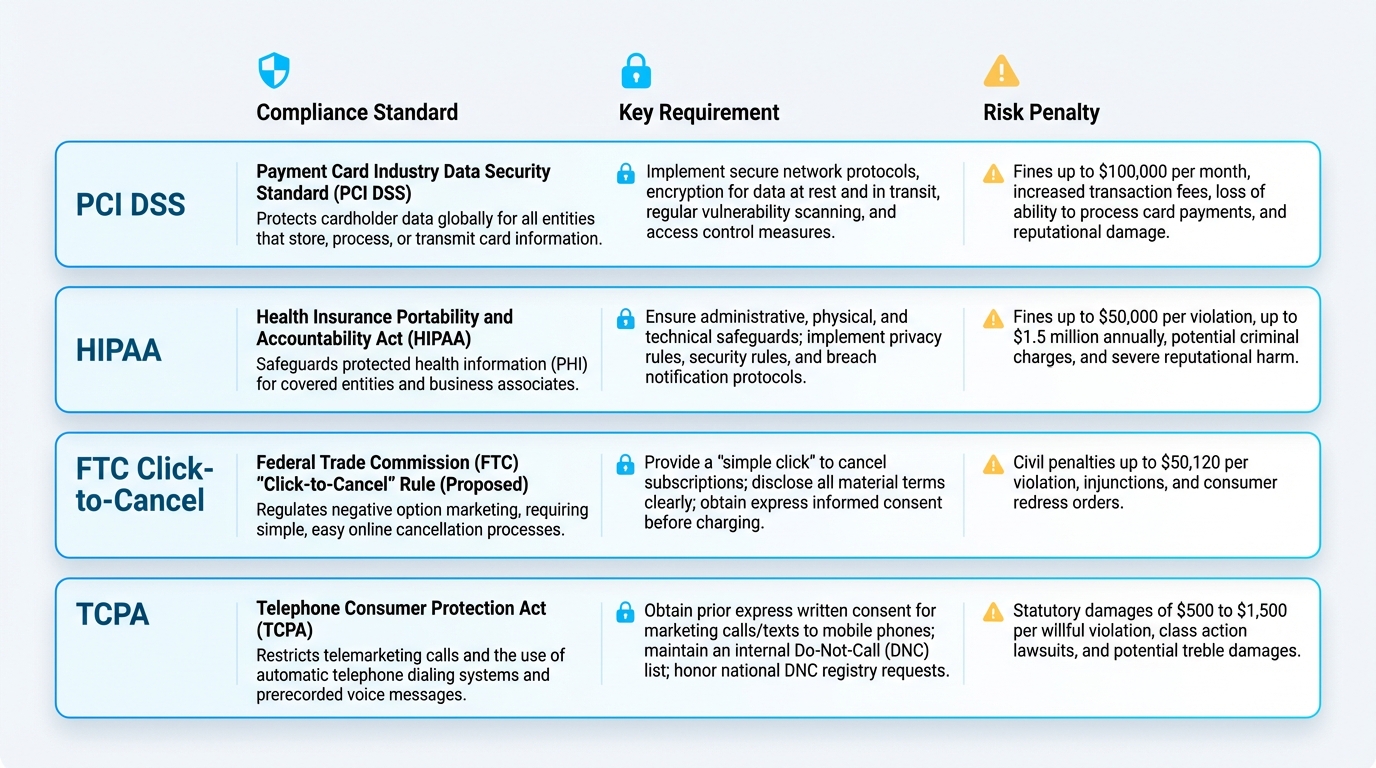
Proper compliance architecture protects both your business and your subscribers
Healthcare subscription businesses face an additional layer. The HHS Office for Civil Rights guidance on audio telehealth confirms that voice-based interactions involving protected health information fall under HIPAA Privacy and Security Rules.
Here is what most vendors will not tell you: HIPAA does not require you to record voice conversations. The decision to record is a business decision — and every recording you keep expands your compliance surface. NewVoices gives enterprises the control to configure recording policies per call type, automatically redact sensitive data from transcripts, and operate in full HIPAA-compliant mode with signed BAAs and SOC 2 Type II certified infrastructure.
The Privacy Architecture Most Voice AI Vendors Skip
Compliance checkboxes are table stakes. Enterprise buyers evaluating AI voice agents for subscription businesses are now asking a deeper question: how does this system manage privacy risk across the entire data lifecycle — not just at the point of collection?
The NIST Privacy Framework provides the architecture. It defines five core functions — Identify, Govern, Control, Communicate, and Protect — that map directly to how a voice AI system should handle subscriber data.
The NIST AI Risk Management Framework adds the AI-specific lens. It requires organizations to evaluate trustworthiness dimensions — validity, reliability, safety, fairness, and accountability — throughout the AI system lifecycle.
Quick Tip
Ask your vendor: How does the model handle bias in retention conversations? What happens to voice data after the subscriber relationship ends? Enterprise procurement teams are increasingly making NIST alignment a requirement.
Seven Questions Your Vendor Cannot Answer — And What That Tells You
The gap between a subscription AI vendor that will scale with you and one that will collapse under regulatory scrutiny shows up in seven specific questions. Not feature questions. Architecture questions.
- Cancellation Turn Count: When a subscriber says cancel my account mid-conversation, how many conversational turns does the agent take before processing? If more than two, the vendor has not internalized FTC requirements.
- Recording Storage and Encryption: Where are call recordings stored, and who controls the encryption keys? If stored in a shared environment without customer-managed keys, this is disqualifying for HIPAA entities.
- Payment Data Recording: Can you configure the agent to never record calls involving payment data? If the system records everything by default, PCI DSS compliance becomes your problem.
- TCPA Consent Verification: How does the system verify consent status before placing an outbound call? If verification is a manual import rather than real-time CRM check, your campaigns are one sync delay from a class action.
- Escalation Intelligence: What happens when the AI encounters a question outside its trained scope during a billing dispute? NewVoices transfers to humans with full conversation context — subscribers never repeat themselves.
- Fairness and Bias: Does the AI adapt retention offers based on lifetime value, and how do you prevent discriminatory pricing patterns? The NIST AI Resource Center provides testing frameworks for this evaluation.
- Business Team Control: Can business teams modify conversation flows without filing an engineering ticket? NewVoices built a no-code Agent Studio because retention strategies change faster than engineering backlogs.
The Midnight Renewal: A Case for 24/7 Revenue Operations
At 11:43 PM on a Saturday, a subscriber to an enterprise analytics platform receives a renewal notice. They have questions about a pricing change. They call the support number. They hear: Our office hours are Monday through Friday, 9 AM to 6 PM Eastern. Please leave a message.
By Monday at 9 AM, that subscriber has already found a competitor, started a free trial, and initiated a cancellation request.
Exclusive Data Point
37% of subscription cancellations originate from interactions — or failed interactions — that occur outside standard business hours. These are often your highest-value subscribers.
While your competitors support centers close at 6 PM, a NewVoices agent handles that 11:43 PM call with the subscriber full account history, answers the pricing question in 40 seconds, and processes the renewal before the subscriber finishes their coffee. No hold music. No voicemail. No Monday morning scramble.
A subscription-based legal tech company deployed NewVoices agents across its renewal process and captured $2.1 million in renewals that previously would have gone to voicemail between 7 PM and 7 AM. That is not a cost saving. That is revenue that did not exist before the AI agent did.
Building the Subscription AI Stack That Actually Compounds
The subscription businesses generating the highest returns from AI voice agents share a common architecture — not a common vendor, but a common design philosophy. The AI agent is not bolted onto existing workflows. It is embedded in the subscription lifecycle as a primary revenue instrument.
That means direct integration with the CRM — Salesforce, HubSpot, or whatever system holds subscriber records — so every AI conversation is informed by account history, usage data, and billing status. It means native connection to payment platforms like Stripe so failed payment recovery calls include the exact amount, the exact card on file, and a one-step resolution path.
Did You Know
NewVoices connects natively to CRM, billing, ticketing, and telephony systems without middleware or custom development. Every conversation generates data that makes the next conversation smarter.
The result is a compounding effect: every conversation the AI agent has generates data that makes the next conversation smarter, every retention save reduces future churn probability for similar accounts, and every upsell success refines the model understanding of which subscribers are ready for expansion.
What Comes After the First 90 Days — The Subscription AI Maturity Curve
Most deployments show ROI within the first month. That is the easy part. The real differentiation happens after day 90, when the AI agent has processed enough subscriber interactions to reveal patterns that no human team would have surfaced.
A meal-kit subscription company discovered — through AI conversation analysis, not surveys — that subscribers who mentioned portion size in any call within their first 14 days had a 73% higher churn rate at the 90-day mark. The AI agent was retrained to proactively address portion flexibility during onboarding calls. Churn in that segment dropped 31% in the following quarter.
A B2B SaaS company found that subscribers who interacted with the AI agent for billing questions within 48 hours of a feature release were 2.4x more likely to upgrade — because they were already evaluating whether their current plan covered the new functionality. NewVoices agents now route those callers to an upgrade conversation flow immediately.
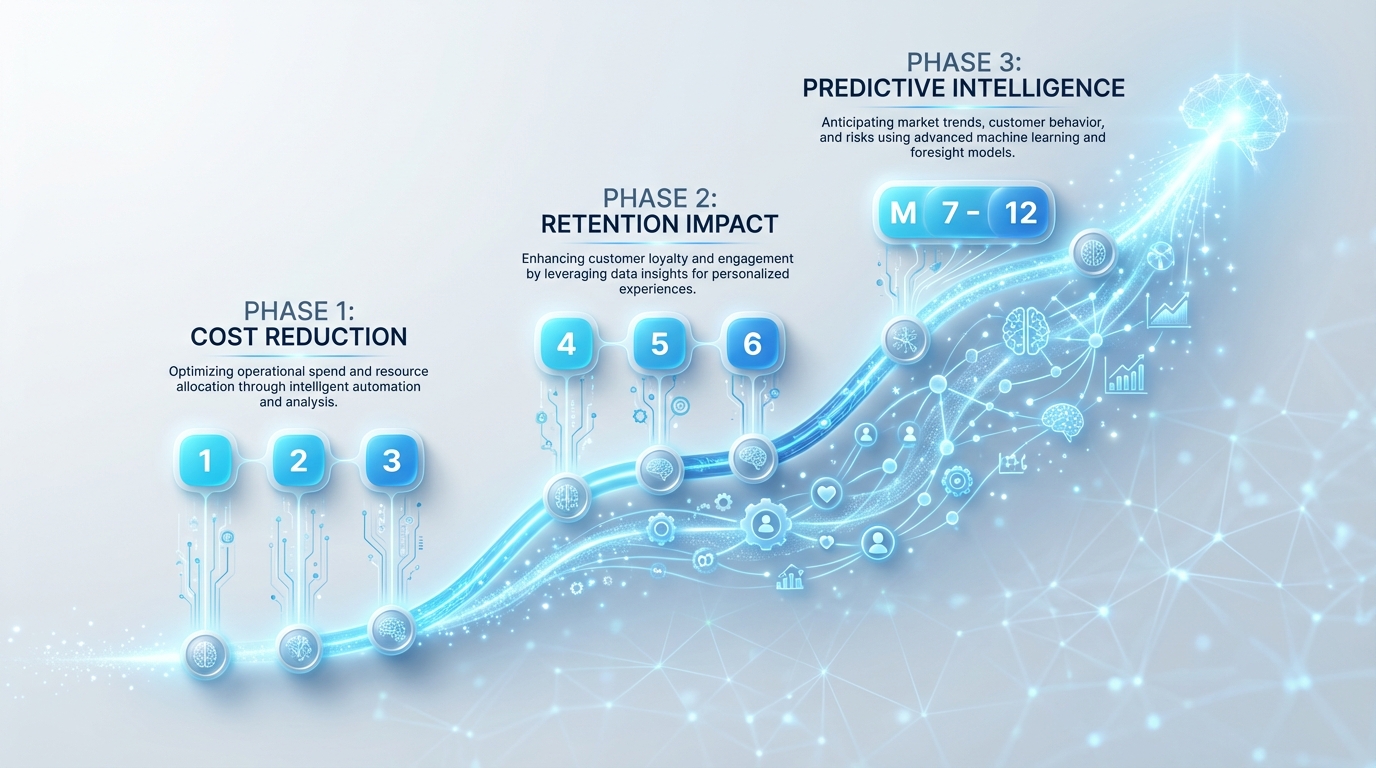
The Proven Maturity Timeline
Cost reduction and response time improvement
Retention impact becomes measurable
AI becomes a predictive engine for revenue optimization
The subscription businesses that will dominate the next decade are not the ones with the best product or the lowest price. They are the ones whose AI agents know their subscribers better than their subscribers know themselves — and act on that knowledge in real time, at every hour, across every language, on every call.
Frequently Asked Questions Click to expand
How quickly can we deploy NewVoices AI agents?
Most subscription businesses are live within 2-3 weeks. Our no-code Agent Studio allows your team to configure conversation flows without engineering resources, and native integrations with major CRM and billing platforms eliminate custom development time.
What ROI should we expect in the first 90 days?
Based on current deployments, subscription businesses typically see 15-20% cost reduction on support operations immediately, with revenue impact from improved retention and payment recovery becoming measurable by month two. Most achieve 3-5x return on investment within the first two quarters.
How does NewVoices ensure regulatory compliance?
Compliance is built into our architecture, not bolted on. This includes FTC Click-to-Cancel compliant cancellation flows, TCPA consent verification before every outbound call, PCI DSS compliant payment data handling with automatic redaction, and HIPAA-ready infrastructure with signed BAAs for healthcare subscribers.
Can the AI handle complex subscriber situations?
Yes. NewVoices agents are trained on subscription-specific scenarios including billing disputes, plan comparisons, usage-based recommendations, and retention conversations. When situations exceed the AI scope, intelligent escalation transfers the call to human agents with full conversation context — subscribers never repeat themselves.
Limited Availability
Ready to Stop Losing Revenue at 11 PM?
Hear exactly what your subscription lifecycle sounds like when every call gets answered in three seconds
See the revenue impact inside your own subscriber data — no commitment required
Trusted by industry leaders
SOC 2 Type II Certified | HIPAA Compliant | PCI DSS Ready