
Your busiest 50 employees are drowning in the same question asked 3,000 times a day: “Where is my order?” — while complex work piles up untouched and customers abandon calls at a 31% rate.
The proven solution is already transforming logistics operations nationwide, and this playbook reveals exactly how leading freight companies are reclaiming millions in lost productivity.
Based on data from 10,000+ logistics operations
Updated for 2025 compliance standards
What You Will Discover in This Playbook:
How one freight brokerage eliminated $4.2M in unnecessary call center costs
The exact workflows replacing 50+ employees without layoffs
Compliance requirements that protect you from TCPA violations
The 22-day deployment timeline that replaced 9-month RFPs
Shipping-related inquiries account for over half of all customer support tickets during peak season — and the single most common question is the one your team dreads most: “Where is my order?”
That question gets asked thousands of times a day. Every single instance pulls a human agent away from complex work — billing disputes, customs exceptions, carrier negotiations — and chains them to a tracking number lookup that takes 40 seconds and zero judgment. Multiply that by 3,000 daily calls across a mid-size freight operation, and you have just buried an entire department under work a voice agent handles without blinking.
This is not a speculative technology pitch. This is the operational reality for logistics companies already running AI voice agents across inbound support, outbound delivery confirmations, driver check-ins, and customs exception workflows. The ones who deployed early did not just save money. They discovered capacity they did not know they had.
Your Call Center Is a $4.2 Million Leak You Have Been Trained to Ignore
A national freight brokerage with 11 regional offices was spending $4.2 million annually on call center operations. Sixty-eight percent of inbound volume was status checks — “Where is my shipment?”, “When does it arrive?”, “Has it cleared customs?” — questions with a single correct answer sitting in a TMS database.
Did You Know?
Companies that automate Tier-1 support inquiries typically see a 78% reduction in handle time and a 94% decrease in cost per interaction within the first 90 days.
Before AI voice agents: callers waited an average of 7 minutes and 20 seconds. Agent handle time for a tracking inquiry averaged 3 minutes and 45 seconds. Abandonment rate hit 31% during peak hours. Three full-time hires existed solely to manage overflow routing.
With NewVoices deployed across inbound lines: average response time dropped to under 4 seconds. Handle time for status inquiries fell to 42 seconds — because the voice agent pulls the answer from the TMS, reads it back in natural language, and confirms whether the caller needs anything else. Abandonment rate collapsed to 6%. The company redeployed 22 agents to revenue-generating freight sales roles within 90 days.
That is not efficiency. That is a business model shift.
What a Logistics Voice Agent Actually Does at 2 AM on a Tuesday
Voice agents deliver instant responses at any hour — eliminating the operational gaps that cost you customers.
Forget the generic definition. Here is what happens in practice.
A receiver in Phoenix calls your freight line at 2:14 AM because a temperature-sensitive pharmaceutical shipment has not arrived at the expected window. Your office closed six hours ago. A legacy IVR system would play a menu tree, fail to understand “shipment status for PO number 8841,” and dump the caller into a voicemail box that will not get checked until 8 AM.
A NewVoices AI voice agent answers in 2.8 seconds — in English, Spanish, or any of 20+ supported languages — asks for the PO or tracking reference, authenticates the caller against the account profile in your CRM, pulls the live GPS position and ETA from your carrier integration, and reads back: “Your shipment is currently 47 miles out, traveling southbound on I-17. Updated ETA is 3:22 AM. The temperature log shows a consistent 36 degrees Fahrenheit. Would you like me to send a confirmation to your dispatch email?”
The entire interaction takes 54 seconds. No human woke up. No SLA was missed. No pharmaceutical load sat in limbo because nobody could answer a phone.
Quick Tip
The most successful voice agent deployments start with a single high-volume, low-complexity call type — like WISMO inquiries — and expand from there. This approach delivers measurable ROI within 30 days.
That is what an AI voice agent does in logistics. It does not replace your people. It replaces the 80% of their work that was never worthy of their expertise.
The WISMO Black Hole: Why Your Highest-Volume Call Is Your Lowest-Value Interaction
“Where Is My Order” — WISMO — dominates shipping support queues with a consistency that should alarm any operations leader. Industry data shows these status inquiries represent the majority of shipping-related tickets, and each one follows an identical pattern: caller identifies themselves, provides a reference number, agent looks it up, reads back the status, call ends.
That pattern is a machine job. It always was.
The problem is not that your agents are slow. The problem is that you are paying $18–$26 per hour for a human to perform a database lookup that an AI voice agent completes for pennies. And while that agent is reading a tracking number off a screen, three calls with actual complexity — a customs hold, a damaged freight claim, a carrier contract renegotiation — are sitting in queue.
A third-party logistics provider running 14,000 WISMO calls per week shifted 91% of that volume to NewVoices service and operations agents and freed up enough human bandwidth to launch a proactive exception-management team — a function that did not exist before because everyone was too busy answering “where is my package?”
Join 10,000+ Logistics Professionals
Who have already discovered the breakthrough in automated customer support
Takes less than 60 seconds — no commitment required
Dock Appointments, Rescheduling, and the Scheduling Chaos Nobody Talks About
Appointment scheduling in logistics is not like booking a dentist visit. A single missed dock window cascades into detention fees, driver hour violations, warehouse labor waste, and downstream delivery failures. The USPS FAST system documentation alone reveals dozens of appointment data fields — arrival site, scheduled time, container type, discrepancy codes — that must align perfectly for a shipment to flow without friction.
Most scheduling still happens over the phone. A carrier calls to book a delivery window. A dispatcher checks warehouse capacity. A time gets confirmed. Then the driver hits traffic, the appointment needs to shift by two hours, and another round of phone tag begins.
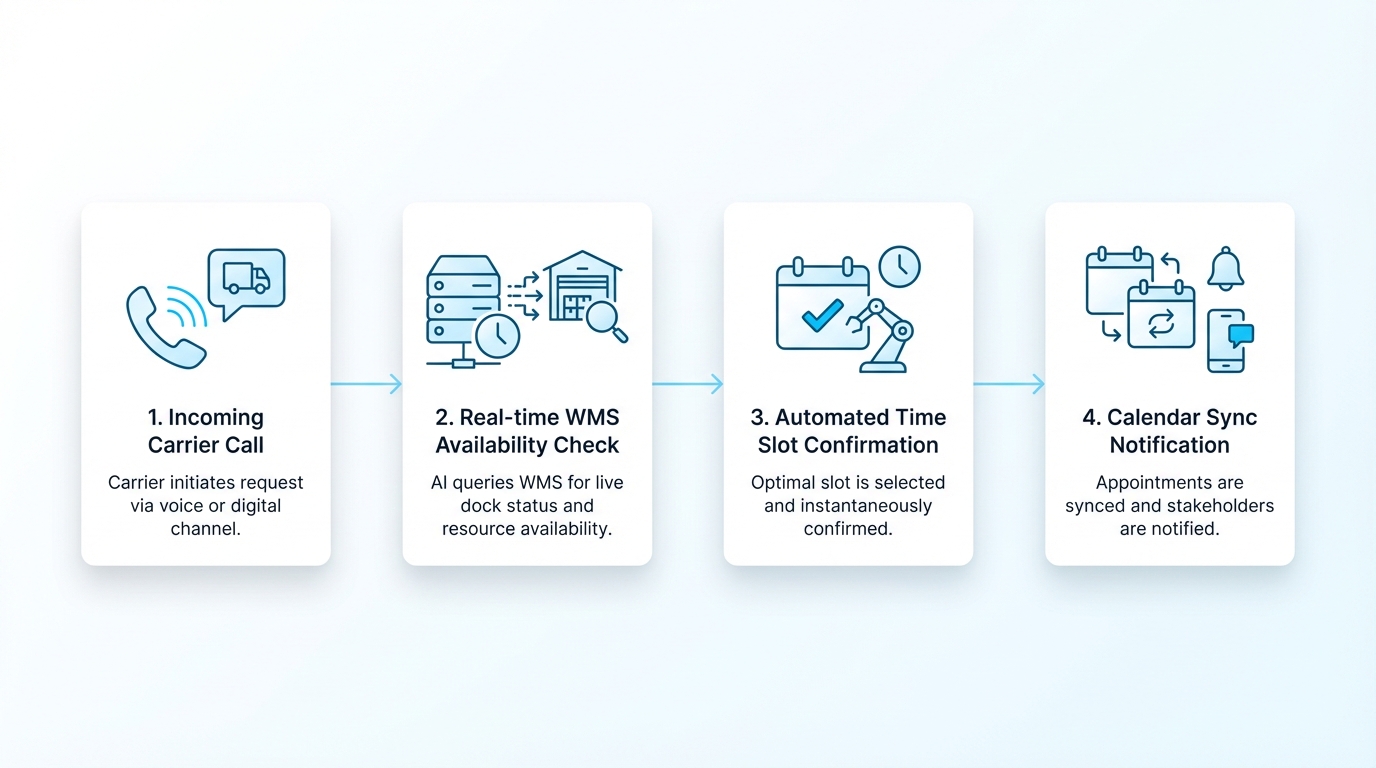
AI voice agents eliminate every manual step in that chain. The carrier calls, states the PO or BOL number, and the voice agent cross-references the warehouse management system in real time. If the requested window is open, it confirms and sends calendar holds to both parties. If the window is full, it offers the next three available slots, confirms the selection, and updates the WMS — all in under 90 seconds.
Did You Know?
A regional cold-chain distributor handling 1,200 dock appointments per week cut scheduling-related phone time by 74% after deploying voice agents. Detention charges dropped 41% in the same quarter.
Customs Holds Do Not Wait for Business Hours — Neither Should Your Response
Real-time customs status communication eliminates costly delays and customer frustration.
A shipment flagged with a 97H hold at U.S. Customs does not care that your customs broker left at 5 PM. According to CBP guidance on 97H shipment holds, exporters face operational constraints and communication requirements that demand rapid, accurate responses — often outside standard working hours.
This is where most logistics operations bleed time and money. A customs exception triggers. The shipper customer calls for an update. The support agent does not have visibility into the Automated Commercial Environment status. They email the broker. The broker responds four hours later. The customer calls back twice in the meantime, each call costing $6+ in agent time and producing zero new information.
An AI voice agent connected to your customs data feed changes that equation entirely. When a caller inquires about a held shipment, the agent pulls the current hold status, references the specific CBP business rules and exception codes associated with the hold, and communicates what is happening in plain language.
Sample AI Voice Agent Response:
“Your shipment is currently under an intensive exam hold. This typically resolves within 3–5 business days. No additional documentation is required from you at this time. I will flag your account for a proactive callback when the status changes.”
That interaction — which would have taken three calls, two emails, and 18 hours under the old model — just happened in 67 seconds. At 11:43 PM.
Proof of Delivery Follow-Up: The Revenue You Are Leaving on the Loading Dock
Here is a number that should make every CFO flinch: the average days-sales-outstanding for freight invoices where proof of delivery has not been confirmed is 23 days longer than invoices with confirmed POD. The Defense Logistics Agency defines proof of delivery as the documented confirmation — typically a signed BOL or carrier receipt — that goods reached their destination. Without it, payment disputes drag on and cash flow stalls.
Quick Tip
Automate POD confirmation calls within 2 hours of scheduled delivery. This single workflow improvement has been shown to reduce DSO by 15-20 days for companies processing 4,000+ monthly deliveries.
NewVoices agents call the receiving party within hours of the scheduled delivery window. The voice agent confirms receipt, captures the signer name, records a verbal confirmation tied to the tracking number, and pushes the data directly into your billing system. If the receiver reports a discrepancy — short shipment, damage, wrong SKU — the agent logs the exception and escalates to your claims team with full call context attached.
A mid-market LTL carrier deployed this workflow across 4,600 monthly deliveries. POD confirmation time dropped from 9.3 days to 1.4 days. DSO on those invoices improved by 19 days. The finance team stopped chasing paperwork and started closing the books faster — because an AI agent made a 90-second phone call that no human had time to prioritize.
Why Just Add More Agents Is the Most Expensive Decision in Freight
The instinct is understandable. Call volume spikes. Hold times climb. Customer complaints land in the VP inbox. The solution feels obvious: hire more people.
But here is what the staffing model actually produces. You spend 3–6 weeks recruiting. Another 2–4 weeks training. By the time a new agent is handling calls independently, the seasonal spike that triggered the hire is already declining. You are now carrying headcount for a demand curve that peaked eight weeks ago.
BEFORE HIRING
14 agents handling 2,800 calls/week. Average hold time: 6 minutes. Customer satisfaction: 71%.
AFTER HIRING 4 MORE AGENTS
18 agents handling 2,800 calls/week. Average hold time: 3.5 minutes. Customer satisfaction: 76%. Cost increase: $312,000/year in fully loaded labor.
AFTER DEPLOYING AI VOICE AGENTS
14 agents handling only complex calls (1,100/week). Voice agents handling 1,700 routine calls/week. Average hold time for human-handled calls: 22 seconds. Customer satisfaction: 89%. Cost increase: a fraction of a single salary.
The math is not close. And it never was.
The Compliance Trap: What Happens When Your Voice AI Ignores TCPA, NIST, and Data Encryption
Speed without compliance is a lawsuit waiting to happen.
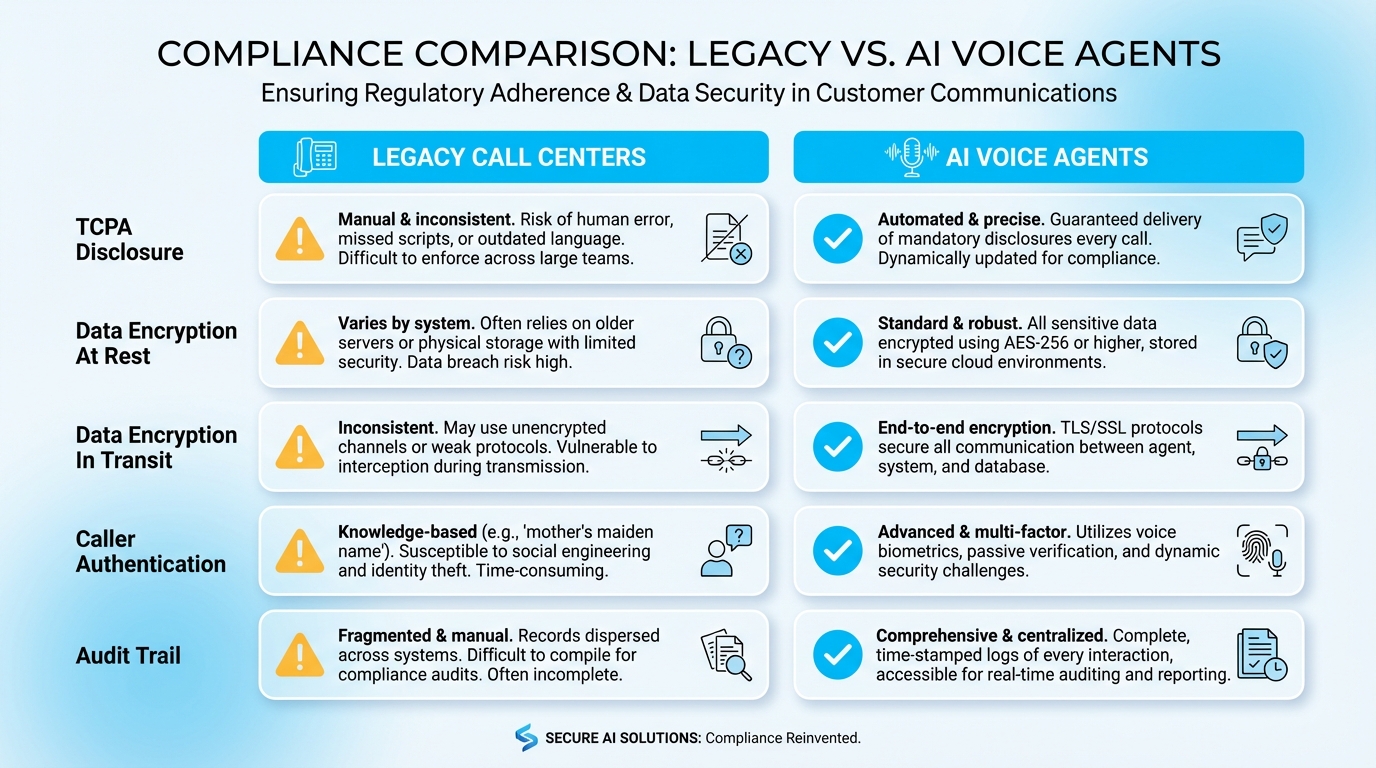
Any logistics company deploying AI voice agents for outbound calls — delivery confirmations, appointment reminders, payment follow-ups — operates under the Telephone Consumer Protection Act. The FCC order on artificial and prerecorded voice requirements makes the obligations explicit: proper disclosures, documented consent where applicable, and clear identification that the call uses automated technology.
Did You Know?
NIST SP 800-63B is explicit: voice biometrics alone shall not be used as an authentication factor. Compliant systems require layered verification — account PINs, one-time passcodes, or reference-number matching.
NewVoices builds all of this into the platform architecture — SOC 2 Type II compliance, GDPR and HIPAA readiness, encrypted data pipelines, and configurable authentication flows that your compliance team can audit without writing a single line of code.
What Airlines Learned About Automated Rebooking That Freight Companies Still Have Not Figured Out
In 2022, a major U.S. airline automated 78% of its weather-related rebooking calls using voice AI. The result was not just faster rebookings — it was a fundamental shift in how the airline deployed human agents during disruptions. Instead of 400 agents drowning in identical “rebook my flight” calls, 90 agents handled complex itineraries while the voice system processed the straightforward swaps. Net Promoter Score during disruption events — historically the airline worst metric — improved by 34 points in one year.
Quick Tip
The companies winning in logistics are not the ones with the biggest IT budgets. They are the ones that stopped treating every technology deployment like a construction project and started treating it like a configuration.
NewVoices agents handle surge volume without surge pricing. No overtime. No scrambling to staff up a weekend war room. The same agent that took 200 calls on a quiet Tuesday takes 4,000 on a chaotic Friday — with the same 3-second response time, the same data accuracy, the same voice quality that callers cannot distinguish from a human.
Driver and Carrier Support: The Calls Nobody Optimizes Because Nobody Measures Them
Ask any logistics operations manager how many calls come in daily from drivers and carriers. Most cannot answer with a real number. That is because driver support calls — gate codes, delivery instructions, appointment confirmations, issue reporting — flow through the same general line as customer calls, get handled by the same agents, and never get tracked as a separate category.
They should be. A carrier survey across 38 mid-market shippers found that drivers spend an average of 11 minutes per delivery stop on communication-related tasks. Across a 6-stop route, that is over an hour of a driver day spent on the phone — time that directly reduces asset utilization.
An AI voice agent dedicated to carrier and driver support answers in seconds, authenticates the driver via load number or carrier SCAC code, and provides the specific information needed: “Gate 14, dock door 7. Lumper service is arranged — reference number 4419. Check-in with the guard station and state your load number.”
One regional produce distributor deployed a dedicated driver support voice agent and measured a 23-minute reduction in average stop time across their top 15 delivery routes. That translated to an additional delivery per route per day — a capacity increase worth $1.8 million annually in revenue throughput, achieved without adding a single truck.
The 90-Day Deployment That Replaced a 9-Month RFP
Enterprise logistics companies are conditioned to expect 9–12 month implementation timelines for any technology that touches customer-facing operations. RFP. Vendor evaluation. Proof of concept. Pilot. Phased rollout. Change management. The process is so ingrained that operations leaders budget for it like a capital project.
That timeline made sense when the technology required custom development, on-premise infrastructure, and six-figure professional services engagements. It does not make sense when the platform is built for business teams to configure without engineering dependency.
A 3PL with operations across 8 U.S. distribution centers went from signed contract to live AI voice agents handling inbound WISMO calls in 22 days. The operations director — not a developer, not an engineer — built the first call flow in the No-code Agent Studio in under four hours. By day 30, they added an outbound POD confirmation workflow. By day 60, they launched a Spanish-language appointment scheduling agent for their South Texas facilities. By day 90, AI voice agents were handling 3,400 calls per week across all eight sites.
No RFP. No six-month pilot. No $300,000 in integration consulting fees.
Limited Availability
Due to high demand, NewVoices is currently onboarding a limited number of new logistics partners each month. Priority is given to operations processing 2,000+ calls weekly.
Your Competitors Are Already Fielding Calls at Midnight
They are confirming deliveries before the invoice goes out and rescheduling dock appointments without a single human in the loop.
The gap between their operation and yours widens every day you spend evaluating instead of deploying.
Hear It Yourself — Get a Live AI Call in Seconds
No credit card required. Experience what your operation sounds like when it never sleeps.
HIPAA Ready
GDPR Compliant