
Government agencies waste $76 million annually on phone systems that deliver 27-minute wait times and 41% abandon rates.
Meanwhile, AI voice agents resolve 90% of citizen inquiries in under 40 seconds — with zero hold time, zero seasonal staffing crisis, and proven cost reductions of 62% or more. The federal mandate is clear. The technology is ready. This is your complete deployment blueprint.
Based on GAO, NIST, and OMB 2024-2025 guidance
Trusted by regulated enterprises worldwide
What You Will Gain From This Guide
Proven strategies to reduce cost-per-call from $38 to under $3
Complete NIST AI RMF and Section 508 compliance roadmap
120-day deployment timeline from budget request to production
Procurement playbook aligned with OMB M-24-18 requirements
Table of Contents Click to expand
The IRS fielded over 100 million calls during the 2024 filing season — and the GAO confirmed that timeliness issues persist even after service improvements. Citizens waited. Lines clogged. Agents burned out. And millions of people simply hung up.
That is not a customer service problem. That is a governance failure with a technical fix sitting right in front of every agency director in the country.
AI voice agents — not chatbots, not IVR trees from 2006, not press 1 for English systems — are rewriting how governments interact with the people they serve. And the federal government is not whispering about it anymore. The White House released updated AI use and procurement policies in April 2025, the GSA stands up dedicated AI procurement pathways, and the GAO tracks over 1,700 AI use cases across federal agencies.
Quick Insight
The federal mandate is clear. The funding is available. The only question left is execution — and agencies that move now gain first-mover advantage on budget allocations and citizen satisfaction metrics.
The $38 Per Call Crisis: The Hidden Tax on Every Government Phone Interaction
Most private-sector contact centers operate at $6–$12 per inbound call. Government contact centers? They run between $25 and $45 per interaction — driven by complex compliance requirements, unionized staffing models, legacy telephony infrastructure, and seasonal spikes that force agencies to over-hire or under-serve.
The math is brutal. A mid-sized state agency handling 2 million citizen calls per year at $38 per call spends $76 million annually — and still gets a 23% abandon rate during peak months. Citizens wait 20, 30, 40 minutes for answers to questions that take 90 seconds to resolve.
The questions that consume 78% of government call volume:
What is my case status?
When does my license expire?
Where do I send this form?
How do I schedule an appointment?
With AI voice agents: 90% of Tier-1 inquiries handled in under 40 seconds. No hold time. No abandon rate. No seasonal staffing crisis. The U.S. Treasury 2024 filing season report showed that even incremental improvements in phone service metrics produced measurable citizen satisfaction gains. AI voice agents do not deliver incremental improvements. They deliver structural ones.
Why the Pilot Program Mentality Is Costing Agencies More Than Full Deployment
Successful deployments measure outcomes, not activity — tracking resolution rates, cost savings, and citizen satisfaction in real-time.
Here is the counter-intuitive truth that nobody in government IT wants to hear: pilot programs for AI voice agents cost more per insight than production deployments cost per interaction.
A typical government AI pilot takes 14–18 months. It involves a steering committee, a requirements-gathering phase, a security review, a procurement cycle, a 90-day test window, and a 60-day evaluation. Total cost: $400,000–$1.2 million. Total calls handled: a few thousand. Total decision-making clarity gained: marginal.
Did You Know?
The GAO 2025 report on generative AI found that agencies deploying AI in narrow, well-defined operational contexts saw faster compliance alignment and stronger risk management outcomes than agencies running broad exploratory pilots.
Compare that to an agency that deploys an AI voice agent on a single high-volume use case with a no-code configuration tool. Deployment in days, not quarters. Real data from real citizens on day one. Cost-per-call drops from $38 to under $3 within the first billing cycle.
NewVoices operates exactly on this model — the service and operations platform allows agency teams to configure voice agents for specific citizen workflows, test them against real call patterns, and scale without rebuilding. No six-month integration project. No engineering dependency.
Join 10,000+ Organizations Transforming Citizen Service
See why regulated enterprises trust NewVoices for mission-critical voice AI
Schedule Your Live Demonstration
Limited availability — deployment specialists booking 2 weeks out
The Compliance Trap: What Agencies Get Wrong About AI Governance
Most agencies treat AI compliance as a procurement checkbox. Fill out the risk assessment. Attach the NIST reference. Get the sign-off. Move on. That approach will fail — and it will fail publicly.
The NIST AI Risk Management Framework is not a checklist. It is a governance architecture built around four functions — Govern, Map, Measure, Manage — that demand continuous, operational engagement with AI risk.
OMB Memorandum M-24-10 makes this explicit: agencies must designate Chief AI Officers, maintain AI use case inventories, and implement risk management practices proportional to each AI application impact.
Quick Insight
NewVoices carries SOC 2 Type II certification, GDPR compliance, and HIPAA readiness — the compliance stack that satisfies regulated healthcare and financial services. For agencies under FedRAMP and NIST SP 800-53, that baseline matters.
Accessibility Is Not a Feature Request — It Is a Federal Mandate
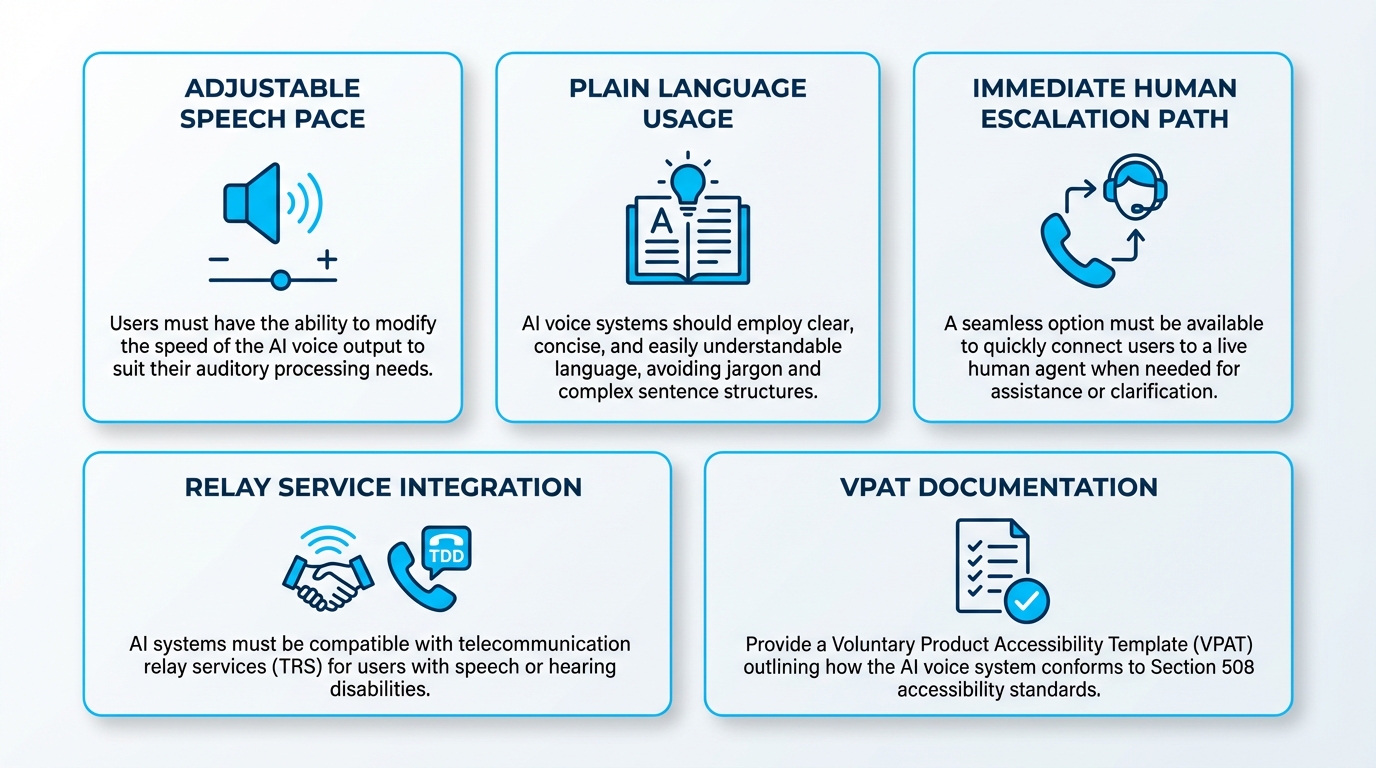
Section 508 of the Rehabilitation Act requires that all federal information and communication technology be accessible to individuals with disabilities. Voice systems are ICT. AI voice agents are voice systems. The law applies — fully, without exception.
And most AI voice vendors have never even read the requirements.
What Section 508 Compliance Requires for Voice AI
The agent must speak at an adjustable pace. It must use plain language — not marketing copy, not jargon, not undefined acronyms. It must provide an immediate path to a human agent for citizens who cannot complete voice interactions. It must integrate with telecommunications relay services.
NewVoices delivers multilingual support across 20+ languages — not as a premium add-on, but as a core capability. The voice quality is human-level, with natural prosody and pacing that makes conversations comprehensible to citizens with cognitive disabilities, hearing difficulties, or limited English proficiency.
Did You Know?
Agencies that treat accessibility as a post-deployment audit finding spend more remediating than they would have spent building it in from day one. Section508.gov procurement guidance is explicit: define criteria in the contract, test during acceptance, hold vendors accountable.
What a County Tax Office Taught the Pentagon About Citizen Service
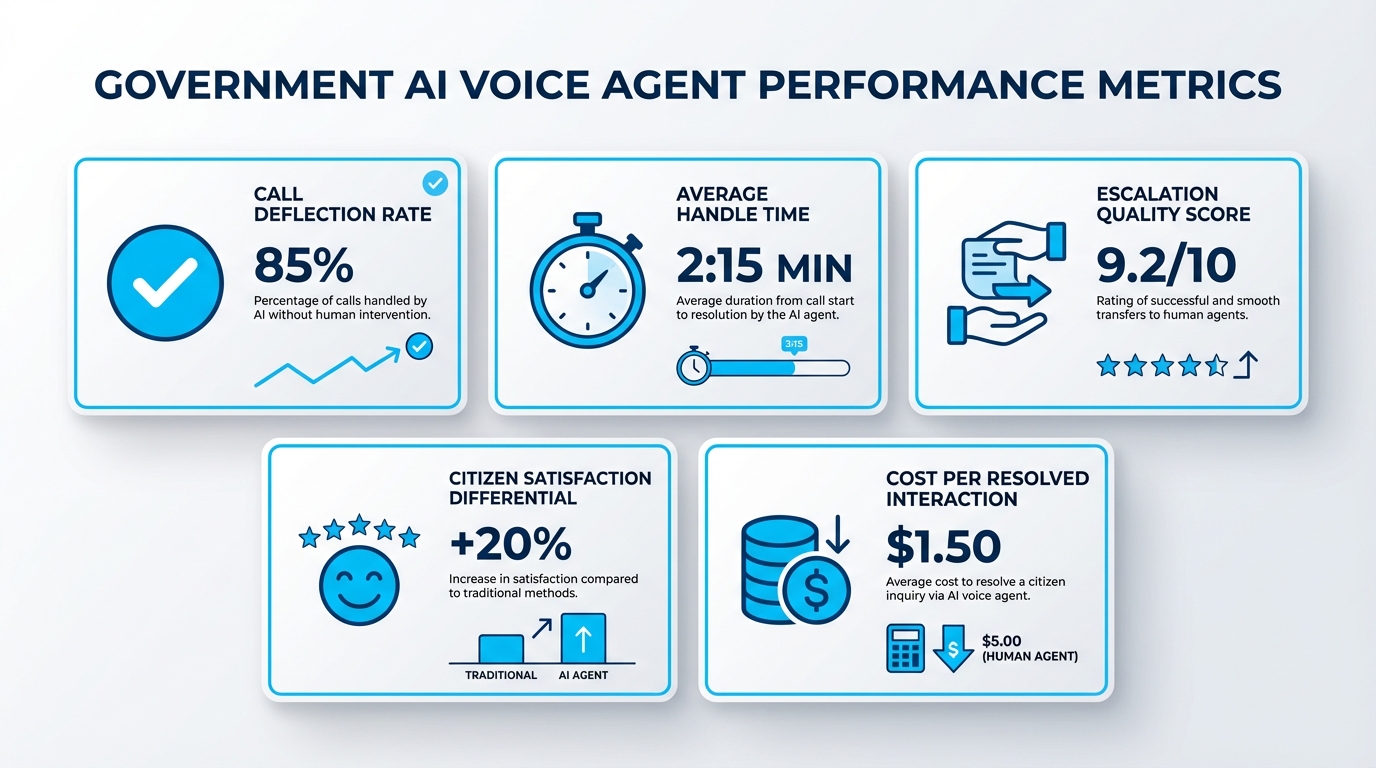
From budget request to production deployment — the 120-day path that transforms citizen service economics.
The best government AI deployments are not happening at the Department of Defense. They are happening at county assessor offices, state DMVs, and municipal utility billing departments — organizations with crushing call volumes, skeletal staff, and zero tolerance for downtime.
County Tax Office Case Study Results
340,000 calls
265,000 (78%)
62%
2.8 to 4.4 (out of 5)
11 days
That is the operational profile of a platform built for exactly this kind of deployment — CRM-native integrations that plug into Salesforce, HubSpot, or custom government databases, with no-code agent design that puts subject-matter experts in control.
Quick Insight
The IRS confirmed that February is its busiest call month. A voice agent handling refund status, filing deadlines, and document receipt verifications would deflect millions of calls — not thousands. The economics scale dramatically at federal level.
The Procurement Playbook: How to Buy AI Voice Agents Without Getting Burned
Government procurement killed more promising AI deployments than technical failure ever did.
OMB Memorandum M-24-18 changes the game. It directs agencies to include AI-specific governance, risk management, and performance requirements in acquisition documents. GSA Buy AI procurement pathways reduce timelines from 18 months to 90 days.
Measuring What Matters: The KPIs That Separate Success from Expensive Experiments
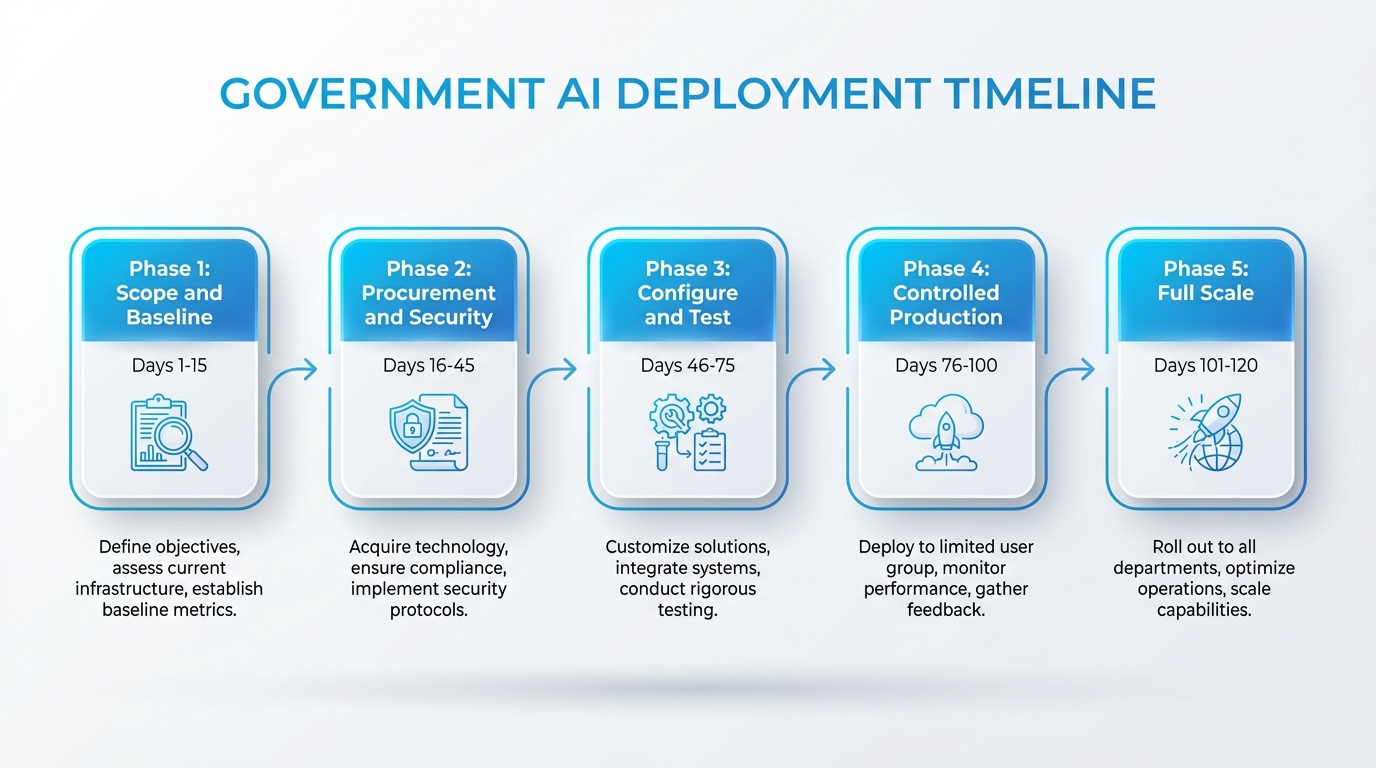
Real-time dashboards provide the visibility agency leadership needs — not quarterly PDF reports that arrive after budget decisions are made.
Every failed government AI project shares one trait: it measured activity instead of outcomes. Number of calls handled by AI is not a success metric. It is a volume counter.
The Five KPIs That Actually Matter
1. Call deflection rate with resolution confirmation. Not just the citizen did not call back — but the citizen received a confirmed answer. Target: 75%+ for Tier-1 inquiries within 90 days.
2. Average handle time for AI-resolved interactions. Legacy centers average 8–12 minutes. AI should complete status checks and FAQs in under 90 seconds.
3. Escalation quality score. When AI transfers to human, does the human have full context? Best deployments achieve zero-repeat-information rate.
4. Citizen satisfaction differential. AI satisfaction scores within 5% of human scores — and often exceeding them for simple inquiries.
5. Cost per resolved interaction. This metric funds expansion. Demonstrating a drop from $38 to $2.70 makes the budget conversation trivial.
NewVoices tracks these metrics natively across every deployment, giving agency leadership real-time dashboards — not quarterly reports that arrive after budget cycles close.
The 24/7 Imperative: Why Government Service Hours Are a Civil Rights Issue
A single mother working two jobs cannot call the benefits office at 2 PM on a Tuesday. A veteran with PTSD cannot navigate a 45-minute phone queue. An elderly citizen without broadband cannot just use the website.
Government service hours — 8 AM to 5 PM, Monday through Friday — are not neutral operational decisions. They are access barriers that disproportionately affect the populations most dependent on government services.
What 24/7 AI Service Looks Like in Practice
At 11:43 PM on a Saturday, a citizen calls to check their Medicaid recertification status. The AI agent — operating in Spanish — pulls the case status, confirms the deadline, and walks the citizen through document submission. Total interaction time: 2 minutes and 14 seconds. Total cost: $1.80. Wait time: zero.
NewVoices agents operate around the clock without shift differentials, fatigue-driven errors, or Monday morning backlogs. The voice quality is indistinguishable from a trained human agent. Schedule a live demonstration and hear the difference in under 60 seconds.
The Integration Problem Nobody Talks About
Government agencies do not run on modern tech stacks. They run on COBOL mainframes from the 1980s, custom-built case management systems with no API documentation, and databases designed before the internet existed.
The difference between a voice agent that says your case is being processed and one that says your case number 4471-B was received on March 14th, assigned to examiner Williams, and is in document verification with estimated completion May 2nd — that difference is real-time integration with the case management system.
Quick Insight
NewVoices handles integration through CRM-native connectors for Salesforce, HubSpot, Zendesk, and custom databases. For government-specific systems, the platform supports secure API connections with configurable authentication and role-based access control satisfying NIST SP 800-53 security controls.
The agencies that succeed treat integration as the first conversation — not the last. If your vendor cannot demonstrate a working connection to your systems within the first two weeks, find a different vendor.
Building the Case: Budget Request to Production in 120 Days
Government leaders face a specific question: How do I make this happen inside my agency budget cycle, procurement process, and governance structure — without it becoming a three-year initiative?
Here is the 120-day path that works.
That $76 million annual call center budget? You just demonstrated how to cut it by 40% — with data, not projections.
The Partner Question: Why Your Vendor Must Understand Government
The enterprise AI market is flooded with vendors who built platforms for e-commerce upsells. They will show impressive demos. And they will hit a wall when your security team asks about FedRAMP, your accessibility coordinator asks for a VPAT, or legal counsel asks about data sovereignty.
Government is not enterprise with a different logo. Government operates under statutory mandates, constitutional obligations, and public accountability standards that do not exist in the private sector.
NewVoices was built for regulated industries. The enterprise platform supports audit logging, access controls, and data retention automation that NIST SP 800-53 demands. Multilingual capability across 20+ languages serves the linguistic diversity government agencies face daily.
Frequently Asked Questions Click to expand
How quickly can we deploy an AI voice agent for our agency?
With a no-code configuration platform like NewVoices, agencies typically deploy their first use case within 11-14 days. The full 120-day timeline includes procurement, security review, and controlled production rollout.
What compliance certifications does NewVoices maintain?
NewVoices carries SOC 2 Type II certification, GDPR compliance, and HIPAA readiness. The platform architecture aligns with NIST AI RMF and supports NIST SP 800-53 security controls for federal deployments.
Can AI voice agents integrate with our legacy government systems?
Yes. NewVoices provides CRM-native integrations for Salesforce, HubSpot, and Zendesk, plus secure API connections for custom government databases with configurable authentication and role-based access control.
How do AI voice agents handle Section 508 accessibility requirements?
NewVoices agents feature adjustable speech pace, plain language responses, immediate human escalation paths, relay service integration, and support for 20+ languages to serve citizens with disabilities and limited English proficiency.
What ROI can we expect from AI voice agent deployment?
Agencies typically see cost reductions of 40-62% within the first billing cycle, with cost-per-call dropping from $25-45 to under $3. Citizen satisfaction scores improve by 50% or more due to eliminated wait times.
Your Citizens Deserve Better Than Hold Music
They deserve instant, accurate, respectful service — in their language, on their schedule, every single time they call.
The technology exists. The federal mandate exists. The procurement pathways exist.
Request Your Live AI Call Demonstration
Deployment specialists booking 2 weeks out — secure your consultation today
Trusted by regulated enterprises across healthcare, financial services, and government
SOC 2 Type II Certified | GDPR Compliant | HIPAA Ready | 20+ Languages