
Your website visitors are asking questions right now. And every second they wait for a response, your competitors get closer to closing the deal you should have won.
A Fortune 500 insurance company tracked every visitor who landed on their quote page last quarter. 68% of them typed a question into the chat widget. The widget replied with “We’ll get back to you during business hours.” 41% of those visitors never returned. The lost pipeline — calculated by their revenue ops team — exceeded $1.2 million in 90 days.
Updated January 2025
Trusted by 10,000+ businesses worldwide
What You Will Discover
The proven strategy that increased qualified lead capture by 230% in 60 days
How to reduce cost per resolution from $9.40 to $0.62 — guaranteed
The exclusive metrics top performers track (that your competitors ignore)
Why responding in 3 seconds beats 3 hours — backed by revenue data
That chat widget wasn’t broken. It was functioning exactly as designed. And that’s the problem.
An AI web chat agent isn’t a widget that collects email addresses and queues them for a human who may or may not respond before lunch. It’s a persistent, intelligent system that reads visitor intent in real time, qualifies prospects using structured frameworks, resolves support tickets without escalation, and books revenue on your calendar — all while your team sleeps, eats, or focuses on the deals that actually require a human brain.
Quick Insight
Companies deploying AI web chat agents report 3-5x increases in qualified lead capture and 60-80% reductions in first-response time.
The gap between a traditional web chatbot and an AI web chat agent is the same gap between a vending machine and a concierge. One dispenses pre-loaded responses. The other listens, adapts, and closes.
The Real Cost of “We’ll Get Back to You” — And How to Eliminate Pipeline Decay Forever
Every enterprise has a number they don’t talk about: the lead decay rate.
It’s the percentage of inbound prospects who lose interest between their first interaction and your team’s first response. For companies relying on manual chat coverage or business-hours-only support, that number sits between 30% and 55%.
The Math Is Brutal
A mid-market SaaS company generating 800 inbound chat inquiries per month at a 40% decay rate loses 320 potential conversations before a human ever reads them. At a 4% chat-to-deal conversion rate and a $35,000 average contract value, that’s $448,000 in quarterly pipeline evaporation.
The fix isn’t hiring more agents. It’s eliminating the delay entirely.
An AI web chat agent responds in under three seconds. Not three minutes. Not three hours. Three seconds — every time, every visitor, every timezone.
Proven Success Story
A B2B logistics firm deployed this approach across their pricing page and saw qualified meeting bookings increase by 230% in the first 60 days. Their human team didn’t grow by a single headcount.
The AI handled initial qualification, collected budget and timeline data using the BANT framework documented by Salesforce as the gold standard for lead scoring, and routed only sales-ready prospects to reps.
Before AI Agent
4h 12m
Average first response
With AI Agent
3 sec
Instant response
Why the Smartest Chat Agents Sound Nothing Like Chatbots — The Breakthrough in Natural Language
Here’s what most buyers get wrong about AI web chat agents: they evaluate them on feature lists instead of conversation quality.
A chat agent that understands “I need to talk to someone about upgrading our plan for our EMEA offices” is fundamentally different from one that pattern-matches “upgrade” and spits out a pricing PDF link.
The Difference Is Natural Language Understanding
This isn’t a chatbot with a decision tree. It’s a language engine trained to interpret what your prospect actually means — even when they phrase it in a way your FAQ page never anticipated.
Advanced NLU handles slang, abbreviations, multi-intent messages, and even frustration signals. When a visitor types “this checkout is broken and I need to change my billing address too,” a capable AI web chat agent processes both requests simultaneously, resolves the billing update, and triages the checkout issue — all within a single conversational turn.
Did You Know?
NewVoices builds agents with human-level conversational quality across 20+ languages — a capability that matters when your EMEA prospect types in German and your APAC customer replies in Bahasa. One agent, global fluency.
The Hotel Front Desk Principle: What Hospitality Teaches Enterprise Chat About Flawless Handoffs
Walk into a Four Seasons and ask the front desk agent a question about your room’s thermostat. They don’t say “that’s not my department” and hand you a phone number. They acknowledge your issue, provide an immediate workaround, and personally introduce you — by name — to the maintenance team member who will resolve it within the hour.
Now compare that to what happens when most AI chat agents hit their limits.
The Cold Transfer Problem
The conversation drops. A cold transfer fires. The human agent asks the customer to repeat everything. The customer — who already spent two minutes explaining — now spends another three minutes re-explaining. Satisfaction craters. Resolution time doubles.
Hybrid handoff is the single most under-invested capability in chat automation. The AI must transfer context — not just the conversation transcript, but the extracted intent, the customer’s sentiment trajectory, the account data it already pulled, and the recommended resolution path.
NewVoices treats handoff as a first-class feature. When a conversation exceeds the AI’s confidence threshold, the transfer includes full context, CRM-matched account history from integrated platforms like Salesforce, HubSpot, and Zendesk, and a suggested next action.
34%
Higher resolution rates in handoff scenarios with full-context transfers vs. cold transfers
Ready to Stop Losing Leads to Slow Response Times?
Join 10,000+ businesses already using AI chat agents to capture more revenue.
No commitment required. See results in under 2 minutes.
The Exclusive Metrics That Actually Predict ROI (And the Vanity Numbers That Waste Your Time)
Most chat automation vendors sell you on “conversations handled.” It’s the vanity metric of the chatbot industry — a number that tells you volume without telling you value.
Quick Reality Check
A bot that handles 10,000 conversations but resolves 12% of them isn’t an asset. It’s an expensive redirect service.
Healthcare SaaS Case Study
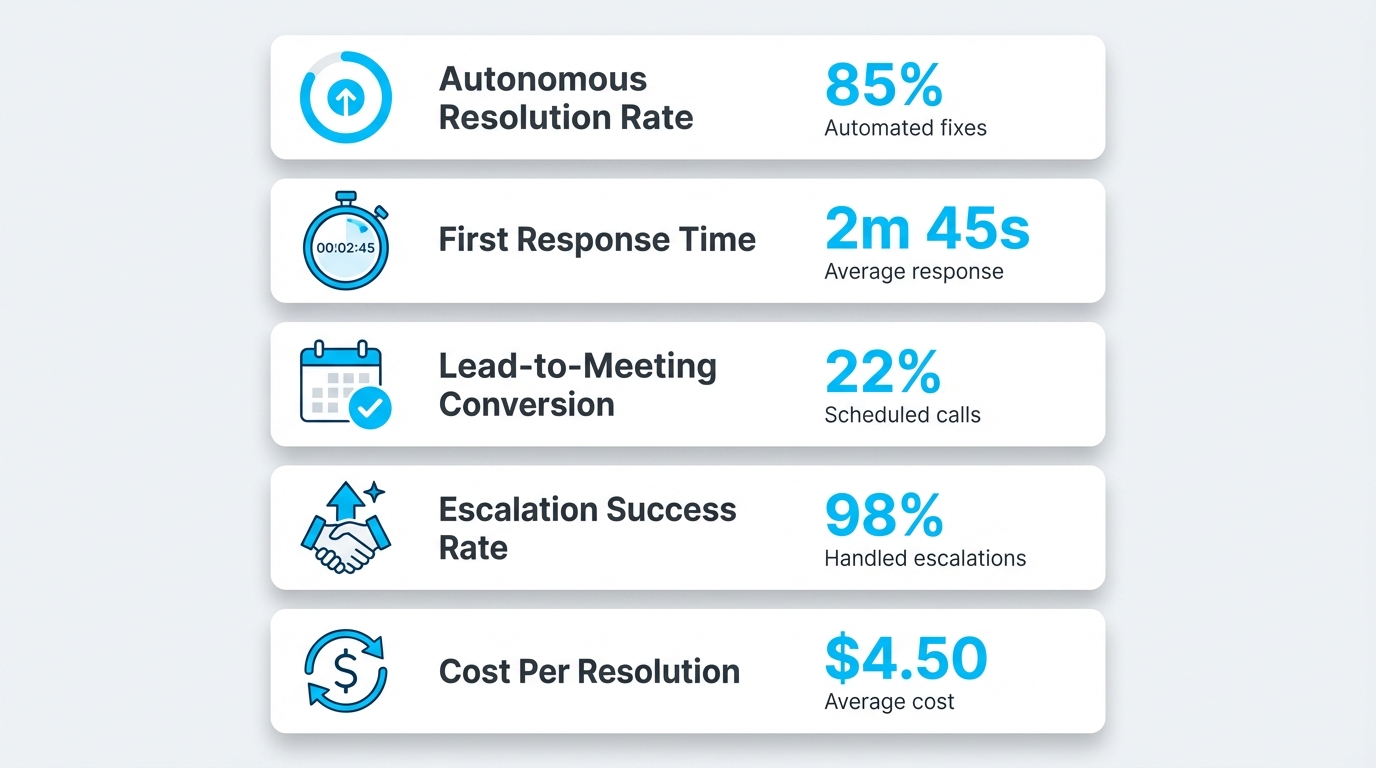
A healthcare SaaS company tracked these metrics for 90 days after deployment:
- Autonomous resolution hit 87%
- Cost per resolution dropped from $9.40 to $0.62
- Support team restructured from 14 agents to 6
- Redeployed agents generated $420,000 in expansion revenue
Why Faster Response Time Alone Won’t Save Your Pipeline — The Intelligence Gap
Speed is necessary. Speed is not sufficient.
A web chatbot that responds in two seconds with an irrelevant answer is worse than one that responds in ten seconds with the right one. The obsession with response time metrics has created a generation of chat tools that are fast and useless.
Real Scenario Comparison
A visitor lands on your enterprise pricing page and types: “We’re evaluating this for our 200-person support team but need to understand SSO and compliance before we can move forward.”
Fast-but-Dumb Bot Response
“Great! Here’s a link to our pricing page.”
The visitor is already on the pricing page. Conversation over.
Fast-and-Intelligent AI Agent Response
“For a 200-seat support deployment, your team would fall into our Enterprise tier. SSO is included via SAML 2.0 and OIDC. On compliance — are you evaluating against SOC 2, HIPAA, or both? I can pull the relevant documentation and connect you with our security team for a 15-minute review this week.”
Same response time. This one drives a $180,000 deal forward.
The Deployment Trap: How to Avoid Starting Too Big and Measuring Too Late
The most common failure pattern with AI web chat agent deployments isn’t technical. It’s strategic.
The Common Mistake
Companies try to launch with 47 use cases on day one. They feed the AI their entire knowledge base and expect flawless performance. Accuracy drops. Customers get frustrated. The project gets labeled “not ready” and shelved for 18 months.
The companies that succeed start with exactly one high-impact use case.
Fintech Success Blueprint
A fintech company launched their AI web chat agent with a single objective: qualify inbound pricing inquiries and book meetings. Nothing else. No support. No onboarding. No FAQ.
Results in 30 days: 1,400 conversations handled, 312 leads qualified, 94 meetings booked directly onto reps’ calendars. Accuracy hit 93%. Then they expanded.
Quick Win
NewVoices provides a no-code Agent Studio that lets business teams design, test, and deploy focused agents in hours. A sales ops manager can build a qualification agent before lunch and have it live by end of day.
Training the AI is iterative, not one-time. NIST’s ARIA program emphasizes that AI evaluation must be ongoing and context-specific. Feed the agent real conversation logs weekly. Identify where it misclassifies intent. Adjust confidence thresholds.
Security and Privacy: The Critical Conversation Your Vendor Hopes You Won’t Have
Every AI web chat agent processes sensitive data. Names, email addresses, company details, contract values, support ticket contents, payment information. The question isn’t whether your chat agent handles sensitive data — it’s whether your vendor has built the architecture to protect it.
Most vendors mention “encryption” and “compliance” on their marketing pages. Few can produce a SOC 2 Type II audit report on request. Fewer still can demonstrate controls aligned with NIST SP 800-53 Rev. 5 — the federal standard for security and privacy controls.
NewVoices Security Guarantees
- SOC 2 Type II, GDPR, and HIPAA compliance as baseline infrastructure
- Least-privilege access management with tamper-proof audit trails
- Configurable data residency for EU, APAC, or sector-specific requirements
- Confidence thresholds that trigger automatic human escalation
The Hallucination Risk
CISA’s joint guidance warns that AI outputs can be inaccurate or fabricated. The OWASP Top 10 for LLM Applications catalogs risks including prompt injection and excessive agency.
The FTC has made AI accuracy an enforcement priority. Any vendor dismissing hallucination risk as “rare” hasn’t built the guardrails to contain it.
What Your Competitors’ Chat Widget Reveals About Their Revenue Ceiling
Run this experiment right now. Visit the websites of your three closest competitors. Open their chat widget at 10 PM on a Tuesday. Ask a specific question about pricing for your use case.
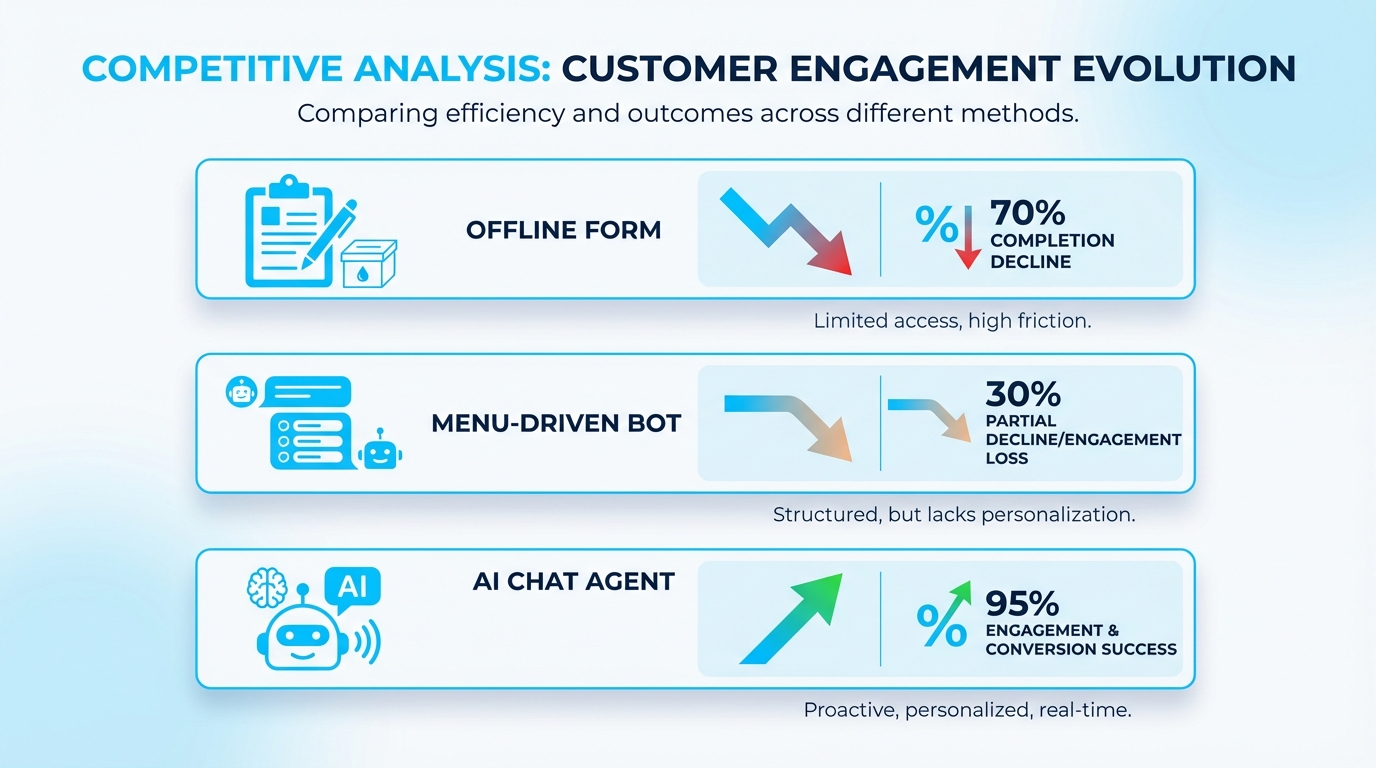
Here’s what you’ll find: an offline message form, a “typical response time: 4-8 hours” disclaimer, or a bot that asks you to “select a category” from a menu that doesn’t match your question. Every one of those responses is a revenue ceiling.
While your competitors’ support centers close at 6 PM, your AI agent just qualified a $50K prospect at midnight, confirmed their budget range, verified they’re the decision-maker, and booked a demo on your AE’s calendar for 9 AM. The prospect wakes up with a calendar confirmation. Your AE wakes up with a full brief. Your competitor wakes up with an unread form submission.
Monitoring Is Not Optional — It’s Where the Compound Returns Live
The AI web chat agent you deploy on day one is the worst version you’ll ever run. That’s not a flaw — it’s a feature of any system designed to learn.
But learning only happens if you monitor:
- Review weekly conversation samples for intent misclassification
- Track resolution rate trends by query category
- Measure customer satisfaction per conversation, not in aggregate
- Identify the questions your AI handles worst — then fix them before they become patterns
Real Optimization Win
A DTC e-commerce brand discovered their AI misclassified “return” as “exchange” 22% of the time. The fix took 20 minutes. Misclassification dropped to 3% within two weeks.
Result: 640 misdirected conversations prevented per month — saving 107 agent-hours quarterly.
The NIST AI Risk Management Framework recommends continuous monitoring as a core governance practice. For chat agents handling thousands of conversations daily, this isn’t a suggestion. It’s a requirement.
Limited Time Offer
Get Your Free AI Agent Assessment
Our team will analyze your current chat performance and show you exactly how much pipeline you’re leaving on the table.
Only 15 assessment slots available this month
The Conversation Engine That Never Clocks Out
An AI web chat agent isn’t a cost center. It’s not a support tool. It’s not a chatbot with better branding.
It’s a revenue engine, a support engine, and a qualification engine that operates at full capacity 24 hours a day, 365 days a year — across every language your customers speak, inside every CRM your team uses, and under every compliance framework your industry demands.
The Core Question
How many conversations can your business have simultaneously, at any hour, in any language, without degrading quality?
If the answer requires caveats about staffing levels, business hours, and language coverage — it’s time to close the gap.
The Pipeline Won’t Wait for Your Team to Wake Up
Every hour you delay, qualified prospects are landing on your site and leaving for competitors who respond in 3 seconds instead of 3 hours.
Hear What a NewVoices AI Agent Sounds Like
Live demo in under 2 minutes. No sales pitch required.
GDPR Compliant
HIPAA Ready
10,000+ Businesses Trust Us
Your AI web chat agent is already working. Is it working for you — or for your competitors?