
Your competitors just hired 20 more SDRs. Meanwhile, a mid-market SaaS company replaced 10 of theirs with AI voice agents — and booked 300% more qualified meetings in a single quarter. The difference between scaling revenue and bleeding pipeline comes down to one decision you’re about to make.
|
Trusted by 10,000+ revenue teams
|
Updated: January 2025
What You’ll Discover Inside
The proven architecture that separates revenue-generating voice AI from expensive failures
Exclusive deployment checklist that vendors don’t want you to see
Guaranteed compliance framework that protects against $43K+ per-violation penalties
Breakthrough KPIs that predict ROI before you deploy
Table of Contents — Jump to Any Section
+
Seventy-eight percent of deals go to the vendor that responds first. Not the cheapest. Not the flashiest. The fastest.
That single data point explains why a mid-market SaaS company with 12 SDRs replaced 10 of them with AI voice agents — and booked 300% more qualified meetings in Q1. The two remaining humans? They only handle enterprise negotiations north of $250K. Everything else — the qualification calls, the follow-ups at 11 PM on a Tuesday, the re-engagement of ghosted prospects — runs on a conversational AI voice platform that never takes a lunch break and never forgets to update the CRM.
This article breaks down what an AI voice agent actually is, how the core technology works under the hood, where companies get deployment wrong, and what separates a voice automation system that generates revenue from one that generates complaints.
Unlock Immediate Value: What an AI Voice Agent Actually Is
An AI voice agent is software that conducts full, natural-language phone conversations with humans — inbound or outbound — without a script tree, without hold music, and without a human on the other end. It listens, interprets intent in real time, responds with a voice indistinguishable from a trained human agent, and executes actions: booking meetings, processing payments, escalating tickets, updating records.
This isn’t a chatbot with a microphone. It’s a full-stack communication engine that combines automatic speech recognition, natural language understanding, real-time decision logic, and neural text-to-speech into a single interaction layer.
Did You Know?
Legacy IVR systems route calls through decision trees. An AI voice agent doesn’t route — it resolves. A customer calls about a billing dispute, and the agent pulls the invoice, identifies the discrepancy, applies the credit, and confirms resolution — all within 90 seconds.
One national insurance carrier deployed voice AI agents across its claims intake line and saw 73% of Tier-1 claims processed without human intervention. Average handle time dropped from 8 minutes 40 seconds to 2 minutes 12 seconds. The agents handled calls in English, Spanish, and French — simultaneously, across time zones, at 2 AM on a holiday weekend.
Stop Losing $4.7 Million: Why Speed Without Context Destroys Pipelines
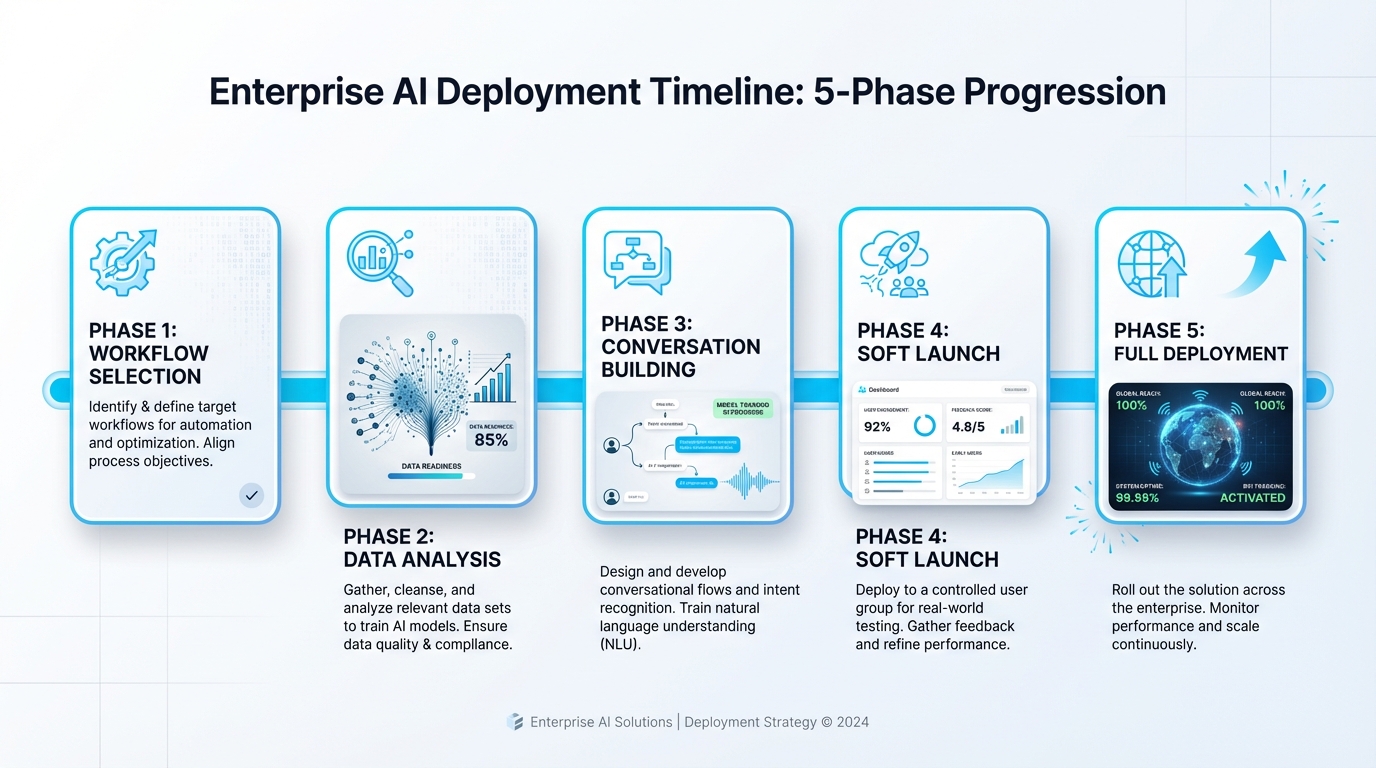
Advanced voice AI architecture enables sub-second response times that dramatically increase conversion rates
Every vendor in this space sells speed. “Respond to leads in under a minute.” The problem? Speed without context is just noise.
Here’s the scenario most companies live in before deploying voice automation: A lead fills out a form at 9:47 PM. The round-robin assigns it to a rep who’s already asleep. At 8:15 AM, the rep calls back. Voicemail. They try again at noon. No answer. By 3 PM, the prospect has already demoed two competitors. The lead — worth $47K in ARR — dies in the CRM, tagged “unresponsive.”
Now multiply that by 100 leads per month. That’s $4.7 million in pipeline leakage per year — not from bad product, not from weak positioning, but from a 10-hour response gap.
Quick Tip
The call itself has to be good. A voice AI agent that picks up in three seconds but sounds robotic does more damage than a delayed human callback. Prospects form an opinion about your brand in the first eight seconds of a call.
NewVoices agents answer every inbound lead call within three seconds — and sound like your top-performing SDR on their best day. The voice quality isn’t “acceptable for AI.” It’s indistinguishable. A sales-focused AI voice agent that qualifies, books, and confirms — with the warmth and cadence of a human — converts at rates that outpace manual outbound teams by 230%.
See the Difference in 60 Seconds
Experience a live AI call that sounds indistinguishable from your best rep
Master the Architecture: What Restaurant Kitchens Teach You About Voice AI
Walk into a high-volume restaurant kitchen during dinner service. Every station — grill, sauté, pastry, expo — operates independently but communicates in real time. The expediter calls orders, the line cooks confirm, and the whole system runs on sub-second coordination. One slow station and the entire service collapses.
An AI voice agent’s architecture works the same way.
Four stations run simultaneously during every call. Speech-to-text (ASR) converts the caller’s words into text — and accuracy here is non-negotiable. The National Institute of Standards and Technology defines Word Error Rate (WER) as the primary metric for evaluating ASR quality. Enterprise-grade systems operate below 5% WER even with background noise, accents, and cross-talk.
The Four Critical Components of Voice AI Success
The NLU layer — natural language understanding — determines intent. Not just what the caller said, but what they meant. “I’m thinking about switching” is a retention trigger, not a casual observation. The NLU engine has to catch that in under 200 milliseconds and route the conversation toward a save offer.
Text-to-speech generates the response. Modern neural TTS engines produce voices with natural breath patterns, micro-pauses, and emotional inflection. The result: callers genuinely cannot tell they’re speaking with software.
And then there’s latency — the expo station. The ACM’s research on conversational turn-taking identifies barge-in handling and sub-400ms response windows as critical thresholds for human-like interaction.
Avoid the 90% Failure Rate: Why Deployments Collapse (And How to Prevent It)
Here’s the uncomfortable truth the vendor demos never show you: the AI voice agent that dazzled your executive team in a 4-minute demo will fall apart in production if you skip conversation design.
Conversation design is the boring part. It’s mapping every branch, every edge case, every moment a caller says something the model didn’t expect. It’s building escalation triggers — not just for “let me speak to a manager” but for emotional cues like rising volume, repeated questions, or silence longer than four seconds.
Cautionary Tale
A regional healthcare network deployed voice AI for appointment scheduling without fallback paths for insurance questions. Within 72 hours, 34% of callers hit dead ends — resulting in callback volume that exceeded pre-deployment levels.
The fix took two weeks. They rebuilt the conversation flow using a no-code agent studio — no engineering tickets, no sprint cycles. A product manager and a senior nurse mapped 14 insurance-related conversation branches, trained the model on 200 real call transcripts, and redeployed. Post-fix, 91% of scheduling calls resolved without human intervention, and insurance-related escalations dropped by 67%.
Define your objectives before you design a single prompt. Are you reducing call volume? Improving first-call resolution? Recovering failed payments? Each objective demands a different conversation architecture. A service and operations deployment looks nothing like a sales qualification flow — different intents, different data requirements, different success metrics.
Protect Your Business: The Compliance Minefield No One Discusses
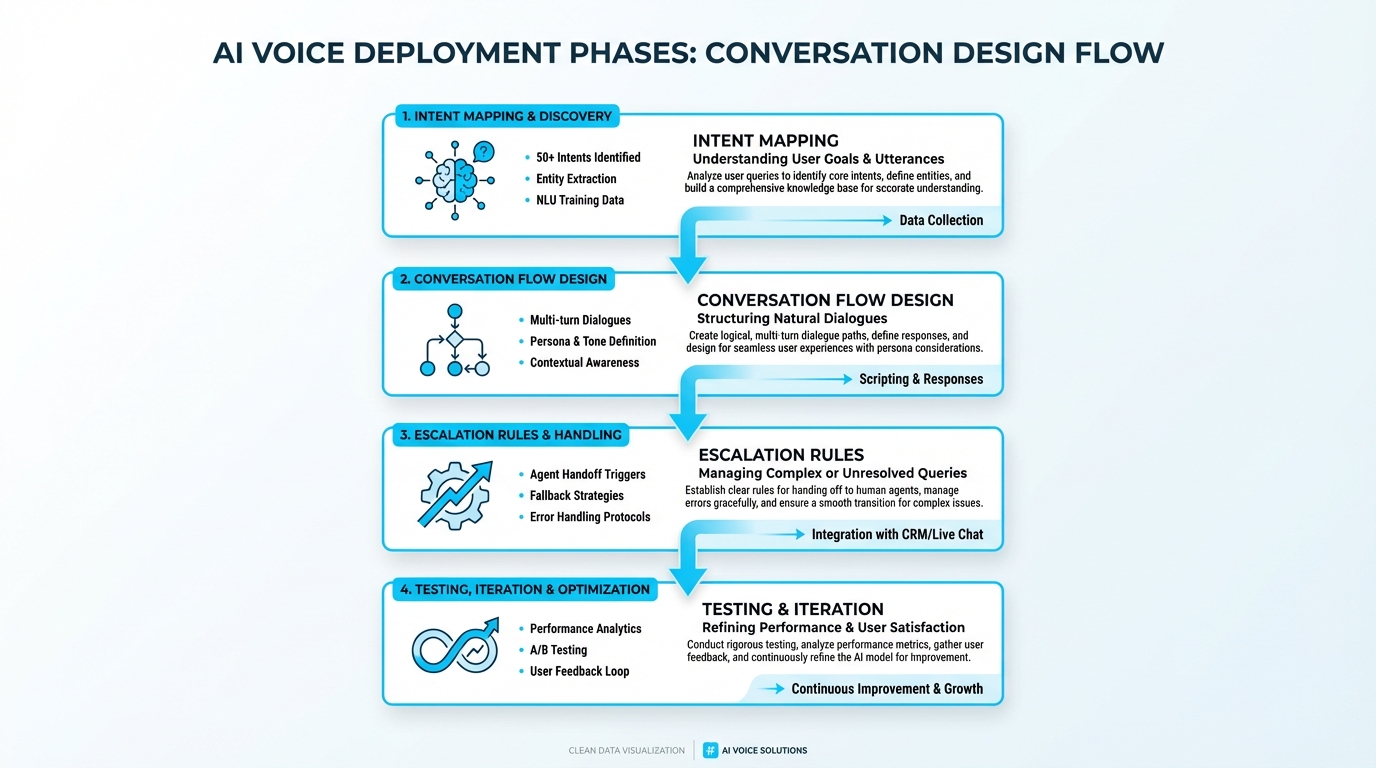
Built-in compliance safeguards ensure every AI interaction meets regulatory requirements automatically
AI voice agents make calls. Calls are regulated. Heavily.
The FCC’s 2024 ruling on AI-generated calls made this explicit: AI-generated voice calls fall under the Telephone Consumer Protection Act. That means prior express consent requirements, disclosure obligations, and penalties up to $43,792 per violation.
Critical Compliance Alert
Your AI voice agent must identify itself as AI within the first five seconds of every call — no exceptions. The FTC has flagged AI voice cloning as a significant fraud risk, and enforcement will only tighten.
Logging and audit trails are mandatory, not optional. NIST’s SP 800-92 framework for security log management establishes the baseline: every AI interaction must be recorded, time-stamped, and stored in a format that supports incident response and regulatory audit.
NewVoices carries SOC 2 Type II, GDPR, and HIPAA compliance out of the box. Every call is logged, encrypted, and auditable. Disclosure scripts are baked into the conversation layer — not bolted on as an afterthought. When a financial services firm with 1.2 million annual customer calls evaluated voice AI vendors, compliance certification eliminated 80% of the shortlist before a single demo was scheduled.
Transform Your Results: Before vs. After NewVoices
A B2B payments company — 450 employees, $38M ARR — was hemorrhaging revenue from three sources simultaneously.
Before NewVoices
- Leads waited an average of 4 hours 12 minutes for a callback
- 62% of after-hours submissions never received a call
- Failed payment recovery via email: 8% recovery rate
- CSAT survey completion rate: only 11%
- CFO flagged $2.1M in recoverable revenue sitting untouched
With NewVoices
- Every lead receives a personalized call within 40 seconds
- Response delay dropped by 95%
- Meetings booked per month increased from 74 to 243
- Failed payment recovery jumped to 41%
- Single workflow recovered $890K in six months
CSAT surveys moved from email to voice. Completion rates jumped from 11% to 38%. The AI agent called customers 24 hours after ticket resolution, asked three targeted questions, captured the NPS score, and flagged any response below 7 for immediate human follow-up.
This isn’t a productivity tool — it’s a revenue infrastructure layer
Every customer touchpoint connects to a measurable outcome
Stop Wasting Budget: Why Hiring More Reps Is a Losing Strategy
The instinct is always the same. Pipeline slowing? Hire more SDRs. Support queue growing? Add headcount. Churn rising? Bring in a retention team.
The math doesn’t work anymore.
The Real Cost Breakdown
A fully loaded SDR: $85K–$115K annually. Makes 40–60 dials/day, connects on 8–12, books 2–4 meetings. Ramp time: 3 months. Attrition: 35% annually. You’re spending $100K+ on someone productive for 9 months.
An AI voice agent makes 1,000+ calls per day. Every day. It doesn’t ramp. It doesn’t quit. It doesn’t have a bad Monday. And it costs a fraction of a single SDR’s fully loaded expense.
A fintech startup with a 6-person sales team deployed NewVoices agents for outbound lead qualification across three time zones and 4 languages. Within 60 days, qualified pipeline increased by 187% while the human team focused exclusively on high-value demos. Total cost of the AI deployment: less than one SDR’s annual salary.
Measure What Matters: KPIs That Predict Success
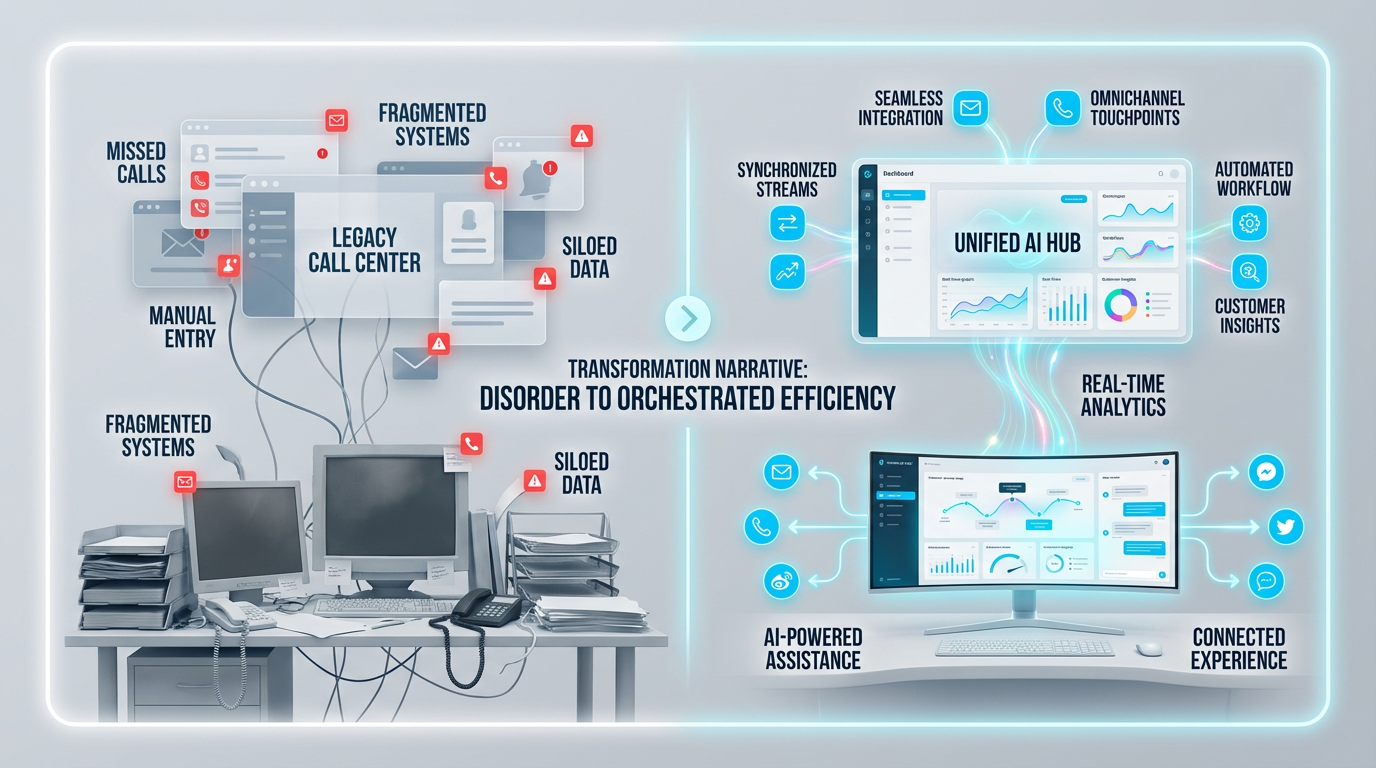
Real-time performance tracking ensures continuous optimization and measurable ROI
Most companies track the wrong metrics for voice AI. They measure call volume and uptime — vanity metrics that tell you nothing about business impact.
The NIST AI Risk Management Framework establishes a structured approach to measuring AI system performance. Applied to voice agents, this translates into five metrics that matter:
Task Completion Rate
Calls resolved without human escalation. Target: 85%+ for service, 70%+ for sales
Conversion Rate Per Call
Well-tuned AI agents convert at 12–18% on warm leads vs. 6–9% for manual teams
Cost Per Resolution
NewVoices clients report $0.35–$0.80 per AI resolution vs. $6–$12 per human call
Escalation Quality
Full context transfer including summary, intent, sentiment, and account data
Time-to-Value
NewVoices agents deploy in days, not quarters
Win the 3 AM Test: Why Availability Drives Revenue
Your support center closes at 6 PM Eastern. Your largest customer is in Tokyo — 14 hours ahead. Their CFO hits a billing error at 7 AM Tokyo time. By the time your team sees the ticket Monday morning, the CFO has already escalated internally and your champion is fielding questions about “vendor reliability.”
An AI voice agent doesn’t have a time zone.
A global e-commerce brand — $120M in annual GMV across 11 markets — deployed multilingual AI voice agents to handle order status, return initiation, and payment disputes across 20+ languages. Before deployment, after-hours tickets averaged a 14-hour response time. After deployment, every call received an answer within four seconds.
Proven Results
52%
Customer effort score reduction
29%
Fewer chargebacks
$340K
Monthly savings
Experience It Yourself
Hear what 24/7 availability sounds like — in any language, at any hour
Your Exclusive Deployment Checklist (What Vendors Won’t Tell You)
Vendors want you excited. They show you the demo, quote you the ROI, and hand you off to onboarding. What they don’t give you is the honest deployment framework that determines whether you’ll hit those numbers or become another failed AI project.
The 5 Non-Negotiable Deployment Rules
- Start with one workflow, not ten. Pick the highest-volume workflow with the clearest success metric. Nail it. Then expand.
- Feed the agent real data. Pull 500 real call recordings. Identify the 20 most common intents. Build flows around actual caller behavior.
- Set escalation thresholds before launch. Define exactly when the AI hands off — sentiment drops, repeated questions, dollar thresholds, legal topics.
- Monitor weekly for 90 days. Review task completion, escalation patterns, and sentiment scores. Adjust based on real data.
- Integrate with your stack from day one. CRM-native integrations are not nice-to-haves — they’re the difference between a voice agent and a voice toy.
The companies that get voice AI right don’t treat it as a technology project. They treat it as an operational transformation — with clear owners, defined metrics, and the discipline to iterate every week until the numbers prove the thesis.
Frequently Asked Questions
+
How quickly can we deploy an AI voice agent?
NewVoices agents built in Agent Studio deploy in days, not quarters. Most teams go from evaluation to live deployment in 2-4 weeks for a single workflow, with full-scale deployment within 90 days.
Will callers know they’re talking to an AI?
Modern neural TTS produces voices with natural breath patterns and emotional inflection. However, compliance requires AI disclosure within the first five seconds of every call. The technology sounds natural while maintaining full regulatory compliance.
What integrations are available out of the box?
NewVoices offers CRM-native integrations with Salesforce, HubSpot, Zendesk, Stripe, Twilio, and dozens of other enterprise platforms. Custom integrations are available for proprietary systems.
What happens when the AI can’t handle a call?
Intelligent escalation transfers full context — call summary, intent classification, sentiment score, and relevant account data — so human agents never waste time re-asking questions the caller already answered.
Limited Availability
Ready to Transform Your Revenue Operations?
Join 10,000+ revenue teams who’ve already made the switch. Get from evaluation to live deployment in weeks — not quarters.
SOC 2 Type II Certified | HIPAA Compliant | GDPR Ready
Trusted by enterprise teams at
|
High-Growth SaaS
|
Global Enterprises