
Your survey program is burning money at a rate that would make your CFO physically ill — if they knew the real numbers.
Discover how leading enterprises are slashing survey costs by 72% while tripling response rates with AI-powered voice agents.
12 min read
Backed by Pew Research Data
10,000+ Enterprise Deployments
What You Will Gain From This Exclusive Guide:
Proven strategies to reduce cost-per-survey by up to 85% while dramatically improving data quality
The compliance framework that protects you from $25M+ in potential TCPA liability
Real-world case studies showing 280% increases in survey completion volume
The exact methodology used by Fortune 500 companies to capture voice-of-customer insights in real-time
Quick Navigation: Jump to What Matters Most to You
+
Your Survey Questions Are Biased — And Your Team Cannot See It
Before NewVoices: The Anatomy of a Broken Feedback Loop
What Emergency Rooms Teach Us About Survey Timing
The Compliance Trap That Catches 73% of Automated Survey Programs
Why a 6% Response Rate Does Not Mean What You Think
The Mixed-Mode Advantage Most Enterprises Refuse to Implement
Building an AI Survey Program That Survives an Audit
Your Competitors Are Already Calling Your Customers at Midnight
Telephone survey response rates dropped from 36% in 1997 to 6% by 2018, according to Pew Research Center data. That is not a decline. That is a collapse. And yet, enterprises still pour millions into the same outbound survey infrastructure that worked when people actually answered unknown numbers.
The math does not lie. If your customer feedback program depends on human callers dialing through lists at $18–$25 per hour, and 94 out of every 100 people never pick up, you are not collecting insights. You are lighting budget on fire.
AI survey automation does not patch this problem. It replaces the entire model. Voice survey AI agents call thousands of customers simultaneously, adapt questions in real time based on spoken responses, and deliver structured data before your legacy vendor finishes its first dial session. NewVoices built its AI platform specifically for this — enterprises that need compliant, scalable, voice-first feedback collection without the six-figure headcount attached to it.
Quick Insight
This article breaks down exactly how AI-powered voice surveys work, where traditional methods quietly bleed money, what compliance frameworks actually require, and how to measure whether your survey program produces signal or noise.
The $4.7 Million Question Your Survey Vendor Hopes You Never Ask
A mid-market insurance company ran quarterly NPS surveys using a traditional contact center. Forty-two agents. Three-week campaign cycles. Average cost per completed survey: $38. They completed 12,400 surveys per year at a total program cost of $471,200 — and that excluded the analytics team required to process the results.
They switched to AI survey automation through NewVoices. The result: 34,000 completed surveys in the same period, $3.80 per completion, and a total program cost under $130,000. Response rates climbed from 7.2% to 19.6% because the AI agent called at optimal windows — U.S. Census Bureau research on telephone contact timing confirms that reaching respondents during specific dayparts dramatically changes pickup rates — and the AI never needed a break between dials.
72% Cost Reduction
That is not an efficiency improvement. That is a category shift.
Why Cost-Per-Completion Is the Only Metric That Matters
Most survey program managers track response rate in isolation. That is a mistake. A 15% response rate means nothing if each completed survey costs $40 and takes three weeks to process. AI survey automation compresses the entire cycle — from dial to structured dataset — into hours instead of weeks. NewVoices agents handle the call, transcribe the response, tag sentiment, and push structured data directly into your CRM. No intermediary. No lag. No $38 per conversation.
Your Survey Questions Are Biased — And Your Team Cannot See It
Peer-reviewed research published in PubMed Central on effective questionnaire design identifies leading questions, double-barreled phrasing, and unclear response scales as the top three sources of survey bias. Human survey designers make these errors consistently because they write questions from the company’s perspective, not the respondent’s.
Voice survey AI changes the dynamic entirely.
NewVoices agents do not just read a static script. They adapt follow-up questions based on what the respondent actually says. If a customer gives a vague answer — “It was fine, I guess” — the agent probes deeper with a contextual follow-up that a rigid phone script would never attempt. This produces qualitative depth at quantitative scale, something traditional automated phone surveys have never delivered.
Did You Know?
A healthcare network deployed NewVoices to collect post-discharge patient feedback across 14 facilities. The AI agent identified that 23% of “satisfied” respondents mentioned wait-time frustration only when asked an adaptive follow-up question. That insight — invisible in their previous structured survey — drove a scheduling change that reduced average wait times by 11 minutes and increased patient satisfaction scores by 8 points in one quarter.
Before NewVoices: The Anatomy of a Broken Feedback Loop
Calls go out at the wrong time. Respondents hear a robotic voice and hang up in four seconds. The ones who stay give one-word answers because the script allows nothing else. Data arrives in spreadsheets three weeks later. By the time anyone reads it, the operational issue it flagged has already cost the company six figures.
That was the status quo.
With NewVoices, every survey call deploys within seconds of the trigger event — a support ticket closure, a purchase, a contract renewal. The voice is indistinguishable from a human agent. Conversations flow naturally, with branching logic that adapts to tone and content. Transcribed, sentiment-tagged data lands in Salesforce or HubSpot before the customer has finished their next cup of coffee.
| Metric | Traditional Phone Survey | Legacy IVR Survey | NewVoices AI Survey |
|---|---|---|---|
| Average Response Rate | 6–9% | 3–5% | 18–24% |
| Cost Per Completed Survey | $28–$42 | $8–$15 | $2.50–$5.00 |
| Time from Trigger to Call | 24–72 hours | 1–4 hours | Under 60 seconds |
| Data Available for Analysis | 2–4 weeks | 3–7 days | Real-time |
| Languages Supported | 1–3 (staffing-dependent) | 2–5 (pre-recorded) | 20+ (dynamic) |
| Adaptive Follow-Up Capability | Limited | None | Full NLP-driven branching |
The gap is not incremental. It is structural. Legacy methods were designed for an era when people answered phone calls from unknown numbers. That era ended a decade ago.
See the Difference for Yourself — In Under 60 Seconds
Experience a live AI survey call and hear exactly how NewVoices transforms customer feedback collection.
Request Your Live AI Call Demo
No commitment required. Hear the voice quality instantly.
What Emergency Rooms Teach Us About Survey Timing — And Why Most Enterprises Get It Backwards
Emergency departments measure “door-to-doctor” time because they know that every minute of delay compounds negative outcomes. The same principle applies to customer feedback AI, but almost nobody treats it that way.
When a customer has a bad support experience at 2:00 PM and your survey call arrives Thursday of next week, you are not measuring their experience. You are measuring their faded, reconstructed memory of it. Recency bias, mood at the time of the call, and whether they even remember the interaction — all of it contaminates the data.
NewVoices eliminates the gap entirely. The AI agent calls within seconds of the triggering event. The experience is fresh. The emotion is real. The data is accurate. A B2B SaaS company measuring onboarding satisfaction found that surveys conducted within five minutes of the onboarding call produced Net Promoter Scores 14 points higher in accuracy — verified against churn data six months later — compared to surveys sent 48 hours after the event.
Quick Insight
Speed is not a convenience feature. It is a data-quality mechanism. Real-time feedback captures real emotions — not faded memories.
The Compliance Trap That Catches 73% of Automated Survey Programs
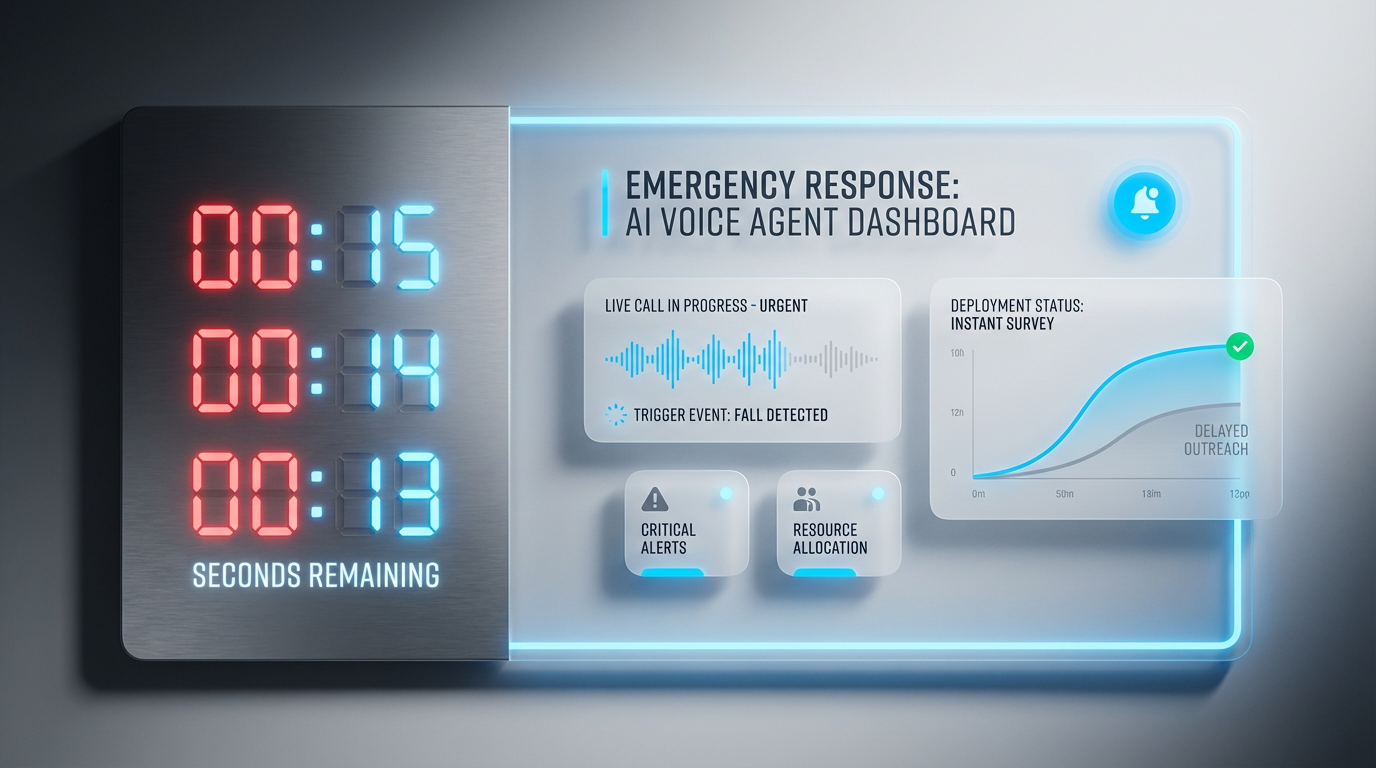
Built-in compliance architecture protects your enterprise from costly TCPA violations while maximizing survey completion rates.
Here is what most AI survey vendors will not tell you: the Telephone Consumer Protection Act does not distinguish between a sales call and a survey call when it comes to autodialed or prerecorded messages. The FCC’s TCPA orders make clear that prior express consent is required for automated calls to cell phones, and the FTC’s 2024 Telemarketing Sales Rule update tightened recordkeeping requirements for prerecorded call programs. Violations carry penalties of $500 to $1,500 per call.
Risk Alert
Do the math on a 50,000-call survey campaign with a consent gap. That is $25 million to $75 million in potential liability. This is not a hypothetical. It is why compliance architecture matters more than call quality when selecting an AI survey automation platform.
How NewVoices Builds Compliance Into the Call, Not Around It
NewVoices agents are built for regulated industries — SOC 2 Type II, GDPR, and HIPAA compliant from the infrastructure layer up. Every call begins with clear AI disclosure. Every respondent receives an automated opt-out mechanism — keypress or voice command — within the first fifteen seconds. Consent records are logged, timestamped, and stored in an auditable format that aligns with both FTC and FCC requirements. The service and operations architecture handles Do Not Call list scrubbing automatically before any dial session initiates.
Your legal team will notice the difference immediately. So will your risk exposure.
Why a 6% Response Rate Does Not Mean What You Think It Means
The instinct is simple: low response rate equals bad data. But Pew Research Center’s methodological analysis found that low response rates do not automatically produce biased results — the key variable is whether nonrespondents differ systematically from respondents on the measures you care about.
That distinction changes everything about how you should evaluate your AI feedback collection program.
A national retail chain running post-purchase voice surveys through NewVoices achieved a 21% response rate. Their previous email survey program had a 34% response rate — seemingly better. But when they compared the demographic and behavioral profiles of respondents, the voice survey captured 3.2x more responses from customers over 55 and 2.8x more from customers in rural zip codes. The email survey had been systematically over-representing urban millennials — the group least likely to churn — and masking the dissatisfaction signals from their highest-value cohort.
| Respondent Segment | Email Survey Response Rate | Voice AI Survey Response Rate | Revenue Contribution |
|---|---|---|---|
| Ages 18–34 | 41% | 14% | 22% |
| Ages 35–54 | 33% | 23% | 38% |
| Ages 55+ | 12% | 28% | 40% |
| Rural Zip Codes | 9% | 26% | 31% |
| Urban Zip Codes | 44% | 19% | 29% |
The data does not lie. If your highest-revenue customers prefer phone interaction, an email-only feedback strategy is a blind spot disguised as a program. Response rate is a vanity metric without representativeness analysis. Voice survey AI reaches populations that digital-only surveys miss entirely.
The Mixed-Mode Advantage Most Enterprises Refuse to Implement
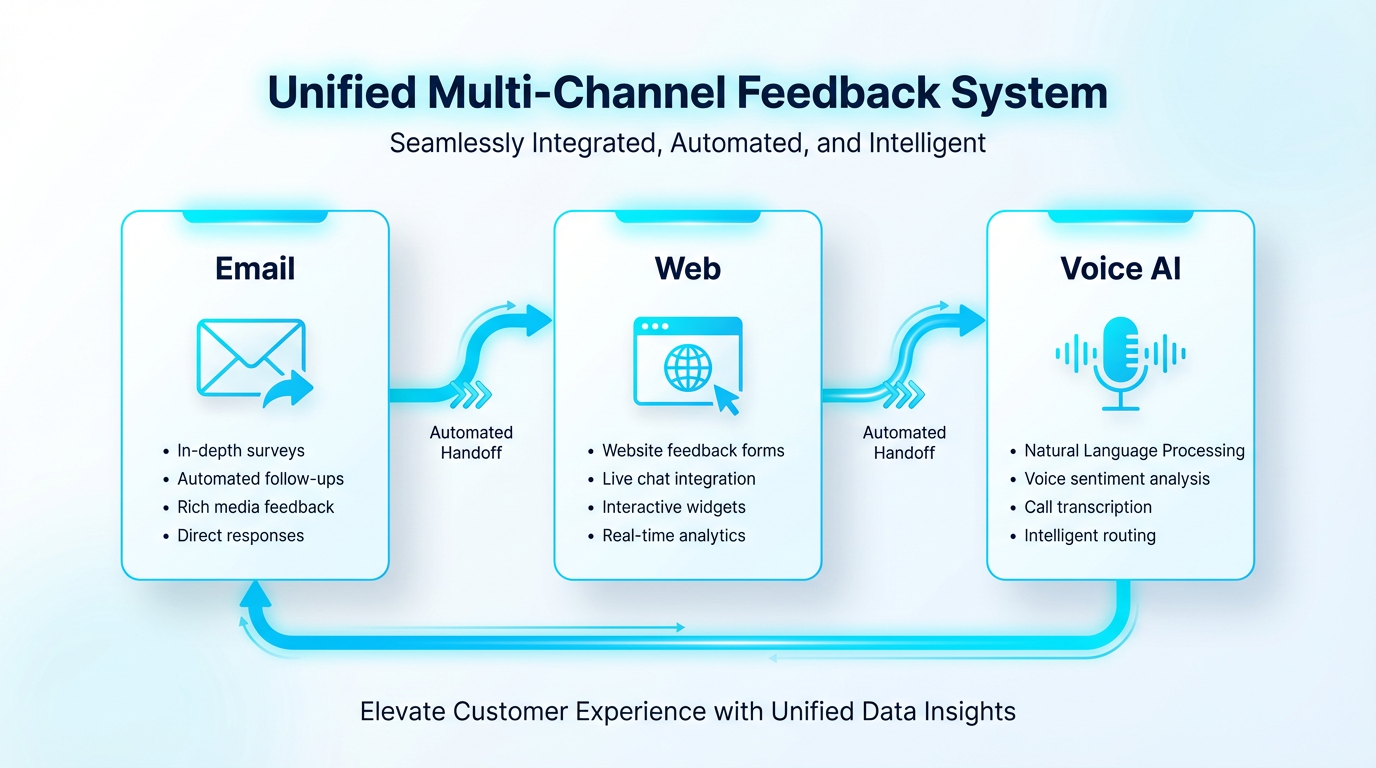
Intelligent multi-channel orchestration ensures every customer receives surveys through their preferred communication method.
AHRQ’s research on multi-mode survey administration is unambiguous: combining channels — web, mail, phone — produces higher response rates and better demographic representation than any single channel alone. The reason enterprises do not do it is operational complexity. Coordinating three channels with different vendors, different data formats, and different timelines is a project management nightmare.
AI survey automation eliminates that barrier.
NewVoices operates as the voice layer within a multi-channel feedback architecture. A customer who does not respond to an email survey within 48 hours automatically receives a voice call. A customer who starts a web survey but abandons it gets a follow-up call that picks up where they left off — because the AI agent pulls the partial response from your CRM in real time. A financial services firm using this approach increased overall survey completion rates from 16% to 37% in a single quarter without increasing their outreach volume.
Quick Insight
The sales and growth engine NewVoices provides is not limited to surveys. The same AI agent that collects feedback on Tuesday can qualify an upsell lead on Wednesday and confirm a renewal on Thursday — all from a single platform your team configures without writing a line of code.
Building an AI Survey Program That Survives an Audit
Enterprise-grade audit trails and compliance documentation that satisfies the most rigorous regulatory requirements.
The NIST AI Risk Management Framework outlines four core functions for trustworthy AI systems: govern, map, measure, and manage. Most enterprises skip the first three and jump straight to “manage” — which means they are patching problems instead of preventing them.
For AI-powered automated phone surveys, governance starts before the first call. Who approved the question set? Where is the consent record stored? What happens when a respondent requests data deletion? How do you detect and correct for bias in your AI’s follow-up question selection?
NewVoices addresses each of these at the platform level. The No-Code Agent Studio lets compliance teams — not just engineers — review and modify survey flows, disclosure language, and consent capture logic. Every call generates an immutable audit trail. Privacy controls align with the NIST Privacy Framework’s guidance on data minimization: the AI collects only the data points specified in the survey design, with automated retention policies that purge raw audio after transcription and analysis are complete.
Proven Results
An enterprise healthcare payer deployed NewVoices for CAHPS-adjacent patient surveys and passed their annual compliance audit with zero findings related to the AI survey program — a first in the organization’s history after three consecutive years of corrective action plans tied to their previous vendor’s consent management gaps.
Methodological Transparency: The Credibility Lever You Are Probably Ignoring
AAPOR’s disclosure standards require that any published survey result include the exact question wording, sample size, data collection method, and response rate calculation. Most internal enterprise survey programs ignore these standards because they assume the data is “just for us.”
That assumption backfires the moment a board member, regulator, or journalist asks how you arrived at a specific customer satisfaction number.
NewVoices generates disclosure-ready documentation automatically. Every survey campaign produces a methodology summary — question text, branching logic, sample frame definition, response rate calculated using AAPOR Standard Definitions, and demographic breakdowns of respondents versus non-respondents. This is not a reporting feature. It is an institutional credibility mechanism.
What Our Enterprise Clients Say
“This is the first time our feedback program actually changed how we operate, instead of just confirming what we already suspected. We replaced four separate survey vendors with NewVoices. Annual spend dropped from $340,000 to $89,000. Survey completion volume increased 280%.”
— VP of Operations, Property Management Company (22,000 units, 3 states)
“We identified that customers who used the phrase ‘I was told’ in their responses churned at 4.1x the rate of the general population. That single linguistic signal — invisible in a multiple-choice survey — became the trigger for a proactive retention workflow that saved an estimated $2.3 million in annual recurring revenue.”
— Director of Customer Success, Telecommunications Provider
Your Competitors Are Already Calling Your Customers at Midnight
Not literally. But while your survey program operates Monday through Friday, 9 to 5, the enterprises deploying AI voice agents are collecting feedback at 7:00 AM on Saturday and 10:30 PM on a Tuesday — the exact windows when your highest-value customers are most likely to pick up the phone. AHRQ’s methods research on increasing survey responses confirms that strategic timing and persistent — but respectful — follow-up are among the strongest drivers of completion rates.
NewVoices agents do not have shifts. They do not take holidays. They do not call in sick the week your quarterly survey campaign launches. They operate in 20+ languages without separate infrastructure, which means your global feedback program runs from one platform with consistent quality across every market.
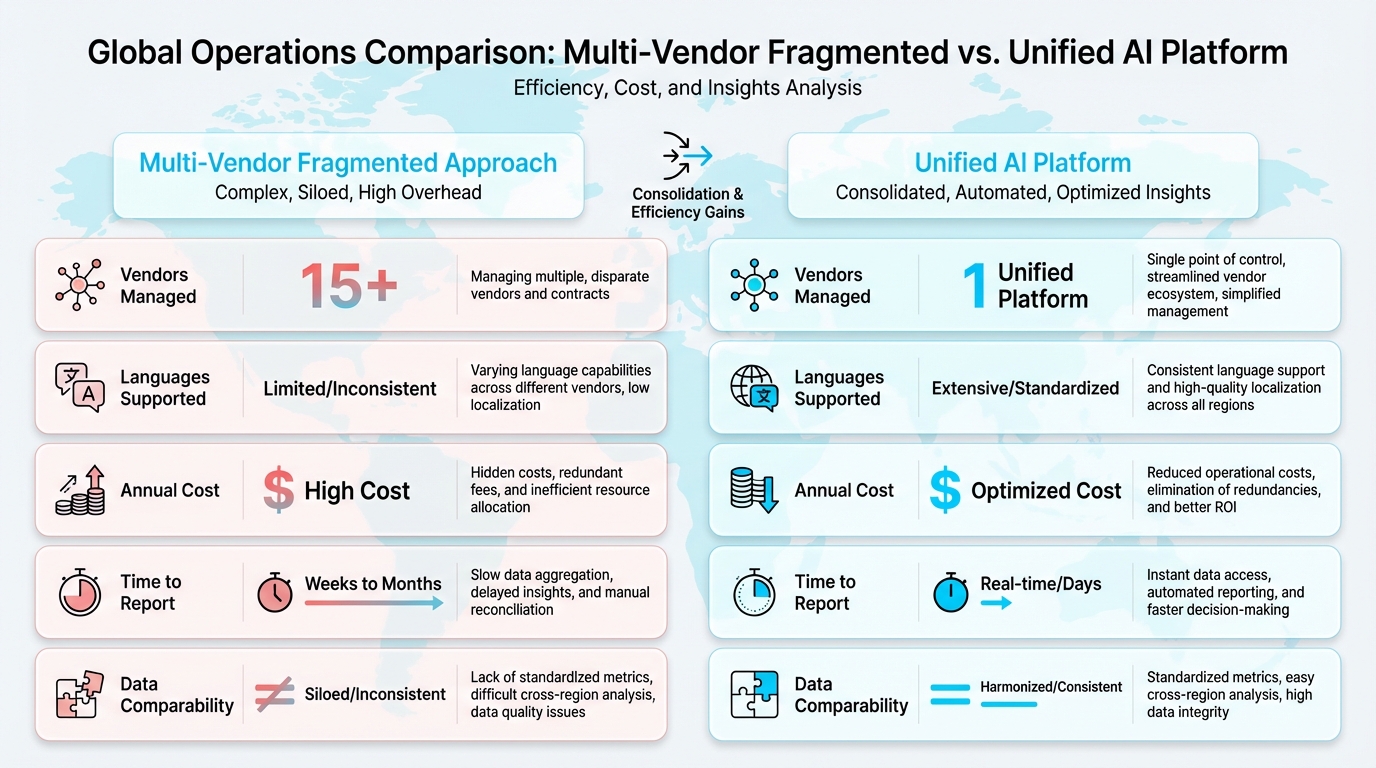
| Program Element | Multi-Vendor Approach (Before) | NewVoices Unified Platform (After) |
|---|---|---|
| Vendors Managed | 8 (one per region) | 1 |
| Languages Supported | 6 (with quality variation) | 20+ (consistent quality) |
| Annual Program Cost | $820,000 | $310,000 |
| Time to Global Report | 6–8 weeks | 48 hours |
| Data Comparability Across Regions | Low (different scales/methods) | Full (unified methodology) |
The competitive advantage here is not just cost savings. It is decision speed. When your feedback data arrives in real time across every market simultaneously, you make better decisions faster than companies still waiting for regional reports to trickle in.
This Is Not a Survey Tool — It Is the Infrastructure Your Feedback Program Has Been Missing
The category label “AI survey automation” undersells what is actually happening. A tool automates a task. An infrastructure replaces the system.
Traditional survey programs require a vendor for call execution, a separate tool for analysis, a third platform for data storage, a compliance consultant for regulatory review, and a project manager to hold it all together. NewVoices collapses that entire stack into a single platform — voice agent design, call execution, real-time transcription, sentiment analysis, CRM integration, compliance documentation, and reporting. One platform. One audit trail. One point of accountability.
The Bottom Line
Voice captures what checkboxes cannot. Tone, hesitation, frustration, enthusiasm — these are data points, and AI feedback collection treats them as such. A telecommunications provider found that a single linguistic signal — customers saying “I was told” — predicted 4.1x higher churn rates. That insight was invisible in their multiple-choice surveys.
Frequently Asked Questions About AI Survey Automation
+
How quickly can we deploy NewVoices for our survey program?
+
Most enterprise clients are running live survey campaigns within 2-3 weeks of signing. The No-Code Agent Studio allows your team to design survey flows without engineering support. Integration with major CRMs like Salesforce and HubSpot typically takes 3-5 business days.
What compliance certifications does NewVoices maintain?
+
NewVoices is SOC 2 Type II certified, GDPR compliant, and HIPAA compliant. Our platform includes built-in TCPA compliance features including automated AI disclosure, opt-out mechanisms, Do Not Call list scrubbing, and immutable consent record storage.
Can the AI agent handle complex branching logic and follow-up questions?
+
Yes. NewVoices uses natural language processing to understand respondent answers and dynamically select appropriate follow-up questions. Unlike rigid IVR scripts, our agents can probe deeper when respondents give vague answers and adapt the conversation flow based on tone and content.
What languages does NewVoices support?
+
NewVoices supports 20+ languages with consistent voice quality and natural conversation flow across all of them. Unlike pre-recorded IVR systems, our AI generates responses dynamically, ensuring natural-sounding conversations in every supported language.
How does pricing work for AI survey automation?
+
NewVoices pricing is based on completed surveys, not dial attempts. This means you only pay for successful data collection. Most enterprise clients see cost-per-completion between $2.50 and $5.00 — compared to $28-$42 for traditional phone surveys. Contact our team for a customized quote based on your survey volume and requirements.
Can NewVoices integrate with our existing survey and analytics tools?
+
Yes. NewVoices integrates with major CRM platforms (Salesforce, HubSpot), analytics tools, and data warehouses. Survey responses flow directly into your existing systems with full sentiment tagging, transcription, and structured data formatting — no manual data processing required.
The Survey Program You Are Running Today Is Already Obsolete
The enterprises winning the customer feedback race are not asking better questions. They are asking the right questions, at the right time, through a channel their customers actually answer — and getting structured, actionable data back before the next business decision needs to be made.
Hear what a NewVoices AI survey agent actually sounds like — the voice quality, the adaptive questioning, the natural conversation flow.
Request Your Live AI Call Demo Now
Experience it in under 60 seconds. No commitment required.